Feature
Ganduje’s political capital: The weight behind his new APC assignment

By Umar Idris Shuaibu, Kano
Politics is built on different forms of capital.
There is financial capital.
There is institutional capital.
There is electoral capital.
And then there is a more enduring form of influence, that is a political capital.
It is accumulated gradually through years of public service, relationships, leadership, negotiation, political judgement and the ability to understand people and institutions.
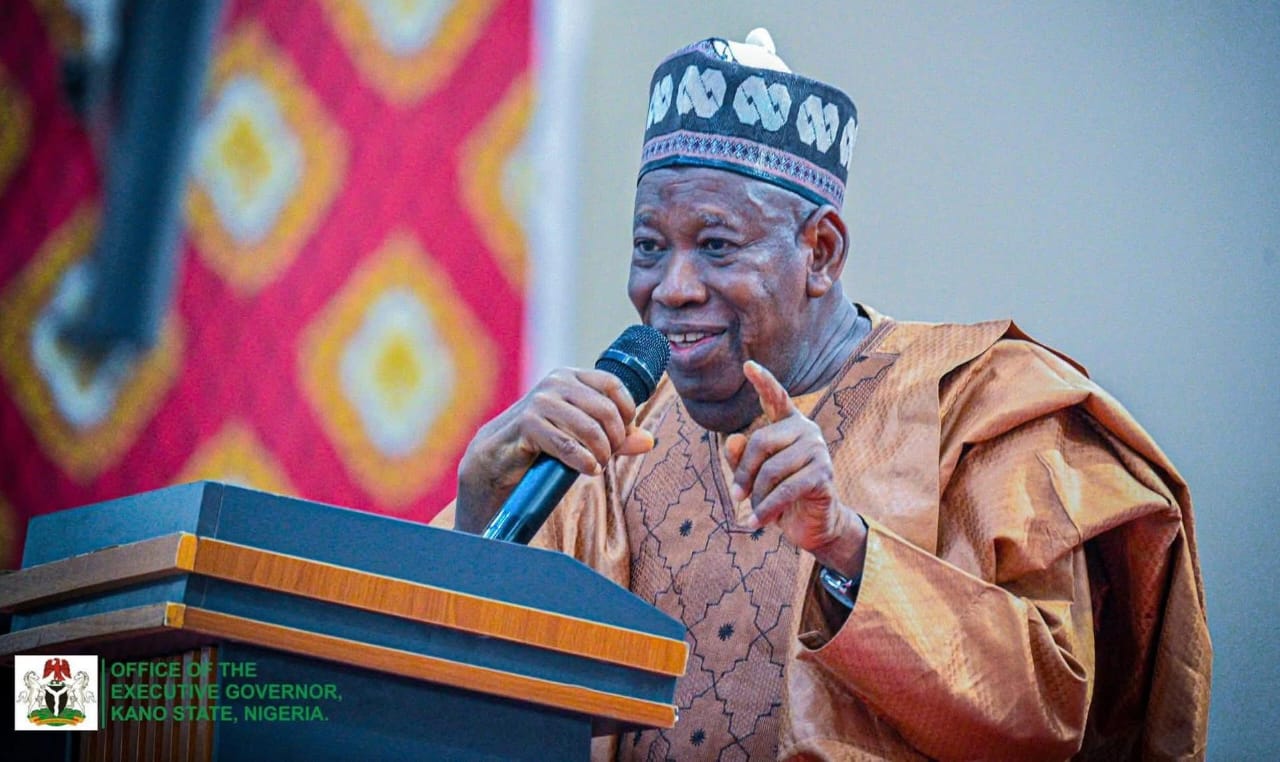
For Dr. Abdullahi Umar Ganduje, that capital is the product of a long political journey.
From public administration to executive governance, from the politics of Kano to the leadership of Nigeria’s ruling party, Ganduje has spent decades moving through different layers of the country’s political landscape.
Today, that experience has found a new expression.
His appointment as Director of Stakeholders’ Mobilisation in the APC Presidential Campaign Council places him at the centre of one of the most important dimensions of the party’s 2027 presidential campaign.
Related:
Ganduje emerges chairman of University of Ibadan alumni board of trustees
Ganduje’s new assignment: The burden of holding APC’s political centre together
2027: Ganduje visits Yari in Abuja, discusses strategies for APC victory
It is an assignment that speaks not only to his present relevance, but also to the value the APC attaches to the experience, relationships and political understanding he has accumulated over the years.
Decades in the making: Ganduje’s political capital
Ganduje’s political capital did not emerge from a single office.
It was built gradually.
His years in public administration gave him an understanding of government and institutions.
His tenure as Deputy Governor and later Governor of Kano State exposed him to the realities of executive leadership in one of Nigeria’s most politically significant states.
His subsequent emergence as National Chairman of the All Progressives Congress took that experience to another level.
At the national level, he was no longer dealing with the politics of one state.
He was operating within a political organisation whose interests stretched across Nigeria’s six geopolitical zones.
Governors, legislators, ministers, party leaders, former office holders and grassroots political actors all formed part of the environment he had to understand.
That experience matters.
It gave Ganduje an opportunity to see Nigerian politics not only from the perspective of a state, but also from the vantage point of a national political institution.
When experience outlives office
The real measure of a politician’s capital is not always the number of offices he has occupied.
Sometimes, it is what remains with him after leaving those offices.
For Ganduje, that includes experience, relationships, institutional knowledge and an understanding of how political interests interact.
These are assets that cannot simply be handed over with an appointment letter.
They are accumulated through years of engagement.
And they become particularly valuable when political organisations need people who can connect different interests around a common objective.
That is precisely where his latest assignment becomes significant.
Why Ganduje’s experience matters
Ganduje brings a combination that is not easily replicated.
He understands government from the perspective of an administrator and former governor.
He understands party politics from the perspective of a former national chairman.
He understands the importance of grassroots structures from his years in Kano politics.
And he understands national political dynamics from his time at the helm of the APC.
This combination gives him a broad political lens.
He can look at a political issue from the standpoint of governance, party organisation, regional interests and electoral mobilisation.
That versatility is one of the strongest components of his political capital.
The weight of stakeholder mobilization
The significance of his new assignment becomes clearer when the responsibility itself is considered.
Stakeholder mobilisation is ultimately about people.
It is about building bridges between political leaders and different interest groups.
It is about identifying areas of common interest.
It is about sustaining relationships.
And, perhaps most importantly, it is about ensuring that different political actors can work towards a shared objective despite having their own ambitions and perspectives.
Such a responsibility requires more than organisational ability.
It requires political temperament.
It requires patience.
It requires familiarity with different political constituencies.
And it requires someone who understands that influence is often built through conversation rather than command.
Ganduje’s career has given him considerable exposure to that kind of politics.
From Kano roots to national reach
There is also a wider significance to Ganduje’s political journey.
Kano was where much of his political identity was forged.
Read Also:
Ganduje salutes Sultan, Babangida on 70th, 85th birthdays
Emulating Grassroots Empowerment: Lessons from Professor Hafsat Ganduje’s Model
Associate Professor Amina Ganduje’s Quiet March into Nigeria’s Intellectual Elite
But his career did not remain confined to the state.
His progression from Kano politics to national party leadership demonstrates an ability to operate within increasingly wider political circles.
That trajectory is important because the 2027 presidential campaign will demand a national outlook.
Nigeria’s political interests are diverse.
What works in one region may not necessarily work in another.
The concerns of one political constituency may differ considerably from those of another.
A successful national mobilisation strategy therefore requires people who can appreciate these differences while still identifying common ground.
Ganduje’s experience places him in a strong position to contribute to that process.
The political weight Ganduje carries from Kano
Yet Kano remains an important part of the story.
The state’s political weight ensures that developments there will continue to attract national attention as the 2027 elections approach.
Ganduje’s deep familiarity with Kano’s political environment gives him a perspective that will remain relevant.
But perhaps more importantly, his Kano experience is now being complemented by a national assignment.
That creates an interesting intersection.
The politician who understands Kano’s grassroots and political dynamics is now being asked to help manage stakeholder relationships on a much broader national platform.
It is a responsibility that demands both local understanding and national vision.
Ganduje’s capital for building bridges
At its best, political capital is not about personal influence alone.
It is about the ability to build bridges.
A politician with political capital can create conversations between people who may not ordinarily sit together.
He can help translate concerns from one political constituency to another.
He can recognise the interests behind political disagreements.
And he can help transform separate networks into a broader political coalition.
That is the real value of Ganduje’s latest assignment.
The APC does not simply need campaign voices.
It needs people capable of connecting its various political constituencies.
Ganduje’s responsibility places him squarely in that space.
When the title changes, the influence remains
There is sometimes a tendency to measure political relevance only by formal office.
By that measure, leaving the national chairmanship could appear to represent a step away from the centre of party politics.
But Ganduje’s latest appointment offers a different interpretation.
His role has changed.
His political value has not necessarily diminished.
Indeed, the new assignment provides another avenue through which his experience can be deployed.
The former national chairman is now being asked to take the experience gained from managing party structures and apply it to the more fluid world of stakeholder engagement and electoral mobilisation.
That is not a retreat from relevance.
It is a transition into another form of political responsibility.
Where Ganduje’s political capital meets the assignment
Ganduje’s political capital is therefore bigger than any single title.
It rests on decades of experience.
It rests on relationships built across different political levels.
It rests on his understanding of Kano and the wider North.
It rests on his experience within the national leadership of the APC.
And it rests on his ability to operate within the complicated space where politics, governance and party organisation intersect.
That is why his appointment deserves to be viewed beyond the formal wording of the campaign council.
The APC has not merely given Ganduje a position; it has given his experience a new assignment.
As the 2027 election approaches, the ability to bring people together will be as important as the ability to campaign.
And in that environment, Ganduje’s greatest asset may well be the political capital he has spent decades building.
From Kano to Abuja, from governance to party leadership, his journey has created a reservoir of experience that the 2027 political season now gives him an opportunity to deploy on an even broader stage.

NUJ seeks justice for Kaduna journalist facing retrial over Facebook post

APC taps Gaya polytechnic committee chairman for academic mobilisation

NBTE proposes polytechnic act amendment to allow BTech degrees

FRSC prohibits political convoy escorts ahead of 2027 elections

Kano Governor Nominates Retired Air Commodore, Professor, Four Others as Commissioners
ABCOAD Unveils Journal, Bids Farewell to Provost

Nigerian Army Begins DSSC 29/2026 Recruitment, Outlines Eligibility Criteria

2027: NDC Releases Full List of Consensus Candidates in Kano

Gaya Polytechnic Opens Recruitment, Advertises 46 Academic, Non-Academic Positions