Bauchi
Toro: The giant LGA with a story bigger than its size

By Umar Idris Shuaibu
Some places are defined by the size of their population. Others are remembered for their political influence, economic importance or historical heritage. Toro Local Government Area of Bauchi State, however, belongs to a different category.
It is a place whose story seems almost as vast as its landscape.
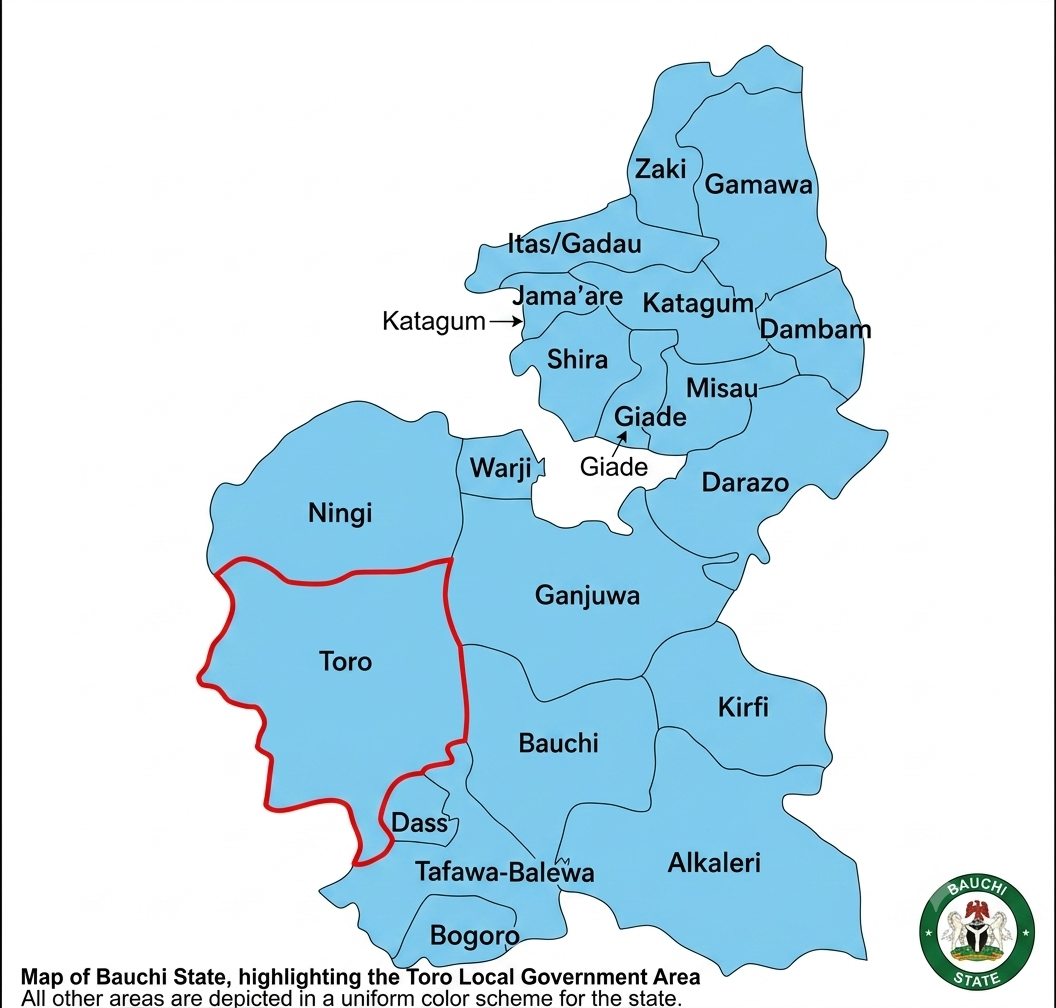
Spreading across more than 6,700 square kilometres, Toro is the largest local government area in Bauchi State and one of the largest in Nigeria. But beyond the figures and the maps lies a remarkable story of people, tradition, agriculture, pastoral life, forests, education, culture and changing systems of leadership.
Indeed, to understand Toro is to journey through a landscape where the old and the new exist side by side.
Here, ancient rock paintings stand as reminders of earlier generations; vast savannahs and forests continue to shape rural livelihoods; farmers cultivate fertile land; pastoralists move with their cattle; schools have educated generations; and traditional institutions continue to evolve with the changing times.
Read Also:
Birnin Kudu: An Ancient Settlement With a Modern National Footprint
Lere: A Historic Fulani Settlement and Cultural Crossroads in Kaduna
Before the “Settler” Label: How Fulani Communities Took Root in Southern Kaduna
And now, with the emergence of the Toro Emirate, another significant chapter has been added to the long history of this remarkable land.
A giant on the map
Created in 1976, Toro occupies an extraordinary geographical space in Bauchi State.
Its headquarters, Toro town, serves as the administrative centre of an expansive territory stretching across communities with different histories, occupations and cultural identities.
Its strategic location further enhances its importance.
Toro connects communities towards Bauchi, Plateau, Kaduna and Kano, placing the local government within a wider network of movement, trade, agriculture and pastoral activities across northern Nigeria.
For generations, people have travelled through this landscape in search of markets, farmland, pasture, water, education and economic opportunities.
Consequently, Toro has never been an isolated territory.
Its geography has continuously brought people and communities into contact with one another, producing a society characterised by cultural interaction and diversity.
Where the land shapes the people
Perhaps the most striking feature of Toro is the sheer diversity of its landscape.
In one direction are extensive farmlands. In another are grazing areas and rural settlements. Elsewhere, woodland, rocky formations and stretches of savannah dominate the scenery.
This physical diversity has, over time, shaped the occupations of the people.
Agriculture remains one of the main pillars of the local economy. Maize, millet, rice, groundnuts, potatoes, onions and other crops are cultivated across different communities.
At the same time, livestock production remains deeply rooted in the social and economic life of the area.
For many pastoral Fulani families, Toro’s wide-open spaces and seasonal grazing routes have historically provided an important environment for cattle rearing.
Thus, farming and pastoralism are not simply economic activities in Toro; they are also part of the history and identity of communities that have inhabited the area for generations.
A meeting place of cultures
Beyond the physical landscape is another defining feature of Toro: its people.
The local government is home to diverse communities, including Hausa and Fulani populations and other ethnic groups whose histories connect Toro to the broader cultural landscape of northern and central Nigeria.
The Fulani presence is particularly visible in both settled and pastoral communities.
Settled Fulani families live in towns and established communities, where they participate in farming, commerce, education, public service and other occupations.
Meanwhile, pastoral Fulani communities continue to maintain traditions associated with livestock production and seasonal movement.
In places such as Tilden Fulani, the historical presence of Fulani communities is reflected even in the names of settlements.
Over the years, interaction among these communities has produced a social environment in which Hausa and Fulfulde serve important roles in communication, commerce and everyday life.
It is this interaction, rather than any single ethnic identity, that forms an important part of Toro’s character.
Beneath the canopy: Toro’s great forest
Yet, perhaps one of the most fascinating dimensions of Toro’s story lies beyond its towns and farmlands.
It lies in the forest.
Toro is part of the landscape of the Lame Burra Game Reserve, one of the significant protected ecological areas in Bauchi State.
The reserve covers approximately 205,900 hectares and extends across Toro, Ganjuwa and Ningi local government areas.
Within this vast landscape are stretches of Northern Guinea Savannah, woodland and riparian vegetation.
For decades, the forest has been connected to the lives of surrounding communities.
It has provided ecological resources and formed part of the wider landscape used by farmers, pastoralists and rural communities.
However, like many forests across northern Nigeria, the reserve faces increasing pressure from human activity, agricultural expansion, settlement and other forms of resource exploitation.
This creates a delicate balance.
On the one hand is the need to protect biodiversity and preserve the forest for future generations. On the other is the reality that thousands of people depend on the surrounding land and natural resources for their livelihoods.
The future of Toro’s forest will therefore depend on finding a sustainable balance between conservation and community livelihood.
Where history speaks through stone
Toro’s history is not preserved only in written records.
Some of it is written on rocks.
The Geji Rock Paintings are among the historical and cultural features associated with the area, providing a glimpse into earlier human activity and artistic expression.
Such sites give Toro something that many modern communities struggle to preserve: a physical connection to a distant past.
They also offer an opportunity.
With proper documentation, conservation and promotion, Toro’s historical sites could contribute to cultural tourism and create greater awareness of the area’s heritage.
In other words, the same land that supports today’s communities may also contain some of the stories of the people who lived there centuries ago.
Education and the making of generations
Toro’s story would be incomplete without education.
For generations, the area has been associated with institutions that have contributed to the educational development of northern Nigeria.
Government College Toro, occupies a particularly important place in this history.
The institution has educated generations of students and produced alumni who have gone on to occupy significant positions in academia, public service and national life.
The College of Education Toro, has similarly contributed to teacher training and educational development.
Through these institutions, Toro’s influence has extended far beyond its geographical boundaries.
Students have arrived from different parts of northern Nigeria, acquired knowledge and returned to their communities as teachers, administrators, professionals and public servants.
In this way, Toro’s educational story has become part of the larger story of human capital development in northern Nigeria.
Among prominent figures associated with Toro’s educational heritage is Professor Mahmood Yakubu, who was educated at Government Teachers College Toro, before building a distinguished academic and public career.
A new chapter in traditional leadership
For all its geographical and historical significance, Toro entered another important chapter in 2025.
The Bauchi State Government embarked on a major restructuring of traditional institutions, creating additional emirates, chiefdoms and districts across the state.
Toro was among the areas affected by the reforms.
The creation of the Toro Emirate marked a significant moment in the area’s traditional history.
Subsequently, Adamu Umar Toro was appointed as the first Emir of Toro.
When the state government formally presented his letter of appointment, the occasion attracted friends, relations, community members and well-wishers who gathered to witness what many regarded as a historic moment.
Presenting the appointment letter on behalf of Governor Bala Mohammed, the Secretary to the Bauchi State Government, Aminu Hammayo, urged the new Emir to discharge his responsibilities with fairness, justice and truth and to remain law-abiding in the conduct of his duties.
The message was significant.
For traditional institutions to remain relevant in a changing society, authority must be accompanied by responsibility.
The new Emir subsequently expressed appreciation to the governor and pledged loyalty and support to government policies and programmes.
Thus, the emergence of the Toro Emirate was not merely about the creation of another traditional title.
For many residents, it represented recognition of the identity, geographical importance and historical significance of the area.
The question of status
Interestingly, the creation of the emirate soon generated another conversation.
Representatives of the people of Toro appealed to Governor Bala Mohammed for the elevation of the new Emir from Third Class to Second Class.
The appeal, made on behalf of the people by Comrade Abdulfatah Mu’azu, President of Toro Uplift, pointed to the importance attached by residents to the new traditional institution.
Related:
Bauchi Governor Signs Law Creating 13 New Emirates, 111 District Heads
Intervention Brings Relief to Struggling Bauchi Nomadic School
Ministry of Livestock Commissions 2,000-Litre Milk Collection Centre in Bauchi
Behind the request was a broader argument: that Toro’s enormous landmass, population, historical relevance, economic potential and geographical importance should be reflected in the status accorded to its traditional institution.
Whether or not such an elevation is eventually granted, the appeal itself reveals how deeply traditional authority remains connected to questions of identity and recognition in the community.
More than farms and cattle
It would, however, be too narrow to define Toro only through agriculture and pastoralism.
The local government possesses other economic and natural resources, including mineral deposits historically associated with tin and columbite.
Its strategic location also gives it commercial potential.
With improved infrastructure, agricultural processing, livestock development, education, tourism and responsible natural-resource management, Toro could strengthen its position as an important economic corridor within Bauchi State.
The challenge, therefore, is not a shortage of possibilities.
It is how to transform those possibilities into sustainable development.
The challenge of governing a giant
Toro’s greatest advantage is also one of its greatest challenges.
Managing an area that stretches across thousands of square kilometres requires more than administrative structures.
It requires roads connecting remote communities, accessible healthcare, quality schools, reliable water supply, telecommunications, security and economic opportunities.
Distance matters.
For residents living far from Toro town, access to government services can be very different from that experienced by people closer to the administrative headquarters.
This is why decentralisation becomes particularly important.
The establishment of the Toro, Jama’a and Lame emirate structures provides an additional traditional framework through which community concerns can potentially reach government more effectively.
But traditional institutions alone cannot solve the challenges of such a vast territory.
Their success will depend on collaboration with elected authorities, local government institutions, security agencies, civil society, farmers, pastoralists, business owners and, most importantly, the people themselves.
A land between the past and the future
Perhaps the most fascinating thing about Toro is that its story is still being written.
Its past can be seen in ancient rock paintings and traditional institutions.
Its present can be seen in farms, markets, schools, livestock routes, forests and growing settlements.
And its future lies in the ability of its people and leaders to transform the area’s enormous resources into opportunities.
The Toro of tomorrow could be a major agricultural centre, a hub for livestock development, an educational destination and a cultural tourism corridor.
Its forests could become better protected while supporting sustainable livelihoods.
Its historical sites could attract researchers and tourists.
Its young population could find opportunities within the local economy rather than being forced to look elsewhere.
And its traditional institutions could become stronger instruments for community dialogue, peacebuilding and cultural preservation.
The giant with a bigger story
Ultimately, Toro cannot be reduced to its size.
Yes, it is enormous by geographical standards.
Yes, its land stretches across thousands of square kilometres.
Yes, its forests, farms, grazing landscapes and settlements make it one of the most expansive local government areas in the country.
But the true magnitude of Toro lies elsewhere.
It lies in its people.
It lies in the cultures that have met and evolved there.
It lies in the farmers who cultivate its soil, the pastoralists who move across its grasslands, the teachers who have educated generations, the traditional leaders who have preserved community identity and the young people who represent its future.
It lies in the forests that still shelter its biodiversity and the historical sites that quietly preserve memories of earlier civilisations.
And now, with the creation of the Toro Emirate, the area has entered a new phase of its traditional history.
From the ancient landscapes of Geji to the vast Lame Burra forest; from the classrooms of Government College Toro to the farms and pastoral routes scattered across its enormous territory; from its diverse communities to the emergence of a new emirate, Toro presents a story that is far greater than its geographical dimensions.
Toro is a giant on the map. But its real story is bigger than its size.

Tinubu’s Kaduna Campaign Eve: Dan’agundi leads thousands of supporters to governor Uba Sani in Massive show of solidarity

Gwarzo’s exclusion: NDC races against time as INEC deadline nears

2027: Mariya Bunkure takes key women affairs role in Kano APC campaign

2027: Kano Governor Names Former Education Commissioner Kiru Campaign Spokesperson II

Sa’adatu Rimi College of Education Hosts NCCE Training as Experts Push Practical Agricultural Education
ABCOAD Unveils Journal, Bids Farewell to Provost

Nigerian Army Begins DSSC 29/2026 Recruitment, Outlines Eligibility Criteria

2027: NDC Releases Full List of Consensus Candidates in Kano

Gaya Polytechnic Opens Recruitment, Advertises 46 Academic, Non-Academic Positions