Feature
Ganduje’s Moment: From APC Chairman to Chief Stakeholder Mobiliser – By UIS

By Umar Idris Shuaibu, Kano
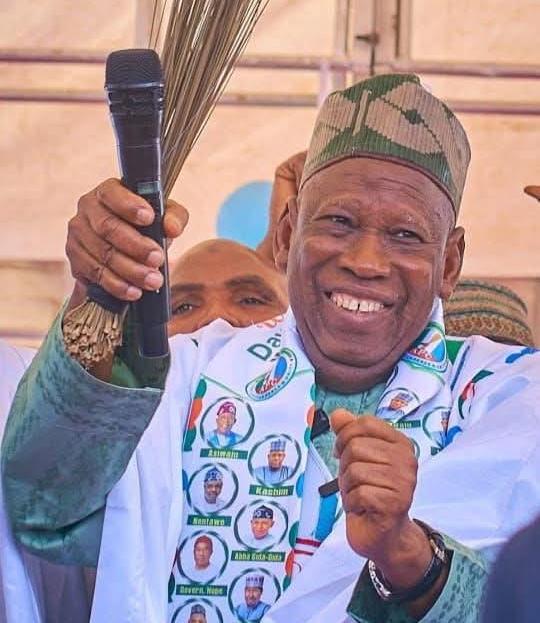
For Dr. Abdullahi Umar Ganduje, the road to the 2027 election has taken an intriguing turn.
Not long ago, he sat at the centre of the All Progressives Congress as its National Chairman, occupying one of the most powerful positions in the party’s formal hierarchy.
Today, the office has changed.
The political assignment, however, remains.
Ganduje has been appointed Director of Stakeholders’ Mobilisation in the APC Presidential Campaign Council for the 2027 election, a role that takes him from the party’s formal command structure into the more fluid, demanding world of political relationships, persuasion and coalition-building.
At first glance, it may appear to be a movement from one title to another.
Look closer, and a different picture emerges.
Read Also:
Ganduje: Tinubu’s Reforms Are Restoring Government’s Capacity to Deliver
APC leaders rally in Kano as opposition members join ruling party
Ganduje Named Grand Patron as Presidential Youth Unity Cup Targets 774 LGAs
This is not necessarily a step away from political relevance. It is a transition into another arena of influence.
The former national chairman is now being asked to deploy something that cannot be captured in an official title: experience.
And in an election as politically consequential as 2027, experience can be a formidable asset.
From the party structure to the political attlefield
The office of National Chairman comes with institutional authority. It is a position embedded in the formal machinery of the party.
Campaign mobilisation operates differently.
Here, influence is built through conversations. Coalitions are strengthened through relationships. Differences are managed through negotiation. Political interests are brought together not by command alone, but by persuasion.
That makes Ganduje’s new assignment particularly interesting.
He has moved from helping steer the party’s machinery to helping bring together the people and interests that the machinery must ultimately mobilise at the polls.
It is a subtle difference, but a significant one.
Political parties have structures.
Elections have people.
Stakeholder mobilisation is where the two converge.
The experience behind the assignment
Ganduje does not arrive at this responsibility as a newcomer to national politics.
His political journey has taken him through public administration, executive governance, Kano politics and national party leadership. His tenure as Kano State governor gave him firsthand experience of the complexities of governing a politically influential state, while his time as APC National Chairman exposed him to the competing interests, ambitions and expectations that exist across the country’s political landscape.
Those experiences matter.
A national political organisation is rarely driven by a single interest. It is a collection of interests, personalities, ambitions and constituencies that must constantly be managed.
Ganduje has operated within that environment.
He has seen how political alliances are built.
He has seen how they are tested.
And he has seen how quickly disagreements can become difficult when they are not properly managed.
That institutional memory could become particularly valuable as the APC prepares for another presidential contest.
More than rallies and meetings
Stakeholder mobilisation is sometimes reduced to rallies, meetings and political gatherings.
The reality is far more demanding.
Behind every successful political mobilisation effort is a network of conversations between party leaders, governors, legislators, traditional and community influencers, interest groups, political blocs and ordinary supporters.
It requires knowing who matters, understanding what matters to them and creating enough trust for different interests to work toward a common objective.
It also requires patience.
Not every disagreement can be solved at a rally.
Not every political interest can be brought together with a speech.
Sometimes, the most important political work happens quietly, across a table, in a telephone conversation or behind the scenes.
That is where the real weight of Ganduje’s assignment may lie.
Leadership without the command
Perhaps the most interesting dimension of the role is that it requires a different kind of leadership.
A stakeholder does not report to the Director of Stakeholders’ Mobilisation.
A governor does not become subordinate to him because of a campaign appointment.
A party leader retains his own interests, calculations and political constituency.
The responsibility, therefore, is not to command them.
It is to engage them.
That requires diplomacy. It requires judgement. It requires an understanding of political sensitivities. Above all, it requires the ability to build bridges between interests that may not always naturally align.
This is leadership without the comfort of direct authority.
And during an election, it can be one of the most difficult forms of leadership.
From Kano roots to national reach
Then there is Kano.
For Ganduje, Kano is more than a geographical reference in his political biography. It is where much of his political experience was forged.
His understanding of Kano’s political environment gives him a perspective shaped by years of engagement with one of Nigeria’s most politically significant states.
That experience could matter beyond the state itself.
Kano’s electoral importance means that developments there will inevitably attract national attention as the 2027 contest takes shape.
Yet Ganduje’s new assignment demands something broader.
He cannot approach the national campaign exclusively through the lens of Kano.
His task is national.
His experience in Kano, however, forms part of the political capital he brings to that national responsibility.
That combination—local understanding and national exposure—could prove useful as the APC seeks to build a broad coalition ahead of 2027.
When the office changes, the influence can remain
There is often a tendency to measure political relevance by position.
By that measure, leaving the office of National Chairman might appear to mark the end of an important chapter.
But political influence is not always confined to an office.
Sometimes, the office changes while the experience remains.
The title may change.
The networks remain.
The institutional knowledge remains.
The relationships built over decades remain.
And so does the understanding of how political interests interact.
That is why Ganduje’s new assignment deserves to be viewed on its own terms rather than simply compared with the office he previously occupied.
He is no longer sitting in the national party secretariat.
He is now being asked to work across the political landscape.
That is a different platform.
It may also be a demanding one.
The assignment ahead
The real test, ultimately, will not be the title attached to Ganduje’s name.
It will be what he does with the responsibility.
The 2027 election will test the APC’s structures, alliances, messaging and ability to translate political support into electoral strength.
For Ganduje, the assignment is to help connect those moving parts.
To bring stakeholders closer.
To manage competing interests.
To strengthen political relationships.
To build consensus where possible.
And, ultimately, to turn political capital into mobilisation.
That is why his appointment carries significance beyond the campaign council’s organisational chart.
The APC has not merely given a former national chairman another position.
It has given his experience a new assignment.
And Ganduje now finds himself at an interesting point in his political journey: no longer the man occupying the party’s highest elected office, but still a politician whose experience, relationships and understanding of the political terrain can be deployed on a national stage.
His moment, therefore, may not be behind him.
It may simply have entered a different phase.
From the national party secretariat to the wider political arena, Ganduje now faces a new test—one that will require less command, more persuasion; less hierarchy, more bridge-building; and less emphasis on the office he once held, and more on what his experience can deliver.
As 2027 draws closer, that could make his new assignment one of the most consequential chapters yet in a political journey that has travelled from Kano to the national stage.

Tinubu’s Kaduna Campaign Eve: Dan’agundi leads thousands of supporters to governor Uba Sani in Massive show of solidarity

Gwarzo’s exclusion: NDC races against time as INEC deadline nears

2027: Mariya Bunkure takes key women affairs role in Kano APC campaign

2027: Kano Governor Names Former Education Commissioner Kiru Campaign Spokesperson II

Sa’adatu Rimi College of Education Hosts NCCE Training as Experts Push Practical Agricultural Education

ABCOAD Unveils Journal, Bids Farewell to Provost

Nigerian Army Begins DSSC 29/2026 Recruitment, Outlines Eligibility Criteria
2027: NDC Releases Full List of Consensus Candidates in Kano

Gaya Polytechnic Opens Recruitment, Advertises 46 Academic, Non-Academic Positions