Feature
Ganduje’s Kano Gambit: The Political Realignment Shaping Tinubu’s 2027 Chances

By Umar Idris Shuaibu, Kano
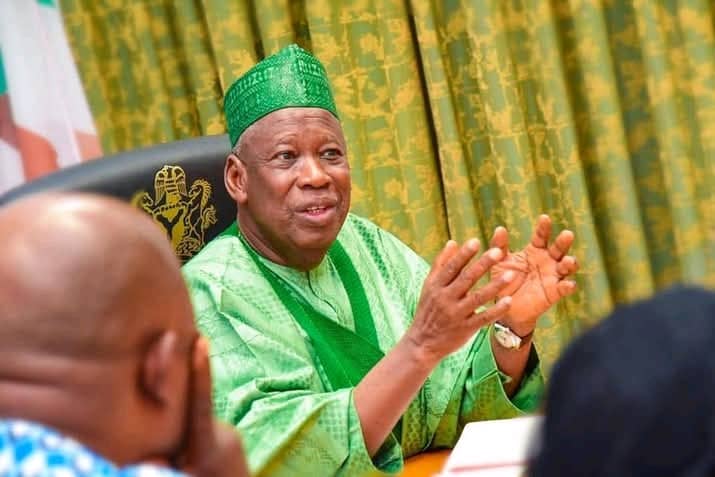
The political landscape in Kano appears to be undergoing a significant realignment, with the growing influence of the immediate past National Chairman of the All Progressives Congress (APC), Dr. Abdullahi Umar Ganduje, emerging as one of the notable developments ahead of the 2027 general elections.
Ganduje’s appointment as Director of Stakeholders’ Mobilisation in the APC Presidential Campaign Council has given his political engagement a fresh national dimension, while recent movements involving prominent Kano politicians and support groups have further strengthened perceptions of his continuing influence in the state.
One of the latest developments was the defection of former Kano Commissioner for Agriculture, Dr. Baraka Sani, and her political allies and support groups to the APC.
Sani also unveiled the structure of the Coalition of Progressive Groups (CPG), an umbrella platform designed to bring together various socio-economic and political interests.
The development has been interpreted by political observers as another indication of the shifting alliances taking shape in Kano ahead of 2027.
Read Also:
Ganduje: Tinubu’s Reforms Are Restoring Government’s Capacity to Deliver
No Vacancy at Villa Until 2031, Mariya Bunkure Tells APC Supporters
90% Delivered: Garo Lists Yusuf’s Achievements in Kano
For Ganduje, whose political career has been built around party organisation, grassroots engagement and stakeholder relations, the emerging realignment could provide an important platform for strengthening the APC’s political base in the state.
Ganduje’s new political assignment
Since taking up his new responsibility in the APC Presidential Campaign Council, Ganduje has continued to receive political groups and stakeholders seeking engagement with the national campaign structure.
Among them is the Presidential Youth Unity Cup (PYUC), which paid a visit to the former governor and subsequently conferred on him the position of Grand Patron.
The development was followed by another engagement involving the National Grand Leader of the Grassroots Mobilization Platform for Good Governance in Nigeria for Asiwaju and Shettima.
Ganduje, in turn, paid a special visit to the Director-General of the APC Presidential Campaign Council, Senator Abdul’aziz Yari, at his residence.
While such engagements may appear routine in the build-up to an election, they also underscore the importance of relationships in the architecture of stakeholder mobilisation.
The responsibility entrusted to Ganduje goes beyond rallies and public appearances.
It places him in a position where political relationships, support groups, grassroots networks and influential stakeholders can be brought closer to the presidential campaign structure.
The Kwankwasiyya challenge
The unfolding political realignment has also coincided with growing challenges for the Kwankwasiyya movement in Kano.
The movement is now facing a series of defections involving prominent political figures, including a sitting governor, serving senators and members of the House of Representatives.
The departure of some long-time political allies has inevitably raised questions about whether the movement can maintain the level of dominance it demonstrated during the last general election.
Political watchers in Kano say the emerging situation could force Kwankwasiyya to reassess its political strategy as alliances continue to shift.
For the movement, the challenge is no longer simply about preserving the political structure that delivered strong electoral numbers in 2023.
It is about adapting to a rapidly changing political environment.
And in that changing environment, Ganduje has emerged as one of the APC figures whose activities are attracting considerable attention.
Ganduje’s political reach
The former APC National Chairman has repeatedly projected confidence in the ability of President Bola Ahmed Tinubu to secure victory in the 2027 presidential election.
At one of the political gatherings, Ganduje openly suggested that the era of the Kwankwasiyya movement in Kano was approaching its end.
On another occasion, while discussing the President’s prospects and other political issues ahead of the election, he maintained that Tinubu would overwhelm his rivals and secure a sweeping victory in Kano.
Such statements reflect Ganduje’s growing confidence in the APC’s prospects in the state.
But beyond the rhetoric lies a broader political calculation.
Kano remains one of the most electorally significant states in Nigeria. Its large voting population and historically intense political competition make it strategically important to any presidential campaign seeking a strong national mandate.
For the APC, therefore, strengthening its presence in Kano is not simply a state-level objective.
It is part of the wider national electoral equation.
*From political experience to electoral strategy*
Ganduje’s political advantage lies partly in the breadth of his experience.
He has served as Deputy Governor, Governor and National Chairman of the governing party, giving him exposure to grassroots politics, executive administration, party organisation and national political negotiations.
His current assignment provides an opportunity to deploy that experience in a different direction.
Rather than occupying the party’s formal leadership structure, he is now positioned within the campaign machinery to engage stakeholders and help build the coalition required for a presidential election.
That distinction is important.
Political structures can create organisation.
But relationships create mobilisation.
And mobilisation ultimately determines whether political structures translate into votes.
Kano and the 2027 equation
The emerging political picture suggests that Kano’s 2027 contest will be shaped not only by party labels but also by defections, alliances, grassroots networks and the ability of competing political camps to consolidate their support bases.
The APC will be looking to strengthen the gains it has made, while opposition political forces will seek to preserve their traditional structures and rebuild where necessary.
Against that backdrop, Ganduje’s role assumes particular significance.
His ability to communicate across political circles, understand competing interests and engage different stakeholders could become an important component of the APC’s strategy.
Whether that translates into electoral victory, however, will ultimately depend on a much broader combination of factors.
For now, the political signals are clear, as alliances are shifting, old assumptions are being tested and the 2027 contest is already beginning to reshape Kano’s political landscape.
And as those pieces move, Dr. Abdullahi Umar Ganduje is positioning himself once again at the centre of the conversation.
The former APC National Chairman may no longer occupy the party’s highest office, but his political engagement in Kano and his new national campaign responsibility suggest that his influence remains an important factor in the unfolding 2027 equation.
For President Tinubu and the APC, the strategic question will be how effectively that influence can be converted into broader stakeholder support and, ultimately, electoral strength.
Ganduje’s Kano Gambit: The Political Realignment Shaping Tinubu’s 2027 Chances

90% Delivered: Garo Lists Yusuf’s Achievements in Kano

Gaya Polytechnic Opens Recruitment, Advertises 46 Academic, Non-Academic Positions

Kano Assembly replaces 62-year-old education law
No Vacancy at Villa Until 2031, Mariya Bunkure Tells APC Supporters
ABCOAD Unveils Journal, Bids Farewell to Provost

Nigerian Army Begins DSSC 29/2026 Recruitment, Outlines Eligibility Criteria

Gaya Polytechnic to Begin with Four Courses as Committee Eyes Year-End Take-Off
2027: NDC Releases Full List of Consensus Candidates in Kano