The Historica Nigeria

2026

Kano, News

Ganduje Clarifies Position on Sanusi, Says Apex Court Will Determine Emirship

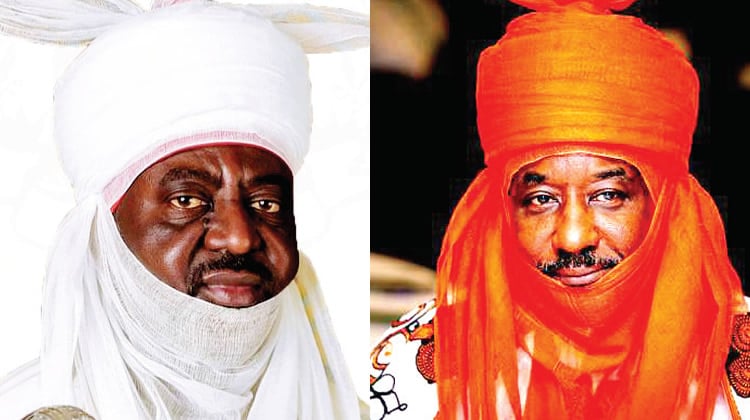
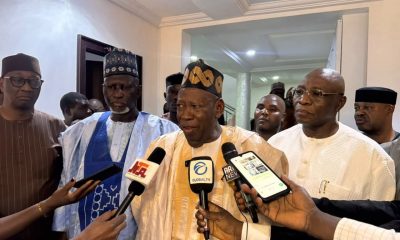
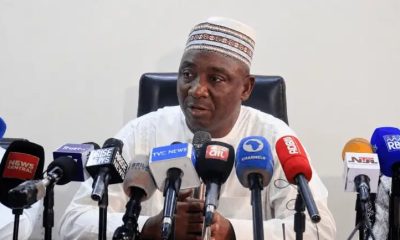
By Umar Idris Shuaibu, Abuja Former Kano State Governor and immediate past National Chairman of the All Progressives Congress (APC), Abdullahi Umar Ganduje, has stated that the ongoing dispute surrounding the Kano Emirship will ultimately be determined by the Supreme Court. Ganduje stated this in an interview with ‘The Historica Nigeria’ in Abuja on Thursday, following reactions that trailed his recent public acknowledgment of Muhammadu Sanusi II during the swearing-in ceremony of the new Deputy Governor of Kano State held at the Government House on Tuesday. At the event, the former governor addressed Sanusi as the Emir of Kano and Chairman of the Kano State Council of Chiefs, a development that attracted applause from dignitaries and political stakeholders in attendance. However, Ganduje clarified that his remarks at the occasion should not be interpreted as political or legal endorsement of any claimant to the Kano Emirship throne. Read Also: A Timeline of Kano Deputy Governors as Murtala Garo Takes Office According to him, the gesture was merely an expression of respect and courtesy in a public gathering, stressing that the matter remains before the apex court for final determination. “It is important to clarify that what happened was simply an expression of respect in a public gathering. It should not be misconstrued as an endorsement,” Ganduje said. The former governor further noted that the existing legal position currently recognises Aminu Ado Bayero as the 15th Emir of Kano, while Muhammadu Sanusi II is recognised as the 14th Emir, pending the final verdict of the Supreme Court. “The interpretation being given to the remark is clearly exaggerated. All parties should exercise restraint and await the Supreme Court judgment expected next year,” he added. The Kano Emirship tussle dates back to March 2020 when Ganduje, as governor, dethroned Sanusi over allegations bordering on insubordination and disrespect to constituted authority before appointing Aminu Ado Bayero as Emir of Kano. In May 2024, Kano State Governor Abba Kabir Yusuf reinstated Sanusi as Emir following the repeal of the Kano Emirates law, a move that reignited legal and political controversies surrounding the traditional institution. The development subsequently led to a fresh legal battle, with Aminu Ado Bayero challenging his removal in court. The Supreme Court recently adjourned hearing on the matter to April 2027. Ganduje reiterated that he has no constitutional or legal authority to determine the outcome of the emirship dispute, insisting that only the judiciary can give a final and binding decision on the matter.

Feature, Kano

Amnesty International Report and My Questions to Them – Sufyan Lawal Kabo

The recent condemnation issued by Amnesty International against the Kano State Government over the alleged killing of five persons during activities surrounding the swearing in of the new Deputy Governor has continued to raise serious concerns among many observers in Kano. While every responsible citizen condemns violence and the loss of innocent lives, many are asking whether Amnesty International acted professionally and fairly before rushing to issue a strong public accusation against the government of Kano State. Amnesty International, can a government that has invested heavily in ending political thuggery and street violence genuinely be accused of sponsoring the same violence it is fighting to eliminate? Would a government that established the Safe Corridor Kano Model, profiled thousands of repentant youths, and committed over six hundred million naira for rehabilitation, empowerment and reintegration of former thugs suddenly turn around to encourage killings and chaos? Can Amnesty International deny the fact that Kano has battled political thuggery and Yan Daba violence for decades, long before the present administration came into office? And among previous administrations, which government confronted the problem more directly than the administration of Governor Abba Kabir Yusuf? Read Also: A Timeline of Kano Deputy Governors as Murtala Garo Takes Office Kano Central Race: Groups Appeal to Shekarau to Decline Ticket Ganduje Links Rising Begging in North to Poor Support for Disabled Persons What political benefit would any serious government gain from encouraging violence against citizens at a time it is working to secure public trust ahead of future elections? Before issuing its condemnation, did Amnesty International contact the Kano State Government, the Police, DSS, Civil Defence, or any recognised security agency in Kano to verify the allegation properly? Or has social media content now become sufficient evidence for an international organisation claiming credibility and neutrality? How did Amnesty International arrive at such a sensitive conclusion without presenting verifiable evidence to the public? And how sure are the people of Kano that those supplying information to the organisation are not politically biased individuals determined to damage the image of the present administration? Is it professional for a respected international body to release emotionally charged reports involving deaths and violence without balanced investigation, fair hearing, or proper engagement with relevant authorities? Can Amnesty International also deny the visible security efforts of the Kano State Government under Governor Abba Kabir Yusuf, including stronger collaboration with security agencies, community security initiatives, deployment of operational support, and consistent public warnings against political violence and hooliganism? If the government’s objective was violence, why would it continue investing public resources into youth rehabilitation, anti thuggery programmes and community peace initiatives? The truth remains that Kano State Government has already condemned every act of violence connected to the incident and security agencies are reportedly investigating the matter. The government has also maintained its commitment to bringing perpetrators to justice according to law. Amnesty International must therefore understand that careless or poorly verified reports on sensitive matters can create unnecessary tension, damage public confidence and unfairly malign governments making visible efforts to solve difficult social problems. Kano deserves fairness. The people deserve peace. And organisations claiming international credibility must uphold professionalism, objectivity and thorough investigation before issuing reports capable of inflaming public emotions and damaging institutional reputations. Sefjamil writes from Abuja

Feature, Kano

Nigerian Democracy Working Group Faults Amnesty International Claims on the Alleged Killing of 5 people

The Nigerian Democracy Working Group strongly expresses concern over the recent report issued by Amnesty International regarding the tragic incident that led to the killing of five persons in Kano State. While we condemn the loss of lives and support every legitimate effort aimed at ensuring justice and accountability, we find it disturbing that Amnesty International rushed to classify the incident as politically motivated without what appears to be a fair, balanced, and comprehensive investigation. From available local accounts and realities on the ground, the incident of Tuesday, May 5, 2026, was a clash involving rival groups of thugs with a long history of violent rivalry. At this moment, there is no publicly verified evidence directly linking the Kano State Government or political office holders to the unfortunate incident. Read Also: Evidence First: Why Amnesty International’s Kano Claims Cannot Stand Northern Youth Assembly Tackles Amnesty International Over Kano Report Abba Yusuf Opens DSS Conference, Warns Against Rising Security Threats We are particularly concerned by what appears to be Amnesty International’s reliance on viral videos and unverified claims in making sweeping allegations capable of inflaming tensions and misleading the international community about the true situation in Kano State. It is unfortunate that what appears to be a criminal clash among rival hoodlums is now being framed in a manner capable of creating a damaging impression against Kano State and its leadership. We also observe with concern what appears to be a disproportionate focus on Kano State by Amnesty International, while several communities across other parts of Nigeria continue to experience serious insecurity, killings, and displacement without attracting similar levels of attention and condemnation. The continuous branding of violent confrontations in Kano as political thuggery without conclusive evidence risks damaging the reputation of innocent individuals, institutions, and the state as a whole. It is important to state that the Kano State Government under the leadership of His Excellency Engr. Abba Kabir Yusuf has continued to demonstrate commitment towards addressing the menace of youth violence and thuggery. A clear example is the recently approved Safe Corridor rehabilitation programme targeted at repentant youths as part of broader efforts to tackle the root causes of violence and social unrest. We therefore call on Amnesty International to embrace fairness, professionalism, and objectivity in addressing issues concerning Nigeria. Selective activism and sensational reporting do not strengthen democracy, nor do they contribute positively to peace-building efforts. The people of Kano will not remain silent while external narratives continue to portray the state negatively through what we consider exaggerated, unbalanced, and insufficiently substantiated allegations. We urge relevant authorities to conduct transparent investigations into the incident and ensure that all individuals found culpable are brought to justice in accordance with the law. Signed: Saed Adam Mohammed Kano State Coordinator, Nigerian Democratic Working Group 7th May, 2026

Feature, Kano

Evidence First: Why Amnesty International’s Kano Claims Cannot Stand

By Mamman Iro Kano On May 5, 2026, Kano State witnessed a moment of constitutional significance. Alhaji Murtala Sule Garo was formally sworn in as Deputy Governor, completing the executive structure of an administration that has navigated months of political turbulence with a clarity and a purposefulness that its governance record continues to validate. Within hours of that ceremony, Amnesty International released a report alleging that five people had been killed in connection with the event. The Kano State Government, in a formal press statement signed by the Commissioner for Information and Internal Affairs, Ibrahim Abdullahi Waiya, described the claim as misleading, unfounded, and mischievous, stating that active inquiries conducted with relevant security agencies produced no official report or credible evidence to support it, and that no violent incident occurred at the Kano State Government House or its surroundings during the official function. That irreconcilable gap between what Amnesty International alleged and what verified institutional assessments confirm is where this analysis begins, and where the evidence, examined honestly and without partisan filter, must ultimately speak for itself. Let us be precise about what Amnesty International has alleged, because precision about the nature of an allegation determines the standard of evidence required to sustain it. This is not a vague claim about generalised insecurity in a northern Nigerian state. It is a specific allegation that five human beings were killed in direct connection with a formal state government ceremony, at or near the seat of the Kano State executive. Read Also: Abba Yusuf Opens DSS Conference, Warns Against Rising Security Threats Northern Youth Assembly Tackles Amnesty International Over Kano Report A Timeline of Kano Deputy Governors as Murtala Garo Takes Office That is among the most serious categories of claim available in the vocabulary of human rights reporting, and it carries a correspondingly heavy evidentiary burden. It attributes to a sitting administration not merely a failure to prevent violence but a direct and operational causal relationship between its own institutional activities and the deaths of five people. The fundamental question this analysis asks is straightforward: does the available evidence meet that burden? On the basis of the documented record, the answer is no. The government’s rebuttal, issued through Commissioner Waiya on the same day as the Amnesty International report, establishes several institutionally grounded counter-claims that any responsible assessment must engage with seriously rather than dismiss as reflexive political defensiveness. The government states that it conducted active inquiries with relevant security agencies specifically to investigate the alleged incident and found no official report or credible evidence to support it. It states that no violent incident occurred at Government House or its surroundings during the swearing-in ceremony. It further notes that the Nigerian leadership of Amnesty International has, in its assessment, repeatedly demonstrated bias and unprofessional conduct in reports relating to Kano State while overlooking comparable developments elsewhere in the country, and it has called upon the organisation’s international leadership to monitor its Nigerian chapter’s activities in order to protect the organisation’s global integrity. These are specific, falsifiable, and institutionally grounded positions. They deserve the same investigative engagement that Amnesty International’s original allegations received, and the absence of independent forensic confirmation of the alleged deaths from any local security structure, community stakeholder, or civil society organisation with verifiable on-the-ground presence represents a critical and unresolved gap in the evidentiary foundation upon which the international narrative rests. The methodological questions raised by this incident go beyond the specific facts of May 5, 2026, and engage with a broader and more consequential concern about how international human rights monitoring is conducted in environments as politically complex as Kano State. In today’s digital information environment, allegations circulate at velocities that far outpace the deliberate, forensically grounded verification processes that responsible documentation requires. Video content spreads without verified timestamps, geographic authentication, or editorial context. Short clips are selectively edited and repurposed, constructing plausible-seeming narratives from fragmentary and decontextualised evidence. Responsible human rights reporting, particularly in a state with Kano’s political and security complexity, must demonstrably rise above these limitations. Any attempt to directly implicate a state government in acts of organised violence must be supported by credible forensic evidence establishing verifiable operational linkages between institutional authority and the specific conduct alleged, verified intelligence assessments from recognised security structures, a documented understanding of the longstanding criminal rivalries and territorial disputes operating among youth groups in the affected communities, and independent on-the-ground verification involving community leaders, traditional authorities, and civil society organisations before conclusions are publicly disseminated. The Unifier Project’s considered assessment is that the claims advanced against Kano State on May 7, 2026, do not demonstrably meet these standards. Beyond the specific facts of May 5, the broader institutional record of the Kano State Government presents a body of documented evidence that fundamentally complicates the narrative of state-sponsored violence. The administration’s Safe Corridor Kano Model, its flagship rehabilitative intervention targeting youth restiveness and street violence, has already profiled over 2,030 repentant youths for enrollment into its structured rehabilitation and reintegration programme. More than six hundred million naira has been approved for the first phase alone, targeting one thousand beneficiaries through vocational training, psychosocial support, and community reintegration pathways. These are not aspirational policy commitments. They are quantified, budgeted, and operationally active institutional investments in dismantling the conditions that produce youth violence. The logical incompatibility between an administration that has committed over N600 million to youth rehabilitation and an administration simultaneously accused of orchestrating the killing of citizens at its own official functions is not a rhetorical flourish. It is a substantive evidentiary consideration that any responsible investigation is obligated to address directly and honestly before reaching the conclusions that Amnesty International has chosen to advance. The full governance record of this administration further deepens that incompatibility. Kano State is implementing a N1.477 trillion budget for 2026, the largest in its history, with 68 percent directed at capital projects. It has invested over N800 million in youth empowerment programmes benefiting more than 5,300 young people, disbursed over N334

Kano, National, News

Abba Yusuf Opens DSS Conference, Warns Against Rising Security Threats

By Umar Idris Shuaibu, Kano Abba Kabir Yusuf has commended President Bola Ahmed Tinubu and the leadership of the Department of State Services for what he described as sustained efforts toward improving security across the Northwest and the country at large. The governor gave the commendation on Thursday while declaring open the Northwest State Directors of Security Services Zonal Conference held in Kano. The conference brought together delegates from Katsina, Jigawa, Kaduna, Kebbi, Sokoto, and Zamfara states to deliberate on regional security challenges and strengthen inter-agency collaboration. Governor Yusuf described the gathering as a critical platform for security stakeholders to exchange operational experiences and develop coordinated responses to emerging threats confronting the region. He noted that Kano, as the most populous and cosmopolitan state in the Northwest, places high priority on security and peaceful coexistence. “Kano has always placed the highest priority on security. Challenges faced by our sister states inevitably affect us because criminal activities cannot be confined by borders,” the governor stated. He cited the recent abduction of the Secretary of Kibiya Local Government Area, Alhaji Hamza Musa Durba, as one of the growing security concerns in the region, revealing that intelligence-led operations by security agencies led to the rescue of the victim and arrest of suspects on March 26, 2026. Read Also: Northern Youth Assembly Tackles Amnesty International Over Kano Report The governor praised the DSS and other intelligence agencies for what he described as professionalism and swift response in tackling insecurity, while also acknowledging the support of the Federal Government under President Tinubu in strengthening efforts to protect lives and property. According to him, the Kano State Government has continued to invest in security infrastructure and logistics support for security agencies operating in the state, including the provision of operational equipment to the DSS. Governor Yusuf further noted that despite the numerous security challenges facing the Northwest including banditry, farmers-herders clashes, cyberbullying, cyberstalking, and activities of street miscreants, Kano has remained relatively peaceful due to effective collaboration among security agencies. “I must commend the Kano State Command of the DSS for its proactive role in containing these threats and for working closely with sister security agencies to safeguard our people,” he added. Earlier in his remarks, the Kano State Director of the DSS, Hussaini Abubakar, said the conference was organised to address security issues peculiar to the Northwest and improve synergy among security agencies. He identified banditry, illegal mining, sabotage of national assets, cyber-related crimes, and divisive campaigns as major threats confronting the region, stressing that the DSS has continued tactical operations aimed at neutralising such challenges. Also speaking, the Kano State Commissioner of Police, Adamu Bakori, represented by Deputy Commissioner of Police Lawal Mani, disclosed that Kano recently recorded infiltration attempts by bandits operating along the Kano-Kaduna-Katsina border corridors. He, however, attributed the relative peace in the state to strong cooperation between the police, DSS, and other security agencies. In a goodwill message, the Director of Special Services, Kano State Government, retired Major General Muhammad Sani, described the conference as timely, noting that the Northwest continues to grapple with banditry, kidnapping, communal clashes, and urban crime worsened by poverty, unemployment, and climate-related pressures. “True security is more than the absence of violence. It is the presence of order, trust and justice,” he said, urging security agencies to deepen intelligence sharing, proactive operations, and collaboration with local communities. The conference is expected to generate practical strategies aimed at strengthening peace, stability, and socio-economic development across the Northwest region and Nigeria as a whole.

National, News

Northern Youth Assembly Tackles Amnesty International Over Kano Report

The Northern Youth Assembly has criticised Amnesty International over its recent report concerning the alleged killing of five persons in Kano State, accusing the organisation of bias, selective outrage, and attempting to tarnish the image of the state. In a statement jointly signed by the President of the assembly, Mohammed Ali Idris, and the Secretary General, Hafiz Garba, the group described Amnesty International’s report as “reckless, unbalanced, and politically coloured.” The assembly alleged that the organisation rushed to label the incident as politically motivated without conducting what it termed a fair and comprehensive investigation. It further accused Amnesty International of concentrating excessively on Kano State while allegedly paying limited attention to insecurity and violent incidents occurring in other parts of the country. According to the group, several communities across Nigeria continue to face serious security challenges leading to deaths and displacement, yet such incidents do not always attract the same level of international attention directed at Kano. Read Also: A Timeline of Kano Deputy Governors as Murtala Garo Takes Office Kano Central Race: Groups Appeal to Shekarau to Decline Ticket NDC Zones 2027 Presidential Ticket to South — Galadima The Northern Youth Assembly maintained that the clash which occurred on Tuesday, May 5, 2026, involved rival groups of thugs with a history of violent confrontation, insisting that there was no evidence linking the Kano State Government or political actors to the incident. The group also faulted Amnesty International for allegedly relying on viral videos and unverified claims to make accusations against APC stakeholders and government officials in the state, warning that such narratives could escalate tension and mislead the international community. “It is unfortunate that Amnesty International has chosen to politicise what appears to be a criminal clash among hoodlums in order to create a false impression against Kano State and its leadership,” the statement said. The assembly further accused the organisation of operating double standards by amplifying incidents in Kano while allegedly overlooking similar security concerns in other states. While calling on Amnesty International to embrace fairness, professionalism, and objectivity in its reporting, the group urged the organisation to avoid what it described as selective activism and sensational narratives capable of damaging the reputation of individuals and institutions. The Northern Youth Assembly reiterated that the people of Kano would continue to reject what it termed unfounded and exaggerated allegations capable of portraying the state negatively before the international community.

Adamawa, News

Fintiri Dissolves Adamawa Investment Company Board, Orders Restructuring

Ahmadu Umaru Fintiri has approved the dissolution of the Board and Management of the Adamawa State Investment and Property Development Company Limited as part of efforts to reposition the agency for improved performance. The decision was disclosed in a statement issued in Yola by the Chief Press Secretary to the Governor, Humwashi Wonosikou, who said the move is aimed at strengthening institutional efficiency and enhancing service delivery. Following the dissolution, the governor directed the Executive Secretary of the Adamawa Investment Promotion and Development Agency, Halilu Malabu, to oversee the affairs of the company pending the appointment of a new Board and Management team. Read Also: Tinubu Points to Past Errors in Power Sector as Blackouts Persist According to the statement, the caretaker will exercise the functions of the Board to ensure continuity of operations during the transition period. Governor Fintiri further directed the dissolved Board and Management to hand over all responsibilities to the interim overseer as the government moves to reconstitute the agency in line with its reform agenda.

Katsina, News

EU-project steps in to tackle farm season clashes in Katsina

By Abbas Bamalli The Conflict Prevention, Crisis Response and Resilience (CPCRR), a project funded by the European Union (EU), has organised a two-day state-level Conflict prevention and mitigation dialogue for 200 participants in Katsina. The multi-stakeholder engagement aimed at strengthening coordination, promoting peaceful coexistence, and preventing conflict during the 2026 farming season in Katsina. Speaking at the event, the Commissioner for Livestock Development, Prof. Ahmed Bakori, highlighted the significance of the training designed to equip communities, especially those in frontline areas, with conflict resolution skills and strategies for peaceful coexistence. He cited successes recorded in communities such as Batsari, Safana, Danmusa, and Kankara, where trained stakeholders have helped in integrating peace agreements and reducing tensions between farmers and pastoralists. The commissioner however, noted that communities without such training often face challenges in maintaining peace due to lack of awareness and coordination. Read Also: Murtala Garo Officially Takes Charge, Pledges Loyalty and Service to Kano A Timeline of Kano Deputy Governors as Murtala Garo Takes Office Kano Central Race: Groups Appeal to Shekarau to Decline Ticket He further called on stakeholders to intensify efforts toward promoting community peace to ensure a hitch-free farming season across the state. The commissioner stressed that peace remained a critical requirement for agricultural productivity and economic growth, noting that farmers and cattle rearers could only thrive in a stable and secure environment. According to him, community-based peacebuilding initiatives have proven to be effective in tackling conflicts, as they promote local ownership and participation in resolving disputes. Bakori emphasised the importance of stakeholder engagement, describing traditional and religious leaders as vital in fostering dialogue and mutual understanding among community members. The commissioner reiterated the commitment of the state government to supporting initiatives that promote peace and stability, particularly in rural communities. Earlier, Mr Philip Ikita, Programme Manager at Mercy Corps, said the initiative was designed to reinforce peace and socio-economic stability in Northwest Nigeria through inclusive and locally driven approaches. Ikita explained that the programme was built on the successes of previous interventions, particularly the Conflict Mitigation and Community Reconciliation (CMCR) project, to address the root causes of recurring conflicts in the region. He noted that the CPCRR Programme currently operates in 48 communities across 10 Local Government Areas in Zamfara and Katsina, focusing on enhancing resilience, strengthening livelihoods and promoting social cohesion. According to him, the state-level dialogue is a multi-stakeholder engagement aimed at strengthening coordination among government institutions, communities and development partners. “The objective is to promote peaceful coexistence between farmers and herders, identify potential conflict triggers, and develop practical strategies to mitigate tensions during the farming season,” he said. Ikita added that the dialogue would also produce a joint action plan to guide conflict prevention efforts across affected communities. According to him, the event is convened by Mercy Corps in collaboration with the Katsina State Ministry of Agriculture and the Ministry of Livestock Development under the CPCRR Programme. He said that the CPCRR Programme is being implemented by the International Organization for Migration (IOM) in partnership with Mercy Corps and the Centre for Democracy and Development (CDD). The News Agency of Nigeria (NAN) reports that the targeted local government areas are Batsari, Danmusa, Jibia, Kankara, Dandume, Faskari, Sabuwa and Safana. (NAN)

Kano, News

Murtala Garo Officially Takes Charge, Pledges Loyalty and Service to Kano

Murtala Sule Garo has officially resumed duty as the Deputy Governor of Kano State, marking the formal commencement of his responsibilities in the state’s leadership. The event drew a high-profile gathering of political heavyweights, government officials, and supporters, underscoring the significance attached to his assumption of office. Among those in attendance were former governors, Dr. Abdullahi Umar Ganduje and Malam Ibrahim Shekarau, alongside members of the National Assembly including Abubakar Abba Bichi and Alhassan Ado Doguwa. Also present was the Minister of State for the Federal Capital Territory, Mariya Mahmoud Bunkure, as well as party stalwarts, associates, and well-wishers who thronged the premises to witness the occasion. The resumption, held in a calm but celebratory atmosphere, signalled a renewed commitment to governance and service delivery in Kano State, with supporters describing the moment as a reflection of unity and continuity within the political structure. Read Also: A Timeline of Kano Deputy Governors as Murtala Garo Takes Office Speaking shortly after assuming office, Murtala Garo expressed gratitude to Almighty Allah for the opportunity to serve and pledged to work diligently in support of the administration’s policies and programmes. He assured the people of Kano State of his loyalty, dedication, and readiness to contribute meaningfully to the government’s development agenda. Observers noted that the presence of prominent political figures highlights broad-based support for the Deputy Governor and underscores the importance of collaboration among stakeholders in advancing the state’s progress. The event ended with goodwill messages and prayers for a successful tenure, as attendees expressed optimism that Garo’s assumption of office would further strengthen governance and enhance service delivery across Kano State. Photo News:

Education, National, News

FG Bans Use Of ‘Dr’ Title By Honorary Degree Recipients

The Federal Government has approved a new policy prohibiting recipients of honorary degrees from using the title “Doctor,” in a move aimed at restoring integrity within Nigeria’s academic system. The decision, endorsed by the Federal Executive Council (FEC), introduces a regulatory framework to guide the award and usage of honorary degrees by tertiary institutions, with sanctions outlined for defaulters. Speaking on Wednesday in Abuja, the Minister of Education, Tunji Alausa, said the policy became necessary following growing concerns over the misuse and politicisation of honorary doctorates. He explained that the reform is designed to safeguard academic standards, restore public confidence in university awards, and curb the increasing commercialisation of honorary degrees. Read Also: KSP Partners JOSTUM to Offer PGD Courses in Management, Social Sciences According to him, the government observed a “troubling trend” where some universities confer honorary doctorates indiscriminately, including on serving public officials, with recipients subsequently adopting the “Dr” title in official and public engagements. “Recipients are expected to acknowledge the degree as an award or recognition and not as a formal academic qualification,” he said. Alausa warned that misrepresenting honorary degrees as academic credentials would henceforth be treated as academic fraud, attracting both legal and reputational consequences. The minister further stated that only universities with established doctoral (PhD) programmes would be permitted to confer honorary degrees, describing the practice by institutions without such capacity as a “misnomer.” He noted that the policy reinforces the Keffi Declaration, developed by the Committee of Vice-Chancellors of Nigerian Universities, to address abuses associated with honorary awards. On enforcement, Alausa disclosed that the Federal Ministry of Education, through the National Universities Commission (NUC), would issue detailed guidelines, monitor convocation ceremonies, and publish an annual list of legitimate honorary degree recipients. “We will collaborate with the media to discourage the improper attribution of academic titles to people who were awarded honorary degrees,” he added. Responding to concerns over university autonomy, the minister emphasized that institutional independence must operate within the confines of the law. “Autonomy does not equate to the right to break the law in this country,” he reiterated. Also speaking, the Minister of State for Education, Suwaiba Ahmad, said the Keffi Declaration, though previously developed by vice-chancellors, lacked legal backing. She noted that the new federal approval now provides the declaration with “authoritative backing” for proper implementation. Meanwhile, FEC also approved the establishment of a national research and innovation development fund aimed at strengthening coordination across Nigeria’s research ecosystem and aligning investments with national development priorities. The minister reiterated the government’s commitment to resuscitate credibility in the nation’s education sector through strict enforcement of standards and accountability measures.

Scroll to Top