Feature
Aminu Bayero’s Admirers, Sanusi’s Hawan Sallar Gani and Kano’s Royal Divide

By Umar Idris Shuaibu
When the horses came out in Kano in August, the procession was celebrated as a new chapter in the city’s traditional calendar.
When the horses appeared again in September, however, the atmosphere was markedly different.
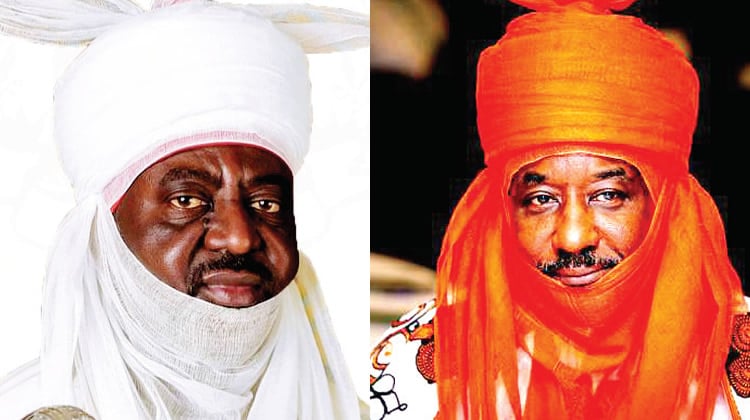
The two occasions involved the two men at the centre of Kano’s unresolved emirate dispute that involves Emir Muhammadu Sanusi II and the 15th Emir of Kano, Alhaji Dr Aminu Ado Bayero.
Sanusi’s Hawan Sallar Gani, held in August, passed through parts of Kano without the kind of government restriction that later confronted Aminu Ado Bayero’s Hawan Zaga Gari.
Barely a month later, Kano State Government announced a restriction on Durbar processions and horse-riding activities throughout the metropolis after Aminu Ado Bayero embarked on a royal procession from his Nasarawa mini-palace.
That sequence of events has raised a question that goes beyond the horses, the crowds and the traditional ceremonies:
Why was Sanusi’s procession allowed to take place, while the government moved to stop or restrict Aminu Ado Bayero’s planned Hawan Zaga Gari?
The answer lies partly in the security explanation offered by the government, but also in the complicated history of the Kano Emirate dispute, the competing royal camps and the different circumstances surrounding the two processions.
Read Also:
Kano raises concern over delayed release of approved funds as 2026 nears end
Two Hawas, one disputed throne
The contrast between the two events is difficult to ignore.
On August 29, 2026, Muhammadu Sanusi II led the first Maulud Durbar organised by his Kano Emirate Council.
The procession, known as Hawan Sallar Gani, began from Gidan Rumfa and moved through parts of Kano before returning to the palace.
Sanusi rode on horseback alongside district heads and traditional title holders, while large numbers of residents came out to see the procession. The Kano Emirate Council said the event would henceforth become an annual observance.
The event was presented primarily as part of the commemoration of the birth of Prophet Muhammad and as a new addition to Kano’s traditional calendar.
Then came Aminu Ado Bayero’s Hawan Zaga Gari.
The 15th Emir planned to leave his Nasarawa mini-palace, ride through parts of the metropolis, greet residents and proceed to Yakasai for a Qur’anic graduation ceremony before returning to his residence.
Unlike Sanusi’s procession, however, the event quickly became the subject of a government security intervention.
On September 27, Kano State Government announced that all forms of Durbar procession and horse-riding activities within the metropolis were restricted until further notice.
The government said the decision followed an emergency meeting of the State Security Council, which reviewed the security situation surrounding the planned activities.
Related:
Ganduje Clarifies Position on Sanusi, Says Apex Court Will Determine Emirship
Supreme Court Adjourns Kano Emirate Suit to April 2027
Why The Sun will honour Ganduje with lifetime achievement award
According to the government, security assessments indicated significant mobilisation of supporters, creating fears of possible confrontation, loss of lives, damage to property and a breakdown of law and order.
But why the different outcome?
This is where the politics of the Kano Emirate becomes unavoidable.
The government did not publicly say that Aminu Ado Bayero was prohibited from riding because he was the 15th Emir.
Instead, its stated position was that the security environment surrounding the activities had changed.
The restriction was therefore framed as a general security measure covering Durbar processions and horse-riding throughout Kano metropolis.
But the timing made the Aminu Ado Bayero procession the immediate focus.
Reports said the 15th Emir had already left the Nasarawa mini-palace and moved through major parts of the metropolis, with thousands of people lining the route, before the government announced the restriction.
The procession passed through areas including IBB Way, Wambai, Zage and Yola Road before reaching his Mandawari residence.
It was this mobilisation, according to the government’s explanation, that heightened security concerns.
That raises another question:
Was the concern really the traditional ceremony itself, or the political and public mobilisation surrounding the ceremony?
The government’s explanation points to the latter.
Bashir Ahmad: “Aminu Ado Bayero has many admirers”
The size of the crowd became particularly relevant to the public debate.
Former Special Adviser to ex-President Muhammadu Buhari on Digital Communications, Bashir Ahmad, weighed into the controversy in a Facebook post commenting on Aminu Ado Bayero’s Hawan Zaga Gari.
Bashir said the 15th Emir has a large number of admirers.
His observation is important to the story because the size of the crowd around Aminu Ado Bayero’s procession was one of the issues that distinguished the event from an ordinary private royal appearance.
But a large crowd can mean different things.
It may represent traditional loyalty, cultural attachment, respect for the personality of the Emir, curiosity, community ties or support for his claim to the throne.
It does not, by itself, settle the legal question of who is entitled to occupy the Kano Emir’s stool.
That remains a matter for the courts.
What it does demonstrate is that Aminu Ado Bayero retains a visible public following and that his appearance in the streets of Kano can generate substantial mobilisation.
That is precisely what makes the security question more complicated.
Sanusi’s procession and the government’s position
The apparent difference between the two events has inevitably generated questions among observers.
Sanusi’s Hawan Sallar Gani involved the same basic ingredients, that
an Emir on horseback, district heads, traditional title holders, a royal entourage and large crowds in the metropolis.
The procession moved from Gidan Rumfa through parts of Kano and back to the palace.
Yet there was no comparable announcement from the Kano State Government restricting the event.
The government has not publicly stated that Sanusi’s procession was exempt from security considerations.
Nor has it said that Aminu Ado Bayero’s procession was stopped because of his personal identity.
Its stated justification for the September restriction was the security situation surrounding the planned activities and the mobilisation of supporters.
That distinction is important.
It means that the available evidence establishes a difference in outcome, but does not by itself establish that the government deliberately applied two different rules because it favoured one Emir over the other.
The circumstances surrounding the two events may have been different.
And that is precisely where the history of Kano’s emirate crisis becomes important.
How Kano got two royal centres
The roots of the present dispute go back to 2019.
Muhammadu Sanusi II became the 14th Emir of Kano in 2014 following the death of the late Emir Ado Bayero.
His reign, however, eventually became strained by a prolonged disagreement with the administration of then-Governor Dr. Abdullahi Umar Ganduje.
In March 2019, the Kano State Government created additional emirates, effectively dividing the historic Kano Emirate into five.
In March 2020, Governor Ganduje removed Sanusi from the throne.
Aminu Ado Bayero, son of the late Emir Ado Bayero, was subsequently installed as Emir of Kano.
For several years, Aminu Ado Bayero functioned as the recognised Emir under the structure created by the Ganduje administration, while Sanusi remained outside the Kano throne.
Then Kano’s political landscape changed.
The 2024 reversal
After Abba Kabir Yusuf became governor in 2023, his administration moved to reverse the five-emirate arrangement.
In May 2024, the Kano State House of Assembly passed legislation repealing the law that had created the additional emirates.
Governor Yusuf subsequently reinstated Muhammadu Sanusi II as Emir of Kano.
Sanusi returned to Gidan Rumfa.
But Aminu Ado Bayero did not simply disappear from the traditional landscape.
He continued to maintain his position and activities from the Nasarawa mini-palace and challenged the changes through the courts.
The result has been an unusual situation in which Kano has one historic emirate but two competing royal centres.
The courtroom and the streets
The legal dispute has continued alongside the public activities of both camps.
That is why the two Hawas of 2026 carry a meaning beyond their traditional purpose.
Sanusi’s Hawan Sallar Gani was a public demonstration of the functioning of the Kano Emirate Council under the structure restored by the 2024 law.
Aminu Ado Bayero’s Hawan Zaga Gari, meanwhile, was a public demonstration of his continuing traditional presence and the support of people who recognise him as the 15th Emir.
The two events therefore occurred against the same unresolved background, but from opposite sides of the emirate dispute.
And when large numbers of supporters gather around competing royal camps, the security implications become difficult to separate from the traditional ceremonies.
It is not simply Sanusi versus Bayero
There is another important point.
The latest government directive was not worded as a ban on Aminu Ado Bayero personally.
It restricted all forms of Durbar processions and horse-riding activities within Kano metropolis until further notice.
The State Security Council said the measure was intended to prevent confrontation, preserve public order and protect lives and property.
That means the government’s official position is that the restriction is about the circumstances surrounding the royal activities rather than the cultural legitimacy of one Emir’s Hawa over another.
But the timing inevitably invites comparison with the August event.
If Sanusi was able to conduct his Hawan Sallar Gani with district heads, horse riders and large crowds, why did a similar public appearance by Aminu Ado Bayero lead to an emergency security meeting and a metropolis-wide restriction?
The government has not, in the statements cited, provided a detailed public comparison between the security assessments surrounding the two events.
That leaves room for competing interpretations.
The crowd factor
One of the clearest differences reported around Aminu Ado Bayero’s procession was the scale of public mobilisation.
Premium Times reported that thousands of people lined the route as the 15th Emir travelled from the mini-palace towards Mandawari.
Bashir Ahmad’s public comment about the 15th Emir having many admirers therefore entered an already sensitive conversation about the extent of his popular support.
But popularity and legal recognition are not necessarily the same thing.
A large crowd cannot determine who is legally the Emir.
Neither can the absence of a crowd determine the legitimacy of a traditional institution.
The significance of the mobilisation is instead that it demonstrates how deeply the dispute continues to resonate in Kano’s public life.
A traditional ceremony becomes a security question
This is ultimately why the story of Hawan Zaga Gari cannot be separated from the history of Kano’s emirate crisis.
The horse procession itself is traditional.
The Emir greeting his people is traditional.
District heads accompanying their Emir is traditional.
Residents gathering along the route is also familiar to Kano’s royal culture.
What has changed is the political environment in which those traditions are now taking place.
When there is only one uncontested Emir, a royal procession is primarily a ceremonial event.
When two men continue to claim the authority of the same historic throne, the same procession can become a demonstration of public allegiance.
That is the difficult space in which Kano now finds itself.
Two Hawas, two messages
Sanusi’s Hawan Sallar Gani and Aminu Ado Bayero’s Hawan Zaga Gari consequently tell two different stories about the same traditional institution.
Sanusi’s procession showed the restored Kano Emirate Council exercising traditional functions from Gidan Rumfa.
Aminu Ado Bayero’s procession showed that the 15th Emir still commands a visible public following and remains an active figure in Kano’s traditional life.
Bashir Ahmad’s intervention brought attention to that second dimension: the size and enthusiasm of the public around Aminu Ado Bayero.
The Kano State Government, however, viewed the mobilisation through the lens of security.
Its decision was therefore not officially presented as a judgment on the competing claims of the two Emirs, but as a precaution against possible confrontation.
For now, the two Hawas have exposed the central contradiction at the heart of Kano’s traditional politics.
There is one historic Kano Emirate, but two competing claims to its most powerful traditional institution.
And as long as that question remains unresolved, the sound of horses moving through Kano’s streets will carry meanings far beyond ceremony.

The Tinubu Health Reset: A Consultant Examines Nigeria’s Healthcare Reforms
Aminu Bayero’s Admirers, Sanusi’s Hawan Sallar Gani and Kano’s Royal Divide
Why The Sun will honour Ganduje with lifetime achievement award

Idris assures NIPR of FG support for 2026 World PR forum

NECO releases 2026 SSCE results, 58.67% record five credits including English, Maths

ABCOAD Unveils Journal, Bids Farewell to Provost

Nigerian Army Begins DSSC 29/2026 Recruitment, Outlines Eligibility Criteria

2027: NDC Releases Full List of Consensus Candidates in Kano

Gaya Polytechnic Opens Recruitment, Advertises 46 Academic, Non-Academic Positions