Feature
Ganduje: When political influence outlives political office

By Umar Idris Shuaibu, Kano
In Nigerian politics, the end of an official position does not necessarily mark the end of political influence. Sometimes, relevance survives through relationships built over years, institutional experience and networks that extend beyond a single office.
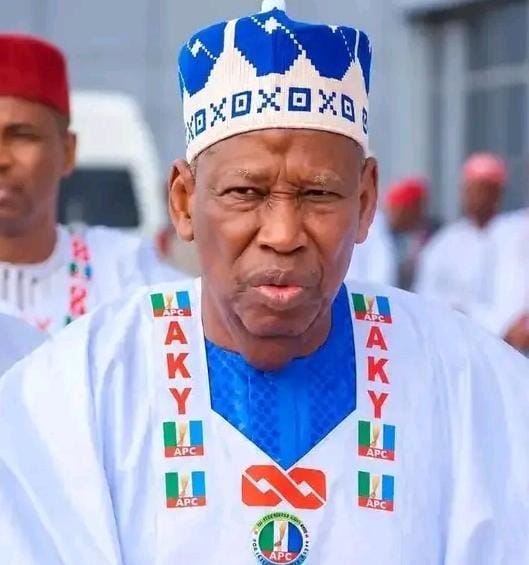
That provides a useful lens through which to examine the continuing political role of former Kano State Governor and immediate past National Chairman of the All Progressives Congress, Dr Abdullahi Umar Ganduje.
Ganduje is no longer the national chairman of the APC. He left the position in June 2025, after which the party moved through an acting leadership arrangement before Nentawe Yilwatda emerged as national chairman at the party’s March 2026 convention.
His formal party authority has therefore changed. But his subsequent activities suggest that he has remained engaged in the political conversations surrounding Kano and the APC.
Read Also:
Ganduje: The political capital Tinubu’s APC cannot afford to ignore
X-Raying The Ganduje Political Powerhouse
Ganduje’s Kano Gambit: The Political Realignment Shaping Tinubu’s 2027 Chances
The question is no longer simply what office Ganduje occupies. It is what political capital accumulated from his years in government, party administration and northern politics means in an APC preparing for another electoral cycle.
From Kano Government House to party headquarters
Ganduje’s political career has placed him at several important levels of Nigeria’s political structure.
He served as Kano State governor from 2015 to 2023 before becoming national chairman of the APC. His movement from Government House, Kano, to the national secretariat of the ruling party gave him experience in both executive administration and party organisation.
His tenure as APC national chairman ended in 2025. Shortly afterwards, he was appointed chairman of the Board of the Federal Airports Authority of Nigeria. The appointment gave him a new federal institutional role, although one outside the day-to-day political administration of the ruling party.
Since then, his political activities have continued to attract attention, particularly in Kano.
That distinction is important. Institutional authority can end with an appointment, but relationships and political experience accumulated over years do not necessarily disappear at the same time.
The Kano factor
Any assessment of Ganduje’s political position inevitably returns to Kano.
The state remains an important arena in northern and national politics, and its political realignments have consequences beyond its borders.
One of the most significant developments in the state’s recent political landscape was Governor Abba Kabir Yusuf’s return to the APC in January 2026 after leaving the New Nigeria Peoples Party.
Ganduje was among the APC leaders who received Yusuf at the ceremony marking his return to the ruling party. At the event, Ganduje publicly assured Yusuf of support for his second-term bid and said APC governorship aspirants had agreed to support the governor.
The development was notable not merely because of Yusuf’s defection, but because of the political history between the governor and Ganduje.
Yusuf had governed Kano on the NNPP platform, while Ganduje had been one of the leading figures on the opposing APC side. Their political positions had therefore been associated with competing blocs in the state.
The January 2026 development presented a different political configuration.
Ganduje publicly welcomed Yusuf into the APC and backed his second-term ambition, illustrating how political alliances can change as parties and interests realign.
From contest to accommodation
That episode also highlights one of the less visible aspects of political influence: the ability to operate within a changing political environment.
The Kano APC of 2026 is not the same political structure that existed when Ganduje was governor.
New actors have emerged, former allies have taken different positions and politicians who once occupied secondary roles have acquired greater influence through elected offices, appointments and party structures.
Ganduje, however, has remained involved in the conversations surrounding the state’s political direction.
In May 2026, he attended a closed-door meeting with Vice-President Kashim Shettima alongside former Kano Deputy Governor Abdullahi Tijjani Muhammad Gwarzo and Bichi Federal Constituency lawmaker Abba Abubakar Bichi. The meeting was reported to have focused on political developments and affairs in Kano North ahead of the 2027 elections.
The meeting, by itself, does not establish that Ganduje controls the direction of Kano politics. It does, however, place him among the political actors participating in consultations on an important part of the state’s political landscape.
That is a different proposition from claiming that he remains the dominant political force in Kano.
The value of political experience
Ganduje’s political asset may therefore lie less in formal authority than in experience accumulated across different layers of political organisation.
He has occupied the office of governor.
He has headed a major national political party.
He has participated in federal political administration.
He has operated within Kano’s complex political environment for decades.
Such experience gives a politician an understanding of how government, party structures, elected institutions and grassroots interests interact.
It also provides knowledge of relationships that may remain relevant even after formal responsibilities change.
For a political party preparing for another election, such experience can become useful in consultations, reconciliation and coalition-building.
But its actual value depends on how other political actors choose to engage with it.
Ganduje and Tinubu
Ganduje’s political relationship with President Bola Ahmed Tinubu has also remained visible.
In January 2026, Ganduje publicly backed Tinubu’s bid for another term and said northern voters would support the President. Those remarks were his political position, rather than an independently verifiable forecast of voting behaviour.
His continued public alignment with Tinubu places him within the group of northern APC figures campaigning around the President’s 2027 political project.
But Ganduje’s relevance to the APC extends beyond his public endorsement of Tinubu.
His more enduring asset is the experience and network that underpin his political activity.
A different kind of political role
The post-chairmanship phase may therefore represent a different type of political role for Ganduje.
The APC national chairmanship provided formal institutional authority. Outside that position, political influence depends more heavily on relationships, experience, access, credibility and the ability to participate in negotiations among competing interests.
That form of influence is less visible than holding a national party office.
It is also more difficult to measure.
Ganduje’s recent involvement in Kano political engagements provides evidence of continued participation, but the extent to which that participation translates into measurable influence remains a matter for political developments to determine.
The changing Kano equation
The broader Kano political environment is itself undergoing significant change.
Governor Yusuf’s movement from the NNPP to the APC has altered the alignment of major political forces in the state. The APC’s internal structure has also continued to evolve, with different politicians competing for positions and influence ahead of 2027.
In Kano North, for example, the political contest has involved senior figures including Deputy Senate President Barau Jibrin and former Deputy Governor Gwarzo, while consultations involving national leaders have continued.
Within that environment, Ganduje represents one of the party’s more experienced political figures.
Advert
Whether that experience becomes decisive in particular political contests is another question.
What can be established is that he remains involved in political discussions at both state and national levels.
Political capital beyond office
The broader lesson from Ganduje’s current position is that political capital and political office are not necessarily the same thing.
A politician may lose formal authority but retain relationships.
A former governor may no longer control government machinery but retain institutional knowledge.
A former party chairman may leave the national secretariat but continue to participate in party consultations.
That appears to be the phase Ganduje is now navigating.
He is no longer the governor of Kano.
He is no longer the national chairman of the APC.
But he remains a former governor of one of Nigeria’s most politically significant states, a former national chairman of the governing party and a senior political figure with extensive experience in Kano and national politics.
Those credentials form part of his political capital.
2027 election cycle
As the 2027 electoral cycle approaches, the APC will have to manage competing ambitions, changing alliances and the expectations of politicians operating at federal, state and grassroots levels.
Kano will be one of the arenas where those competing interests are particularly visible.
For Ganduje, the next phase may therefore be less about returning to a former office and more about how effectively he deploys the experience acquired from Kano Government House, the APC national secretariat and years of political engagement.
His recent participation in Kano-related consultations and his public role in the political realignment following Governor Yusuf’s return to the APC show that his political activities have continued beyond the national chairmanship.
The extent of that influence, however, will ultimately be measured not by titles but by political developments, alliances and outcomes.
For now, Ganduje’s story illustrates a familiar feature of Nigerian politics: leaving an office can change a politician’s role without necessarily ending his place in the political conversation.

Ganduje: When political influence outlives political office

Mariya Bunkure Joins African Leaders at Global Business Initiative

Former Kogi Governor Ibrahim Idris Dies at 77

Kano loses political veteran Sani Lawan Kofar Mata at 73

Kano SEMA donates cows, foodstuff to 13 rehabilitation centres
ABCOAD Unveils Journal, Bids Farewell to Provost

Nigerian Army Begins DSSC 29/2026 Recruitment, Outlines Eligibility Criteria
2027: NDC Releases Full List of Consensus Candidates in Kano

Gaya Polytechnic Opens Recruitment, Advertises 46 Academic, Non-Academic Positions