The Historica Nigeria

Kano

Kano, Politics

Mu’azu Magaji Suggests Bichi, Rurum as Strong Deputy Governor Options for Kano

Discussions over the choice of a running mate for the 2027 Kano governorship election have continued to generate political debate, with stakeholders calling for a balanced and strategic selection that could strengthen party unity and electoral prospects. A former Kano State Commissioner for Works and Infrastructure, Mu’azu Magaji, has weighed in on the matter, advocating for regional considerations in the selection of a deputy governor candidate. Magaji noted that while Kano Central already holds the governorship position through Governor Abba Kabir Yusuf, attention should be shifted to other senatorial districts to ensure balance and political inclusiveness. He identified Engr. Rabi’u Suleiman Bichi from Kano North and Rt. Hon. Kabiru Alhasan Rurum from Kano South as strong contenders, describing both as credible figures capable of complementing the governor’s leadership. Read Also: Waya Hails Governor Yusuf’s Reforms, Calls for End to Political Thuggery in Kano Kano in Tight Corner as Deputy Governor Nomination Sparks Divisions All You Need to Know About Kiru Local Government Area According to him, either of the two candidates would strengthen the governing arrangement and improve the party’s chances in the next election. Magaji, however, stressed that the final decision rests solely with the governor, whom he described as having the constitutional prerogative to select a running mate of his choice. He suggested that whichever candidate is not selected as deputy governor could be considered for a ministerial position at the federal level, in order to ensure broader political inclusion and balance. The former commissioner also called for the proper political integration of former deputy governorship aspirant Murtala Sule Garo, urging that he be assigned a role that would reinforce internal party cohesion. He further appealed to key political stakeholders, including senators and members of the state assembly, to rally behind the eventual decision of the governor in the interest of party unity and electoral success. Magaji emphasised that the Speaker of the State House of Assembly, Jibril Isma’il Falgore, who is also being linked to the deputy governorship position, would be better positioned in his current legislative role, noting that it offers partnership with the executive arm of government. He expressed optimism that with proper consultation and inclusiveness, the party would emerge stronger and better positioned for future elections, while prioritising the development and stability of Kano State.

Kano, News

Waya Hails Governor Yusuf’s Reforms, Calls for End to Political Thuggery in Kano

Umar Idris Shuaibu, Kano A former governorship candidate in Kano State and ex-senior official of the Nigerian National Petroleum Corporation (NNPC), Inuwa Waya, has commended the reform initiatives of Governor Abba Kabir Yusuf, particularly in civil service and local government administration. Waya made the remarks during an interview with members of the Kano Online Media Chapel of the Nigeria Union of Journalists (NUJ) in Kano. He praised the state government’s interventions in critical sectors, including youth education, empowerment, and employment, noting that these policies are gradually improving the living conditions of citizens across the state. According to him, the administration has demonstrated clear commitment to addressing long-standing administrative challenges inherited from previous governments. He further noted that the strengthening of local government administration remains a key achievement of the present government, describing it as the closest tier of government to the grassroots and essential for sustainable development. Read Also: Inuwa Waya Advocates Support for Governor Yusuf, Urges Leaders to Invest in Youth Development Inuwa Waya Urges Professionalism as Online Media Takes Centre Stage All You Need to Know About Kiru Local Government Area “The local government system is being strengthened by this administration because it represents the government at the grassroots, and it will undoubtedly contribute significantly to societal development,” he said. Waya observed that while the system had suffered serious neglect in the past, the current leadership is gradually restoring efficiency and public confidence in governance. “The system was deeply weakened under previous administrations, but with the present government’s determination to correct the situation, we are witnessing the gradual restoration of its lost glory,” he added. The APC chieftain also called on political actors to desist from the use of political thugs, warning against the exploitation of youths from underprivileged backgrounds. He stressed that such youths should instead be empowered through education, employment, and economic opportunities to enable them to contribute positively to society. Waya lamented that political elites often fail to invest in the future of young people, while prioritising quality education and opportunities for their own children. “We must sit down and develop a collective agenda to abolish thuggery. Our youths must be used for their own benefit and for the good of society at large,” he said. He urged leaders to prioritise youth development, education, and empowerment as key pillars for peace, stability, and sustainable progress in the state.

Feature, Kano

All You Need to Know About Kiru Local Government Area

In the heart of Kano State lies Kiru Local Government Area, a region whose economic strength is quietly anchored in agriculture, livestock development, and a thriving culture of trade that continues to sustain livelihoods across Northern Nigeria. When ‘The Historica Nigeria‘ paid a visit to the area, the reality on ground reflected a community deeply connected to production and exchange, where farming and commerce are not just occupations but a way of life. Across its vast land, farmers cultivate essential crops such as maize, millet, sorghum, rice, and groundnuts, reinforcing Kiru’s role as a key contributor to food supply within the state. Livestock rearing also remains a dominant economic activity, supported by structured efforts to organise pastoral life. In settlements such as Dansoshiya/Kamanda, Ruga communities established by a past Kano administration have continued to provide a framework for Fulani herders to manage cattle within a more coordinated environment. These settlements reflect an effort to resuscitate pastoral livelihoods while fostering coexistence with farming communities. Read Also: Lere: A Historic Fulani Settlement and Cultural Crossroads in Kaduna Birnin Kudu: An Ancient Settlement With a Modern National Footprint Why Tarauni Remains a Pillar of Kano’s Metropolitan Development However, beyond the farms and grazing fields, one landmark stands out as a defining pillar of Kiru’s economy. At Kwanar Dangora close to Kafin Maiyaki, a historic periodic market continues to shape the commercial identity of the area. During the visit by ‘The Historica Nigeria‘ on market day Friday, the market presented a vivid picture of economic activity in motion. Recognised as one of the oldest periodic markets in Kano State, ‘Kwanar Dangora‘ has built a reputation as a major centre for the exchange of agricultural commodities, livestock, and essential goods that meet the daily needs of people. Traders at the market are not limited to Kano alone. Many travel from neighbouring parts of Kaduna State, reinforcing its status as a regional hub that connects rural producers with a wider network of buyers and merchants. On market days, the atmosphere reflects a dynamic blend of tradition and commerce. Grains are traded in large volumes, livestock changes hands, and a wide range of goods circulate among buyers and sellers. The scale of activity underscores the market’s enduring relevance in a rapidly evolving economic landscape. The impact of Kwanar Dangora market extends beyond trade. It serves as a significant source of internally generated revenue for the state while providing employment opportunities for a large number of people, including farmers, herders, traders, transporters, and youths from both rural and urban centres. The accessibility of Kiru further strengthens this economic chain. Road networks such as the Kiru, Karaye, Gwarzo Road and the Zaria Road enable the steady movement of goods and people, linking the area to other parts of the state and beyond. With a climate that supports year round agricultural activities and a population engaged in productive enterprise, Kiru continues to demonstrate the enduring value of rural economies in national development. What emerges from Kiru is a compelling narrative of resilience and productivity. From its farmlands and Fulani settlements to the historic Kwanar Dangora market, the local government area stands as a testament to how rural communities can drive economic growth through consistency, structure, and enterprise. As development conversations continue across the country, Kiru offers a clear example that sustainable progress is often rooted in communities where production meets opportunity, and where markets such as Kwanar Dangora continue to serve as the beating heart of economic life.

Kano, Politics

Governor Yusuf Defends APC Move, Insists He Leads Party in Kano

Kano State Governor, Abba Kabir Yusuf, has declared that the immediate past National Chairman of the All Progressives Congress (APC), Dr. Abdullahi Umar Ganduje, cannot dictate to him on political matters in the state, insisting that he is now the party’s leader in Kano. The governor made the remark while responding to criticisms trailing his defection from the New Nigeria Peoples Party (NNPP) to the APC, maintaining that his decision was neither an act of betrayal nor politically misplaced. Speaking during a meeting with his supporters, Yusuf said his exit from the NNPP was prompted by internal crises within the party, which he claimed could have negatively affected millions of people in Kano State if left unaddressed. “I want to reaffirm that in breaking away from our former movement, we did not commit any wrongdoing. We raised concerns about the state of affairs in the party because we foresaw the crisis. We offered advice, but it was dismissed,” he said. Read Also: Reps Member Muhammad Hassan Dies After Prolonged Illness According to him, the early decision to leave the party has helped restore calm in the state’s political environment. Yusuf also dismissed allegations that he betrayed the Kwankwasiyya Movement, arguing that some members had earlier left the party without consulting others. “They accuse us of betrayal, but were members informed before some people decided to leave the NNPP? Isn’t that also betrayal?” he queried. On claims that he had aligned with Ganduje to relinquish political control, the governor insisted that his move to the APC represents progress rather than regression. “Abba, who was alone in NNPP, is now among over 31 governors. Is that backwardness or progress?” he asked. Yusuf emphasised that while he maintains mutual respect with Ganduje, he remains firmly in charge of the APC structure in Kano State. “What exists between me and Ganduje is mutual respect. But he cannot give me instructions because I am the leader,” he said. The governor reiterated that his political decisions are guided by the interest of the people, stressing that his administration remains focused on governance and stability in the state.

Kano, News

Reps Member Muhammad Hassan Dies After Prolonged Illness

A member of the House of Representatives representing Dawakin Kudu/Warawa Federal Constituency of Kano State, Muhammad Danjuma Hassan, has died at the age of 66 following a prolonged illness. His death was confirmed in the early hours of Saturday in a statement issued by the spokesperson of the House of Representatives Nigeria, Akin Rotimi. According to the statement, the lawmaker passed away on Friday evening and will be buried on Saturday in accordance with Islamic rites in Abuja. Describing the loss as significant, Rotimi said the late legislator’s demise was a major setback to the National Assembly and the country at large. “His passing is a profound loss to the House of Representatives, his constituents, and the nation,” he said. Read Also: Mustapha Bala Dawaki and the Prospect of a 2027 Political Comeback Governor Yusuf Defends APC Move, Insists He Leads Party in Kano U.S. Embassy Cancels Visa Appointments in Abuja Amid Rising Security Concerns The statement further noted that Hassan was widely regarded as one of Nigeria’s foremost legislative counsels and legal draftsmen, with numerous laws bearing his imprint over the years. “With his demise, Nigeria has lost one of its foremost legislative counsel and legal draftsmen, whose contributions significantly advanced legislative development and constitutional processes,” Rotimi added. The Speaker of the House, Tajudeen Abbas, also extended condolences to the family of the deceased, his constituents, and the government and people of Kano State. Hassan, who was elected into the House in 2023 on the platform of the New Nigeria Peoples Party (NNPP), served as the Deputy Chairman of the House Committee on Judiciary. Before joining partisan politics, he had a distinguished career in the National Assembly bureaucracy, rising to the rank of Permanent Secretary. His vast institutional knowledge and administrative experience were said to have enriched legislative deliberations and policy oversight. During his time in the House, he served on several committees, including Public Petitions, Aviation, Solid Minerals, Constitution Review, and Treaties, Protocols and Agreements.

Kano, News

Governor Yusuf Confirms Bilkisu Maimota as Kano Head of Service

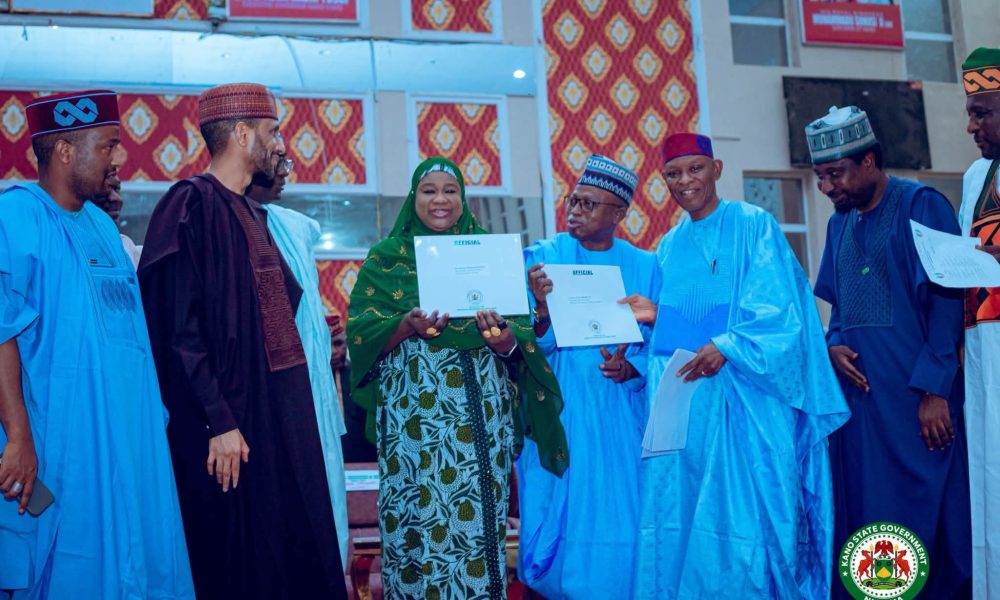
Kano State Governor, Abba Kabir Yusuf, has confirmed Hajiya Bilkisu Shehu Maimota as the substantive Head of the Kano State Civil Service, marking a significant step in the administration’s ongoing public service reforms. The confirmation was disclosed in a statement issued by the Governor’s Chief Press Secretary, Mustapha Muhammad, following a high-profile event for the unveiling of the sixth tranche of payments aimed at settling long-standing gratuities and death benefits owed to pensioners and families of deceased civil servants. Maimota’s elevation to the position signals her rise to one of the most influential administrative roles in the state and is seen as a strategic move to stabilise the bureaucracy and strengthen institutional efficiency. Read Also: Kano in Tight Corner as Deputy Governor Nomination Sparks Divisions She had assumed the role in an acting capacity barely a month ago after the removal of Alhaji Abdullahi Musa. Her confirmation, observers say, reflects the administration’s confidence in her leadership and capacity to drive reforms within the civil service. Governor Yusuf, while announcing the appointment, tasked the new Head of Service with leveraging her experience to revamp the system, stressing the need to consolidate ongoing reforms and deliver a more responsive, efficient, and accountable public service. He also congratulated Maimota on her appointment, expressing optimism that her tenure would bring measurable improvements across ministries, departments, and agencies, especially at a time when expectations from both the workforce and the public remain high.

Kano, News, Politics

Inuwa Waya Advocates Support for Governor Yusuf, Urges Leaders to Invest in Youth Development

Umar Idris Shuaibu, Kano A prominent legal practitioner and former senior official of the Nigerian National Petroleum Corporation (NNPC), Inuwa Waya, has endorsed the defection of Kano State Governor, Abba Kabir Yusuf, to the All Progressives Congress (APC), while calling for greater youth inclusion and responsible political engagement. Waya made the remarks during an interaction with online journalists under the auspices of the Online Media Chapel in Kano, where he also announced his withdrawal from the 2027 governorship race. He explained that his decision to step down was informed by the emergence of aspirants with similar vision, as well as his assessment of the current administration’s performance, noting that many of his campaign ideas in 2023 are being implemented by the Yusuf-led government. Describing the governor as a “valuable political asset,” Waya said the defection to the APC was a strategic move that would enhance governance, improve federal collaboration, and accelerate development in Kano State. According to him, the crisis within the New Nigeria Peoples Party (NNPP), characterised by factional disputes and protracted litigations, made it politically risky for the governor to remain. He added that aligning with the ruling party at the centre provides the necessary stability and synergy for effective governance. Read Also: Kano in Tight Corner as Deputy Governor Nomination Sparks Divisions “Governor Yusuf’s decision is a product of political calculation. It frees him from distractions and allows him to concentrate on delivering dividends of democracy to the people,” Waya said. He further noted that the move has helped to calm political tensions in Kano, reducing rivalry and creating a more stable environment for governance. Waya highlighted several achievements of the current administration, including reforms in land administration, infrastructure development, urban renewal, and efforts to address water scarcity through international partnerships. He also cited improvements in education, healthcare services, civil service efficiency, and local government administration as indicators of progress. He commended the government’s steps to sanitise the land system, curb fraudulent practices, and prosecute offenders, describing land reforms as critical to societal stability and economic growth. On youth development, Waya issued a strong warning against the exploitation of young people for political thuggery, urging politicians to instead invest in their education, employment, and overall development. He stressed that youth must reposition themselves as drivers of positive change rather than instruments of disruption. “Politics should be about service and development, not a means to amass wealth without impact. Young people must rise, participate responsibly, and shape the future of this country,” he said. Drawing a global comparison, Waya referenced the political rise of Julius Malema in South Africa, noting that youth-driven political movements can transform governance when properly guided. He concluded by urging Kano residents to support Governor Yusuf’s administration, stating that the government has shown commitment to restoring the state’s lost glory and deserves collective backing to achieve its vision. Waya reiterated that building a functional political system requires patience, discipline, and a shared commitment to people-centred development.

Feature, Kano, Politics

Power play in Kano: is Murtala Garo the missing link In Yusuf’s political equation?

Umar Idris Shuaibu, Kano In the ever-evolving theatre of Kano politics, where alliances are constantly tested and recalibrated, the re-emergence of Murtala Sule Garo in strategic conversations is stirring fresh debate across the state’s political landscape. Though not currently occupying a frontline executive role, his enduring influence within grassroots structures and institutional networks continues to position him as a figure of consequence, whose name is now being quietly projected in some quarters as a possible Deputy Governor under the administration of Abba Kabir Yusuf. Garo’s political journey reflects a steady climb built not on sudden prominence but on sustained engagement at the grassroots level. His tenure as Chairman of Kabo Local Government Area marked a defining period in his public service career, where he cultivated a reputation for accessibility and responsiveness. In a political environment where many leaders struggle to maintain direct connection with their constituencies, Garo’s approach resonated strongly among rural communities, laying a foundation that continues to underpin his relevance. His subsequent appointment as Commissioner for Local Government and Chieftaincy Affairs during the administration of Dr. Abdullahi Umar Ganduje further expanded his political reach and administrative experience. Operating at the delicate intersection of governance and traditional authority, he was tasked with overseeing local councils while maintaining cohesion with Kano’s deeply rooted traditional institutions. The role demanded tact and political intelligence, qualities that observers say enabled him to navigate complex relationships and consolidate a network that cuts across districts and political tendencies. In Kano’s political environment, relevance is rarely accidental; it is sustained through a careful balance of loyalty, visibility, and strategic restraint. Garo appears to have mastered this equilibrium. Despite shifts in political alignments and the often intense rivalry that defines the state’s politics, he has maintained a measured presence, avoiding unnecessary controversies while preserving his influence among key stakeholders. This has made him a figure that different interests may find acceptable, a valuable attribute in any consideration of executive partnership. Read Also: Kano Political Shift: Ganduje Hails Reps’ Defection to APC The growing speculation surrounding his possible elevation is not without strategic logic. For Governor Abba Kabir Yusuf, any move to recalibrate the structure of governance would carry implications beyond administrative convenience. It would signal intent whether towards consolidating political support, broadening inclusivity, or stabilizing relationships across divides. In that context, Garo’s grassroots penetration, administrative background, and familiarity with both political and traditional institutions present a compelling profile. Yet, such a potential move would also attract scrutiny. Kano’s political space is layered with competing interests, and any decision of this magnitude would inevitably raise questions around alignment, loyalty, and the broader balance of power. It could reshape existing dynamics, revive dormant political networks, and alter calculations ahead of future contests, particularly in a state where political structures remain highly influential at both urban and rural levels. For now, the conversation remains speculative, but in Kano, speculation often serves as a precursor to reality. The recurring mention of Murtala Sule Garo in discussions of the deputy governorship reflects more than passing rumour; it underscores a sustained political presence built over time through grassroots connection and administrative experience. As the administration of Abba Kabir Yusuf continues to navigate the complexities of governance and political expectation, decisions around leadership structure will remain closely watched.

Feature, Kano, Politics

Breaking Barriers: Samira Dilli’s Vision for Transformational Leadership

By Adamu Ahmad Khaleepa It’s not common in our society to see a woman aspiring for a political office, because of the deep-rooted societal attitudes which often relegate women to the home, viewing leadership as a male domain. Born in Brigade Tudun Wada Bus stop, area of Nassarawa Local Government, Kano state Nigeria, coming from a vast family background, she believes in inclusive and participatory leadership with a practical vision, measurable and people centered blueprint, designed not just to win an election, but to build a constituency that works for everyone. She understands the decline in general welfare and community progress as some of the draw back for the people of Nassarawa Local Government. Women in Nigerian politics face significant underrepresentation, with participation rates hovering around 6.7% in elective and appointive positions, far below the global average. Despite holding nearly half the population and notable strides in corporate leadership, women constitute only about 4% of the National Assembly. Looking at this challenges Hon. Samira Dilli holds on to her internal motive which drive her to aspire for a political office, working day and night to achieve a desired goal through passion and discipline. Read Also: Salihu Sagir Takai and the Politics of Succession in Kano As a woman at early fourtees, she believes in shared responsibility with young people, she believes that young people have the ability and capacity to decide what’s best for them, which is why Hon. Samira Dilli pledged to appoint aides from each of the eleven wards areas who will identify critical community needs, provide adequate and direct feedback to her, to ensure even distribution of development and promote accountability and fairness. Her leadership will not be based on empty speeches but on verifiable results anchored on three pillars, as described in her blueprint. Honorable Samira Dilli already conducted a basic need assessment withing the 11 wards of Nassarawa Local Government, to determine areas of urgent attention. The data compiled during the assessment, was analyzed and measures to be taken were written down as part of her planned activities in her 2027 campaign blueprint, these include construction of roads to boost trade, agriculture and the movement of goods and services, electricity as the backbone of business expansion, industrialization and digital advancement and provision of potable, affordable health care as the foundation of public health, agriculture, and productivity in community development. Hon. Samira Garba Dilli, is a Strategic professional with Bsc. International Relations and Diplomacy, MSc in peace studies and conflict resolution. She is a member Chartered Institute of Management & Leadership, member Association of Financial Analyst of Nigeria, Member Nigerian Institute of Management (Chartered) as well as professional public speaker from Institute of Public Speaking. Honorable Samira Garba Dilli is a seasoned politician, an ambitious advocate with a strong political foundation and a passion for public service. Experienced in local, state and national campaigns, committed to community improvement and utilizing research to drive progressive policy-making. She served as member Trade and Economic Committee, Presidential campaign council for Asiwaju Bola Ahmed Tinubu/Shettima Renewed Hope 2023 election campaign, where she contributed in shaping more dynamic economy, melding the best of the extant sectors with what is new on the economic horizon. As she truly represents competence, capacity, sincerity and compassion for the good people of Nasarawa constituency and Nigeria at large. As discussed with her, she explained that “besides all the experience, she has a clear focus of what she wants to bring to the table for people of Nassarawa constituency, in her own words ‘I Samira Dilli, have identified rising poverty and hardship, lack of economic opportunities, youth unemployment & underemployment, as some of the challenges facing Nassarawa Local Government constituency, and I’m ready to put feasible measures in place to mitigate such challenges’. With the support of Nassarawa Local Government constituents, we believe that Hon. Samira Garba Dilli will bring a sustainable solution to our social challenges. Adamu Ahmad Ibrahim, Executive Director, Arewa Health Promotion Initiative. 08089403454 ibrahimadamu5991@gmail.com

Kano, News, Politics

Ex-Kano South Senator Gaya Dumps APC for ADC

The African Democratic Congress (ADC) has announced the defection of former Senator representing Kano South, Kabiru Ibrahim Gaya, from the All Progressives Congress (APC). The announcement, made via the party’s official Facebook page, described Gaya as a seasoned politician with significant influence in Nigeria’s legislative landscape. Gaya, who first entered the Senate in 2007, represented Kano South Senatorial District for multiple terms. During his early years in the National Assembly, he served on key committees, including Gas, Local and Foreign Debts, States and Local Government, Upstream Petroleum Resources, and Works, placing him at the centre of national policy discussions on infrastructure, petroleum regulation, and fiscal management. A mid-term assessment by ThisDay newspaper had earlier rated him as an active legislator, citing his sponsorship of the Finance Management and Accountability Bill, 2009, aimed at promoting fiscal discipline and transparency, as well as the Millennium Development Agency Bill, 2009, which sought to strengthen Nigeria’s drive toward achieving global development goals. Read Also: Kano in Tight Corner as Deputy Governor Nomination Sparks Divisions He also co-sponsored several motions and contributed actively to plenary debates during his tenure. In 2008, as Chairman of the Senate Committee on Works, Gaya raised concerns over the slow pace of federal road projects and opposed the privatisation of road infrastructure, insisting it should remain under public control. Before joining the APC, Gaya was a prominent member of the All Nigeria Peoples Party (ANPP), where he played key roles in party affairs, including involvement in gubernatorial candidate selection in Kano State ahead of the 2011 elections. He was re-elected to the Senate in 2011 under the ANPP platform and retained his seat in 2015 and 2019, reflecting sustained support from his constituents. Gaya also served as Deputy Minority Whip of the Senate between 2007 and 2011, where he contributed to coordinating minority party positions and legislative strategy.

Scroll to Top