Feature
APC Consolidates Strength Across Nigeria Ahead of 2027 Elections

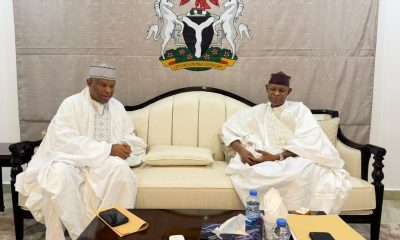
As Nigeria steadily approaches the 2027 general elections, the All Progressives Congress (APC) continues to tighten its grip across the country’s six geo-political zones, emerging stronger and more coordinated than ever. The ruling party’s growing dominance is reinforced not only by the wave of defections from opposition governors but also by the institutional strengthening championed by visionary leaders such as Dr. Abdullahi Umar Ganduje, the immediate past National Chairman of the APC and current Chairman of the Board of the Federal Airports Authority of Nigeria (FAAN).
In recent weeks, several governors elected under the opposition Peoples Democratic Party (PDP) have defected to the APC, citing disunity, lack of ideological direction, and leadership crises within the party. These defections have further consolidated APC’s foothold across regions — particularly in the South-East and South-South — where the PDP once enjoyed strong influence.
One of the most significant political shifts occurred in Enugu State, where Governor Peter Mbah, alongside members of his State Executive Council, officially joined the APC. Barely a day later, Bayelsa State Governor Douye Diri resigned his PDP membership, signaling a major setback for the opposition and a widening acceptance of the APC’s reform-driven governance style.
Related:
APC Hits Back at Daily Trust, Labels Editorial “Biased and Reckless”
Beyond electoral strength, the APC’s growing institutional maturity can be credited to reforms introduced under the leadership of Dr. Ganduje, whose tenure as National Chairman marked a strategic turning point for the party. Among his most notable initiatives was the establishment of the APC Progressive Institute (TPI) — a think tank designed to build intellectual capacity, strengthen internal democracy, and drive policy innovation within the party.
The TPI serves as a research and policy center that develops data-driven ideas to guide national and state governments under the APC. Through this platform, party members, public officials, and emerging political leaders are exposed to structured training in governance, political communication, and sustainable development strategies — aligning the party’s ideology with Nigeria’s long-term growth and democratic consolidation.
Read Also:
Ganduje’s Achievements Still Define Kano, Despite NNPP’s Attempts to Erase Them
Political observers note that such forward-thinking initiatives have transformed the APC into more than just a political party — it has evolved into a policy-driven institution capable of shaping Nigeria’s future through ideas, reforms, and inclusive governance.
Currently, the APC controls 22 out of Nigeria’s 36 states, with a dominant presence in both the North and South. In the South-West, it maintains a solid base in Lagos, Ekiti, Ogun, and Ondo states. The South-East, once seen as a stronghold of the opposition, now boasts APC-led governments in Enugu, Ebonyi, and Imo States. In the South-South, the party has made significant inroads with Delta, Edo, Akwa Ibom, and Cross River under its fold.
In the North, the APC’s dominance remains unshaken. It commands control of nearly all states in the North-West, North-East, and North-Central, including Kano, Katsina, Jigawa, Borno, Gombe, Niger, Kwara, Kogi, and Benue, among others — a testament to its widespread appeal.
Analysts agree that the APC’s current strength is not accidental but the result of deliberate political engineering, internal restructuring, and strategic inclusiveness initiated by leaders like Dr. Ganduje. His role in institutionalizing political education through the Progressive Institute continues to serve as a model for long-term party sustainability and governance innovation.
With a sitting president, a majority in the National Assembly, and dominance in most state governments, the APC enters the 2027 election season as the defining political force shaping Nigeria’s direction. The party’s expanding structure, ideological clarity, and commitment to development-oriented governance make it a formidable institution, far beyond the reach of fragmented opposition parties.
As many political watchers observe, the APC today represents not just a ruling party — but a forward-looking movement anchored on progressive ideas, institutional learning, and national stability.
Umar Idris Shuaibu is a public affairs analyst and Ganduje loyalist from Kano.

Kano NUJ vice chairman Mustapha Gambo loses mother

Kano spends ₦2.7bn on publicity, honorarium, sitting allowances in six months

Kano Emirate Crisis: 200 CSOs to Honour CP Bakori for Peace Efforts

2027: ‘It’s Time to Pay Tinubu Back,’ Ganduje Tells Supporters

World Post Day: NIPOST highlights digital postcodes, logistics opportunities in Kano

ABCOAD Unveils Journal, Bids Farewell to Provost

Nigerian Army Begins DSSC 29/2026 Recruitment, Outlines Eligibility Criteria

2027: NDC Releases Full List of Consensus Candidates in Kano

Gaya Polytechnic Opens Recruitment, Advertises 46 Academic, Non-Academic Positions