Feature
When experience speaks louder than ambition: Why Ganduje’s name resonates in discussions about Chief of Staff

By Umar Idris Shuaibu
In politics, not every influential leader occupies the spotlight. Some of the most consequential figures work behind closed doors, coordinating policy, managing government machinery and ensuring that presidential directives translate into measurable action.
That is the essence of the Office of the Chief of Staff to the President, an office built less on public applause than on discipline, discretion, institutional knowledge and the confidence of the Commander-in-Chief.
As conversations continue in political circles about experienced hands capable of strengthening governance at the highest level, one name that occasionally surfaces is Dr. Abdullahi Umar Ganduje.
Whether such discussions eventually translate into an appointment remains entirely within the constitutional powers of President Bola Ahmed Tinubu. Yet the reasons Ganduje’s supporters advance for considering him offer an interesting lens through which to examine the qualities expected of one of Nigeria’s most strategic public offices.
Read Also:
NDC demands Gbajabiamila’s removal over PFIPC scandal
PFIPC scandal enters new phase as fresh evidence emerges
Why Ganduje remains one of APC’s most valuable political assets
There is an old African saying that “the river that has flowed through many lands knows the safest path to the sea.” For Ganduje’s admirers, this proverb mirrors a career spanning academia, public administration, executive governance and national politics.
Long before he became Governor of Kano State, Ganduje built a career within Nigeria’s public service architecture. His assignments in the Federal Capital Development Authority (FCDA), his role as Sole Administrator in Abuja and later as Executive Secretary of the Lake Chad Basin Development Authority, and exposed him to the intricate workings of government administration, policy implementation and intergovernmental coordination.
These responsibilities demanded qualities remarkably similar to those required of a Chief of Staff: organisation, coordination, strategic planning and the ability to harmonise the activities of diverse institutions.
Supporters also point to his academic background.
Holding a doctorate in Public Administration, Ganduje combines practical governance experience with formal academic training in public sector management. While academic qualifications alone do not guarantee effective leadership, they often provide a deeper understanding of institutional processes, organisational behaviour and administrative reforms.
His tenure as Deputy Governor and later Governor of Kano State further expanded that experience.
Leading Nigeria’s most populous state required constant coordination among ministries, departments and agencies, balancing political expectations with administrative realities while overseeing development programmes across sectors including infrastructure, education, healthcare, agriculture and public finance.
For those who advocate his suitability, governing Kano represented more than political leadership; it was executive management on one of the country’s largest governmental platforms.
Another chapter frequently cited is his service as National Chairman of the All Progressives Congress (APC).
Managing Nigeria’s governing party required navigating competing interests, resolving internal disagreements, coordinating electoral preparations and maintaining party cohesion across the federation.
Such assignments demanded calm judgement, political maturity and the capacity to build consensus under pressure, as qualities many observers associate with the responsibilities of a presidential Chief of Staff.
Trust is another factor often highlighted.
In virtually every administration, the Chief of Staff occupies one of the closest positions to the President, serving as gatekeeper, adviser and coordinator of executive business.
Political analysts have long observed that presidents generally appoint individuals whose judgement they trust implicitly, especially in periods requiring policy coordination and political stability.
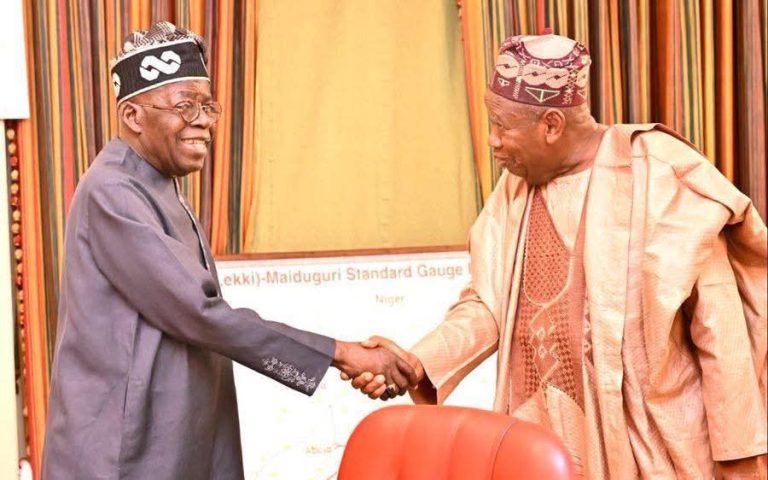
Ganduje’s long-standing relationship with President Tinubu and his consistent support for the administration’s Renewed Hope Agenda have therefore featured prominently in discussions among those who consider him a potential fit for such responsibilities.
Supporters further argue that his extensive political network, particularly across Northern Nigeria and Kano State, could enhance communication between the Presidency, political stakeholders and grassroots constituencies.
In a country where political consensus often shapes policy implementation, such relationships can become valuable institutional assets.
Naturally, democracy accommodates differing opinions.
Critics may assess Ganduje’s record differently or argue that other public servants possess equally compelling credentials for national assignments.
That diversity of opinion remains one of democracy’s defining strengths.
Nevertheless, any meaningful conversation about appointments to sensitive national offices should focus on competence, administrative experience, institutional memory and the capacity to deliver results rather than on political sentiment alone.
The office of Chief of Staff is ultimately not about making headlines.
It is about ensuring that government functions efficiently, policies move from paper to implementation and institutions work in harmony to achieve national objectives.
Whether or not Dr. Abdullahi Umar Ganduje is ever entrusted with such responsibility rests solely with President Bola Ahmed Tinubu.
Yet his supporters believe his decades of experience in public administration, executive leadership and party organisation provide a foundation that explains why his name continues to feature in discussions about senior national responsibilities.
As another African proverb reminds us, “The strength of a house is not measured by the beauty of its roof, but by the firmness of its pillars.”
For those who hold this view, experience remains one of the strongest pillars upon which effective governance can be built.

Kano Emirate Crisis: 200 CSOs to Honour CP Bakori for Peace Efforts

2027: ‘It’s Time to Pay Tinubu Back,’ Ganduje Tells Supporters

World Post Day: NIPOST highlights digital postcodes, logistics opportunities in Kano

A4A Appoints Abubakar Aminu Ibrahim as Mobilisation Secretary in Kano

World Post Day: Postal network eyes new opportunities as NIPOST goes digital

ABCOAD Unveils Journal, Bids Farewell to Provost

Nigerian Army Begins DSSC 29/2026 Recruitment, Outlines Eligibility Criteria

2027: NDC Releases Full List of Consensus Candidates in Kano

Gaya Polytechnic Opens Recruitment, Advertises 46 Academic, Non-Academic Positions