National
Ganduje and the making of a united APC: The story behind Tinubu’s commendation

By Umar Idris Shuaibu, Kano
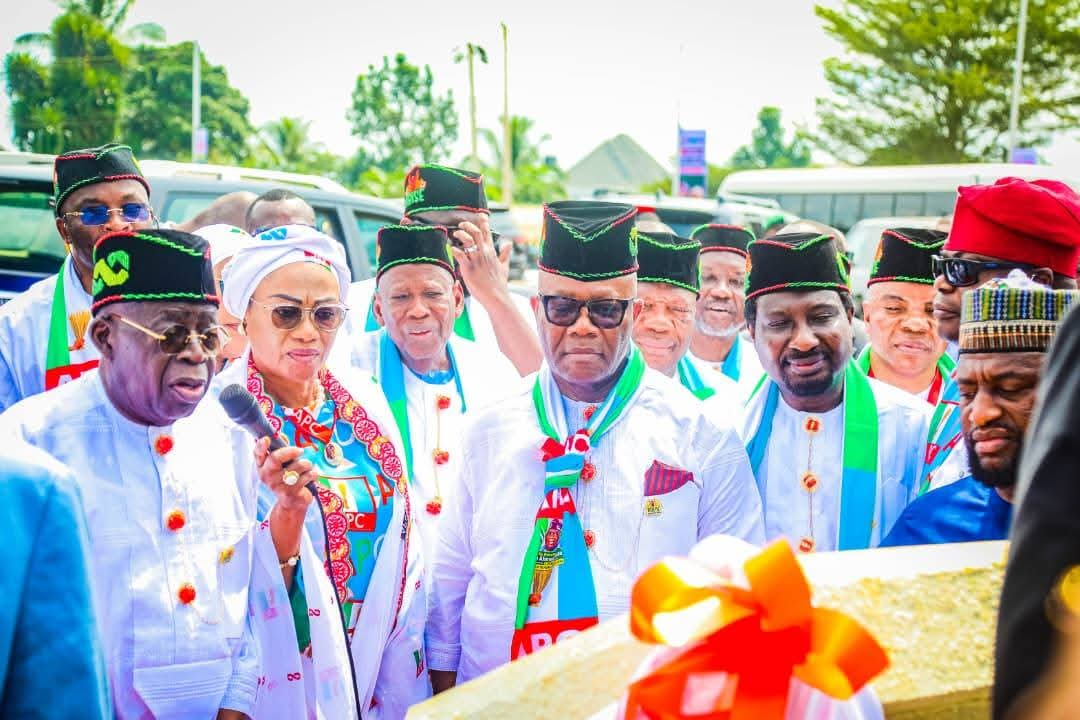
When President Bola Ahmed Tinubu singled out Dr Abdullahi Umar Ganduje for commendation during the APC presidential campaign visit to Akwa Ibom State, his remarks went beyond a simple recognition of an old political ally. They brought attention to the role the former Kano State governor played in managing the affairs of the ruling party during a politically demanding period.
Describing Ganduje as his “dear very good friend”, Tinubu acknowledged his contribution to building a united APC, placing him among party leaders he considered dependable, reliable and honest.
“You can roll down from the former chairman of our party, Umar Ganduje, my dear very good friend, and many other characters there who have led and put together a united APC, people of great dependency, reliability and honesty,” the President said.
The statement has renewed interest in Ganduje’s time as national chairman and the political decisions that shaped his leadership between August 2023 and June 2025.
When Ganduje assumed the position on August 3, 2023, he took charge of a party that had just won the presidential election but was still dealing with internal disagreements, competing interests and the challenge of keeping its diverse political structures together.
Read Also:
Kaduna rally: How Ganduje fits into Tinubu’s northern political strategy
2027: Ganduje and APC heavyweights prepare for a defining political contest
PDP defunct: Ganduje revisits Nigeria’s political history
Having served as governor of Kano State for eight years, Ganduje was not new to the demands of party politics. His experience in managing political alliances and navigating disagreements within the APC became an important part of his approach to the national assignment.
From the outset, he placed considerable emphasis on party unity, reconciliation and strengthening the party’s structures across the country. His argument was that electoral victories alone could not guarantee the long-term strength of the APC; the party also needed to maintain the confidence and participation of its members.
Expanding the party’s political base
One of the notable developments during Ganduje’s tenure was the expansion of the APC’s political base, particularly through the entry of prominent politicians from opposition parties.
The movement of political figures into the ruling party became increasingly visible in the South-South, where the APC made significant gains. Among the prominent entrants were Delta State Governor Sheriff Oborevwori and Akwa Ibom State Governor Umo Eno, whose decisions to join the party attracted considerable political attention.
These developments strengthened the APC’s presence in a region where it had traditionally faced stiff opposition.
While the decisions were influenced by different political considerations, the party’s leadership under Ganduje had the responsibility of managing the new entrants and integrating them into its existing structures.
The challenge was not simply to welcome new members but to accommodate their interests without alienating those who had remained with the party over the years.
Reconciliation as a priority
Perhaps one of the most demanding aspects of Ganduje’s chairmanship was managing disagreements within the APC.
The party had experienced internal disputes in several states, with disagreements among influential stakeholders sometimes threatening its electoral preparations.
Ganduje approached these challenges through consultations and reconciliation, recognising that unresolved disputes could weaken the party’s chances in subsequent elections.
The crisis in Ondo State, involving the late Governor Rotimi Akeredolu and his deputy, Lucky Aiyedatiwa, was one of the issues that tested the party’s leadership. Efforts were made to ease tensions and prevent the disagreement from further affecting the APC’s political fortunes in the state.
In February 2025, Ganduje also spoke publicly about the party’s reconciliation efforts, explaining that the leadership was engaging aggrieved members and encouraging dialogue to address internal disagreements.
His administration equally sought to bring party activities closer to members at the grassroots. The inauguration of campaign councils in different states, rather than concentrating such activities in Abuja, was part of the effort to involve local stakeholders and strengthen participation.
For Ganduje, keeping the APC together required more than meetings among national leaders. It meant maintaining contact with members and stakeholders across the country’s political landscape.
Electoral victories during his tenure
Ganduje’s period as national chairman also coincided with a number of important governorship elections.
The APC retained Kogi and Imo States, won Ondo State and secured victory in Edo State, where it returned to power after losing the previous election to the Peoples Democratic Party (PDP).
These victories provided the party with further opportunities to consolidate its presence across the country.
Although election outcomes depend on several factors, including candidates, local political dynamics and the choices of voters, the national leadership played a role in coordinating party activities and supporting the campaigns.
The results therefore formed part of the political record of Ganduje’s administration.
Beyond elections: Building the party’s structures
Away from election campaigns, Ganduje also pursued initiatives aimed at improving the APC’s internal organisation.
His administration promoted electronic membership registration to improve the party’s membership records and provide a more reliable database for planning and administration.
The party also worked towards strengthening its presence at the grassroots, with the inauguration and operation of offices across its 8,813 wards nationwide.
Another initiative was the proposed National Institute of Progressive Studies (TPI), conceived as a platform for political education, research and the promotion of the party’s ideological principles.
The idea reflected the need for a political party with a nationwide presence to invest in political education and institutional development, rather than concentrating its activities only around election periods.
Such efforts were part of Ganduje’s broader approach to making the APC more organised and better positioned to manage its expanding political interests.
A challenging assignment
His tenure, however, was not without difficulties. His emergence as national chairman generated disagreements among some party stakeholders, particularly over the zoning arrangement that brought him from the North-West after his predecessor, Abdullahi Adamu, from the North-Central, resigned.
There were also internal disagreements and competing political interests that tested his ability to maintain cohesion.
Managing a party as diverse as the APC was never going to be an easy assignment. Its membership included politicians with different backgrounds, ambitions and political calculations, all seeking relevance within the same political platform.
Ganduje’s approach largely centred on consultation, negotiation and reconciliation, although not every disagreement was resolved during his time in office.
He eventually resigned as national chairman in June 2025, bringing an end to a tenure that had witnessed political expansion, electoral contests and efforts to strengthen the party’s internal structures.
The significance of Tinubu’s recognition
Tinubu’s commendation in Akwa Ibom provides an opportunity to look back at that period and examine Ganduje’s place in the APC’s recent political history.
His reference to the former chairman as one of the leaders who helped put together a united party speaks to the importance of political organisation and the management of competing interests within a governing party.
For Ganduje, the assignment was another chapter in a political career that had already taken him through several levels of public service, including his eight-year tenure as governor of Kano State.
His experience in Kano, where he managed party structures and political alliances, became part of the background he brought to the national leadership of the APC.
Whether viewed through the party’s electoral record, its expansion into new political territories or its efforts at reconciliation, his chairmanship remains an important period in the APC’s development.
Tinubu’s words may have been brief, but they have drawn attention to a wider story, that Ganduje’s role in managing the ruling party at a time when keeping its different interests together was just as important as winning elections.

Kano Ex-Commissioners Mourns Lamin Sani’s Mother, Offer Prayers

UNIJOS breaks 50-year barrier, names Patricia Lar first female VC

Pastor Buru Recognises JNI Leader’s Contributions to Peace, Religious Tolerance

NDC’s Gwarzo unveils campaign leadership, picks Sagagi as DG

Kano proposes ₦1.1trn 2027 budget, earmarks 74.5% for five key sectors
ABCOAD Unveils Journal, Bids Farewell to Provost
2027: NDC Releases Full List of Consensus Candidates in Kano

Nigerian Army Begins DSSC 29/2026 Recruitment, Outlines Eligibility Criteria

Gaya Polytechnic Opens Recruitment, Advertises 46 Academic, Non-Academic Positions