Feature
Beyond the APC: Matching Ganduje’s Experience with Nigeria’s Next National Need

By Umar Idris Shuaibu
Politics is often driven by timing, loyalty and competence. Yet history repeatedly demonstrates that the most enduring public servants are not necessarily those who occupy the loudest offices, but those whose experience equips them to solve complex national challenges whenever duty calls.
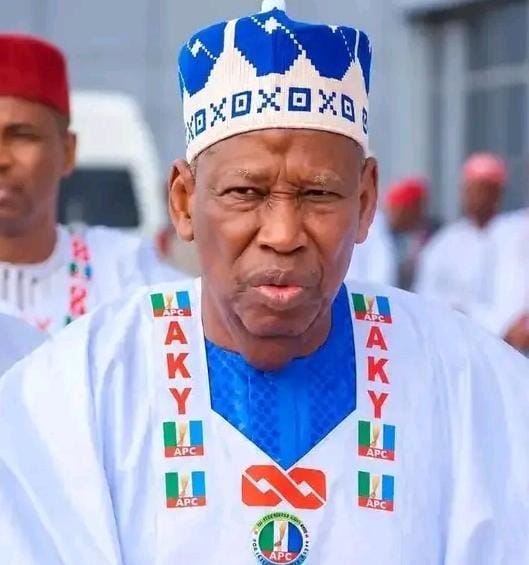
It is against this backdrop that conversations continue to emerge around the future role of former Kano State Governor and former National Chairman of the All Progressives Congress (APC), Dr. Abdullahi Umar Ganduje.
Much of the public discourse has centred on whether he could serve as Chief of Staff to President Bola Ahmed Tinubu. While supporters advance arguments in favour of such a possibility, reducing Ganduje’s wealth of experience to a single office arguably understates the breadth of his administrative and political credentials.
Ultimately, appointments into the Federal Executive remain the exclusive constitutional prerogative of President Bola Ahmed Tinubu. However, national conversations about experienced public servants should be guided by competence and institutional value rather than speculation around a single position.
Related:
Ganduje, Kuku and the transformation of Nigeria’s airports
Unlike many, Ganduje left no major project behind
Emulating Grassroots Empowerment: Lessons from Professor Hafsat Ganduje’s Model
Indeed, several strategic national assignments could benefit from Ganduje’s decades of experience in governance, public administration, party organisation and political consensus-building.
Long before becoming Governor of Kano State, Ganduje had established himself within Nigeria’s administrative system.
His service in the Federal Capital Development Authority (FCDA), his appointment as Sole Administrator in Abuja, and later as Executive Secretary of the Lake Chad Basin Development Authority exposed him to policy implementation, bureaucratic coordination and federal administration.
Those assignments demanded strategic planning, institutional coordination and executive discipline, qualities that remain relevant across several senior government positions.
His academic credentials equally reinforce this profile.
Holding a doctorate in Public Administration, Ganduje combines practical governance with academic understanding of public sector management, institutional reforms and administrative leadership.
His years as Deputy Governor and later Governor of Kano State further broadened that experience.
Administering Nigeria’s most populous state required balancing political interests, managing complex government institutions and coordinating development programmes across infrastructure, healthcare, education, agriculture and public finance.
For many analysts, this represents executive experience on one of Nigeria’s largest governmental platforms.
Equally significant was his tenure as National Chairman of the APC.
Beyond managing the affairs of the country’s ruling party, Ganduje presided over a period that witnessed remarkable political expansion for the APC. Under his leadership, the party attracted high-profile defections from opposition parties across different regions of the country, strengthening its political dominance ahead of the 2027 electoral cycle.
His supporters often describe his leadership style as a political magnet, that combined dialogue, accessibility and strategic engagement to expand the APC’s national reach while preserving internal cohesion.
Since his exit as National Chairman, some party faithful have openly argued that the APC has struggled to maintain the same momentum in attracting influential political figures into its fold.
Whether or not that assessment is universally shared, it reflects the value many attach to Ganduje’s ability to build bridges, manage competing interests and maintain party unity during politically sensitive periods.
This broader perspective also distinguishes the discussion from recent controversies surrounding the Office of the Chief of Staff to the President.
With public attention currently focused on the ongoing investigations into the Presidential Fiscal Policy and Tax Reform Committee (PFIPC), including the Senate’s decision to await the findings of the Independent Corrupt Practices and Other Related Offences Commission (ICPC) regarding issues linked to the office of the current Chief of Staff, any conversation about Ganduje should not be viewed merely through that narrow lens.
Rather, his supporters argue that his experience qualifies him for a range of strategic national responsibilities whenever the President considers it appropriate.
Trust, after all, remains central to every successful administration.
Presidents typically surround themselves with individuals whose judgement, discretion and administrative competence have been tested over decades of public service.
For Ganduje’s admirers, his long-standing relationship with President Tinubu, consistent support for the Renewed Hope Agenda and extensive political network across Northern Nigeria make him an experienced statesman whose contributions to national development are far from exhausted.
Naturally, democracy thrives on differing opinions.
Some Nigerians may disagree with this assessment or believe that other experienced public servants deserve equal or greater consideration. Such diversity of views is both legitimate and healthy in a democratic society.
Nevertheless, appointments into sensitive national offices should continue to prioritise proven administrative capacity, institutional memory, political maturity and measurable leadership experience over transient political narratives.
As an African proverb reminds us, “The strength of a tree is known by the depth of its roots.”
Whether in advisory roles, national commissions, intergovernmental institutions, strategic policy coordination or other senior responsibilities, the conversation surrounding Dr. Abdullahi Umar Ganduje need not be confined to the Office of the Chief of Staff alone.
For many of his supporters, the more important question is not whether he should continue serving Nigeria, but where his decades of experience can deliver the greatest national value.

Kano spends ₦2.7bn on publicity, honorarium, sitting allowances in six months

Kano Emirate Crisis: 200 CSOs to Honour CP Bakori for Peace Efforts

2027: ‘It’s Time to Pay Tinubu Back,’ Ganduje Tells Supporters

World Post Day: NIPOST highlights digital postcodes, logistics opportunities in Kano

A4A Appoints Abubakar Aminu Ibrahim as Mobilisation Secretary in Kano
ABCOAD Unveils Journal, Bids Farewell to Provost

Nigerian Army Begins DSSC 29/2026 Recruitment, Outlines Eligibility Criteria
2027: NDC Releases Full List of Consensus Candidates in Kano

Gaya Polytechnic Opens Recruitment, Advertises 46 Academic, Non-Academic Positions