
National
Promise to Proof: Tinubu’s Appointees Defend Reforms, Showcase Projects at Kano Roundtable

By Umar Idris Shuaibu
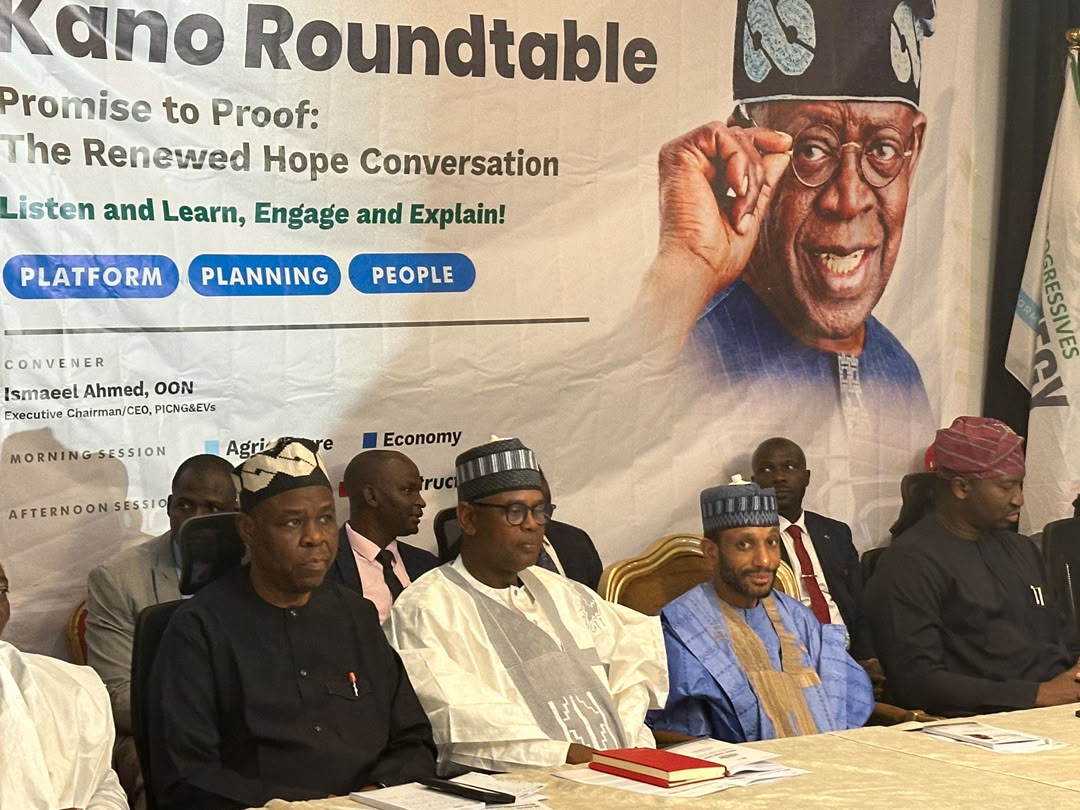
The Kano State Deputy Governor, Alhaji Murtala Sule Garo, and top federal government officials have highlighted ongoing interventions and achievements of the President Bola Ahmed Tinubu administration in agriculture, security, infrastructure and economic development at a strategic roundtable held in Kano.
The engagement, organised by the Progressive Strategic Round Table under the theme, “Promise to Proof: The Renewed Hope Conversation,” brought together representatives of federal and state governments, business leaders, farmers, traders, traditional institutions, civil society organisations and other stakeholders to discuss government policies, assess their implementation and identify practical solutions to challenges confronting the country.
Speaking on behalf of Governor Abba Kabir Yusuf, Garo welcomed participants to Kano and commended the organisers, particularly the convener, Barrister Isma’il Ahmed, for selecting the state as the venue for the engagement.
He described Kano as a major commercial, industrial and agricultural hub of Northern Nigeria, noting that its economic activities have significant implications for the wider region and the country.
The Deputy Governor emphasised the need to modernise agriculture, strengthen security, support industries and expand infrastructure, describing the four sectors as fundamental to economic growth and improved living conditions.
Read Also:
After eight years as governor, why Ganduje still matters in Kano politics
Journalism suffered under Waiya, veteran tells Kano governor
FRSC prohibits political convoy escorts ahead of 2027 elections
On agriculture, Garo called for a transition from traditional farming methods to modern and commercially viable practices, urging farmers to take advantage of the state’s irrigation potential, including its more than 16 dams, to expand dry-season farming.
He said both the Kano State Government and the Federal Government were supporting farmers through the provision of fertilisers, improved seeds and modern agricultural equipment.
He also stressed the importance of storage, preservation, processing and packaging, particularly for perishable agricultural produce such as tomatoes, to minimise post-harvest losses and create opportunities for exports.
The Deputy Governor further advocated the development of modern livestock processing facilities that would enable Kano to process, package and export meat rather than transporting cattle to other parts of the country without fully harnessing the economic benefits of the value chain.
On security, Garo maintained that protecting lives and property was a collective responsibility involving federal, state and local governments, security agencies, traditional rulers, community leaders and citizens.
He acknowledged improvements in security under the Tinubu administration, particularly along major routes linking Kano with Kaduna, Abuja and neighbouring Katsina State, while stressing that sustained collaboration and intelligence gathering remained necessary to address emerging threats.
Addressing economic challenges, he called for stronger support for manufacturers, traders and small businesses, including access to interest-free financing and policies that would ease the burden of taxation on industries and small-scale enterprises.
On infrastructure, Garo commended the Federal Government for ongoing road projects, particularly the Kano-Kaduna-Abuja highway, while acknowledging the Kano State Government’s investments in road construction and rehabilitation.
He also explained that efforts were being made to repair and replace ageing water distribution pipes following the restoration of water supply in parts of Kano metropolis.
Garo urged the organisers to sustain the roundtable beyond the 2027 general elections, stressing that continuous engagement between governments and citizens was essential for responsive governance and lasting development.
In his remarks, the convener of the Progressive Strategic Round Table and Chairman of the Presidential Initiative on Compressed Natural Gas and Electric Vehicles (Pi-CNG & EV), Barrister Ismaeel Ahmed, said the initiative was established to enable federal government appointees, particularly ministers and heads of federal agencies, to engage directly with citizens and explain the policies and programmes of the Tinubu administration.
Ahmed disclosed that President Tinubu had approved the initiative’s expansion across the six geopolitical zones, adding that the organisers had already held an engagement in Abuja before bringing the programme to Kano.
He said subsequent editions would take place in Imo and Lagos states as part of efforts to broaden public participation in national development discussions.
According to him, the roundtable is designed not only to explain government policies but also to listen to citizens, understand their challenges and communicate their concerns to relevant authorities.
Ahmed, who described the Kano engagement as productive, said discussions on agriculture and infrastructure had provided valuable insights into the challenges facing the state and the wider Northern region.
As the 2027 general elections approach, he urged Nigerians to look beyond political sentiments and assess the Tinubu administration based on verifiable achievements and the long-term implications of its economic reforms.
He acknowledged that reforms could be difficult and sometimes painful but maintained that corrective measures were necessary to reposition the country’s economy and secure its future.
Ahmed further explained that the roundtable would continue beyond the elections, insisting that the initiative was intended to establish a sustained platform for dialogue between government and the people.
On whether the administration had fulfilled its promises, he said some commitments had been fully delivered, while others were at different stages of implementation.
Also speaking, the Minister of State for Works, Hon. Bello Muhammad Goronyo, assured Nigerians that the Federal Government remained committed to completing and commissioning the Kano-Kaduna-Abuja highway within the November/December 2026 timeline.
Goronyo disclosed that only about seven kilometres of the project remained to be completed, adding that solar-powered streetlights were being installed to improve security and ease movement along the route.
He described the highway as a strategic road connecting the northern and southern parts of the country, noting that President Tinubu had continued to support its completion.
The Minister said the Ministry would provide further details on federal infrastructure projects in Kano, particularly ongoing road construction and rehabilitation works.
Similarly, the Director-General of the National Agricultural Seeds Council, Hon. Fatuhu Muhammadu Buhari, urged the Kano State Government and farmers to strengthen collaboration with the Council to improve agricultural productivity through the use of quality seeds.
Buhari explained that the Council’s responsibility was primarily regulatory, including overseeing seed production and ensuring that farmers had access to appropriate and certified seed varieties.
He disclosed that the agency regulates approximately 634 seed companies across the country, adding that it provides guidance on improved, drought-resistant and high-yielding varieties suitable for different agricultural conditions.
He said the Council was also implementing a Community Seed Producer programme through which farmers were trained to produce quality seeds locally.
According to him, the programme covers the three major seed classes: breeder, foundation and certified seeds.
Buhari emphasised that using the right seeds and planting them at the appropriate time were critical to improving yields and strengthening food security.
He urged the Kano State Government, particularly its Ministry of Agriculture, to establish closer working relations with the Council, noting that many seed companies were based in Kano and other northern states.
The Director-General stressed that the agency was ready to provide technical guidance and regulatory support to farmers and government institutions seeking to improve agricultural production.
In his contribution, the Managing Director of the Hadejia Jama’are River Basin Development Authority, Engr. Rabi’u Sulaiman Bichi, highlighted the Federal Government’s investments in irrigation and agricultural development under the Renewed Hope Agenda.
Bichi disclosed that the Tinubu administration had allocated more than N78 billion to agricultural activities, with interventions targeting the expansion of irrigable land, rehabilitation of dams, flood and erosion control, and increased crop production.
He said irrigable land under the Authority’s operations had been expanded to approximately 12,000 hectares, while several dams had been desilted to improve water storage and irrigation capacity.
The Managing Director also highlighted the introduction of smart agriculture, the establishment of greenhouses across the river basin areas and efforts to increase crop production, including rice paddy output.
He said the interventions were aimed at improving agricultural productivity, strengthening food security, supporting farmers and maximising the country’s irrigation potential.

Gwarzo appoints Kano Fulani associations chairman to APC 2027 campaign council

Tinubu warns new police officers against oppressing, intimidating Nigerians

Kwankwaso: An Envious Grand Father or an Overwhelmed Vice Presidential Aspirant?

Drama at Abuja mosque as mob attacks Tinubu’s praise singer, Rarara

Why Kano Polytechnic Council Queried Rector Over Financial, Administrative Irregularities
ABCOAD Unveils Journal, Bids Farewell to Provost
2027: NDC Releases Full List of Consensus Candidates in Kano

Nigerian Army Begins DSSC 29/2026 Recruitment, Outlines Eligibility Criteria

Gaya Polytechnic Opens Recruitment, Advertises 46 Academic, Non-Academic Positions

Gaya Polytechnic to Begin with Four Courses as Committee Eyes Year-End Take-Off
-
 Education4 days ago
Kano Polytechnic Council Queries Garun-Danga, Confirms Aikawa, Renews Bursar’s Tenure
-
 Education4 days ago
Kano Polytechnic Council Gives Rector 14 Days to Explain Financial Irregularities
-
Education2 days ago
Why Kano Polytechnic Council Queried Rector Over Financial, Administrative Irregularities