
National
Senate backs state police, assigns commissioner appointment powers to governors

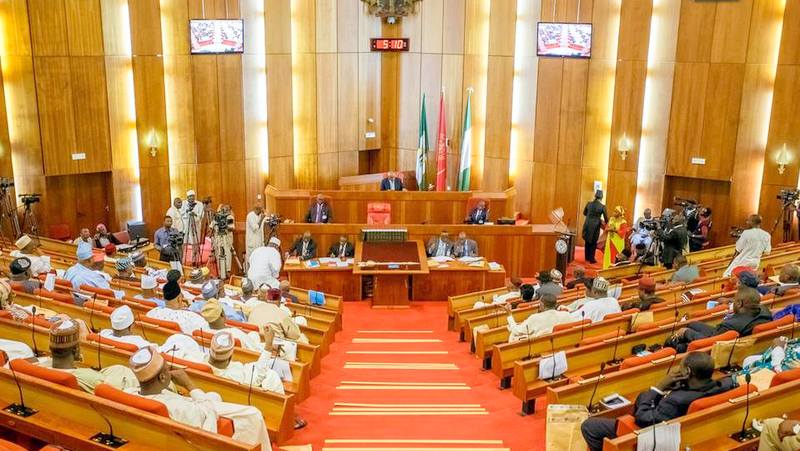
The Senate on Wednesday passed the Constitution Alteration Bill seeking to establish state police across the federation, marking a significant milestone in Nigeria’s long-standing efforts to decentralise policing and strengthen internal security.
The landmark legislation was approved after a clause-by-clause consideration of the bill and a manual voting exercise in which more than two-thirds of senators voted in support of the proposal.
Senate President, Godswill Akpabio, announced the passage of the bill following overwhelming support from lawmakers during plenary.
The upper chamber adopted the report of the Senate Committee on the Review of the Constitution, presented by Deputy Senate President and Chairman of the Committee, Barau Jibrin, before proceeding to the final vote.
Read Also:
Tinubu Approves New Tenure Extension for Customs Comptroller-General
Meet Prof. Ogunsakin and His Team on State Police Creation
Customs intercepts 1,996 kegs of smuggled vegetable oil, other prohibited goods
Leading debate on the bill, Senate Leader Opeyemi Bamidele described the proposal as a critical reform aimed at addressing Nigeria’s security challenges through a more decentralised policing structure.
The legislation seeks to establish state police formations that would operate alongside the existing federal police system, effectively ending the exclusive control of policing by the Federal Government.
A major provision of the bill empowers state governors to appoint Commissioners of Police for their respective states, subject to confirmation by the State Houses of Assembly.
Under the proposed constitutional amendment, while the Federal Police Service will continue to be headed by the Inspector-General of Police, each State Police Service will be led by a Commissioner of Police appointed by the governor and confirmed by the state legislature.
The bill also provides that governors may issue lawful written directives of a general policy nature to Commissioners of Police on matters relating to public safety and order within their states.
To address concerns over possible abuse of state police by political officeholders, lawmakers included safeguards designed to protect civil liberties and political freedoms.
One of the provisions stipulates that a state Commissioner of Police shall not arrest, detain, investigate or deploy force against any individual, political party or group solely for criticising the government, except in accordance with the law.
The provision is aimed at preventing the use of state police formations against political opponents, journalists, activists and other dissenting voices, while ensuring adherence to due process and constitutional protections.
Earlier during plenary, the Senate abandoned plans to deploy an electronic voting system for consideration of the State Police Bill and other constitutional amendment proposals following concerns over technical glitches that could affect participation.
Lawmakers subsequently adopted a manual voting process after a motion by Bamidele, who argued that every senator should have an equal opportunity to participate in the historic exercise.
Akpabio supported the proposal, noting that an open voting process would enhance transparency and allow Nigerians to know the positions of their representatives on key constitutional matters.
The proceedings were witnessed by several high-profile government officials, including the Governor of Kaduna State, Uba Sani; the Governor of Ogun State, Dapo Abiodun; the Governor of Ondo State, Lucky Aiyedatiwa; and the Chief of Staff to President Bola Ahmed Tinubu, Femi Gbajabiamila.
The successful passage of the State Police Bill represents one of the most far-reaching constitutional reforms undertaken by the 10th National Assembly and is expected to significantly reshape Nigeria’s security architecture if it secures the required approval of State Houses of Assembly and completes other constitutional processes.
Supporters of state policing have consistently argued that the current centrally controlled police structure is overstretched and inadequate in addressing the growing threats of terrorism, banditry, kidnapping, communal conflicts and other crimes across the country.
Although critics have raised concerns about possible political misuse of state police by governors, proponents maintain that the safeguards embedded in the legislation provide adequate protection against abuse.
With the Senate’s approval, Nigeria has moved a step closer to establishing state-controlled police services operating alongside the federal police system in what many observers regard as a historic step toward strengthening grassroots security and law enforcement.

CITAD plants 625 trees in 1 million tree campaign, flags seedling shortage

FG declares Thursday public holiday

AHIP trains stakeholders on risks of irregular migration

PCACC arrests suspect over sale of Kano Govt horse stable

Katsina takes governance to 361 wards with community development programme

ABCOAD Unveils Journal, Bids Farewell to Provost

Nigerian Army Begins DSSC 29/2026 Recruitment, Outlines Eligibility Criteria

2027: NDC Releases Full List of Consensus Candidates in Kano

Gaya Polytechnic Opens Recruitment, Advertises 46 Academic, Non-Academic Positions