National
FG Begins State Police Implementation, Gbajabiamila Heads Drafting Committee

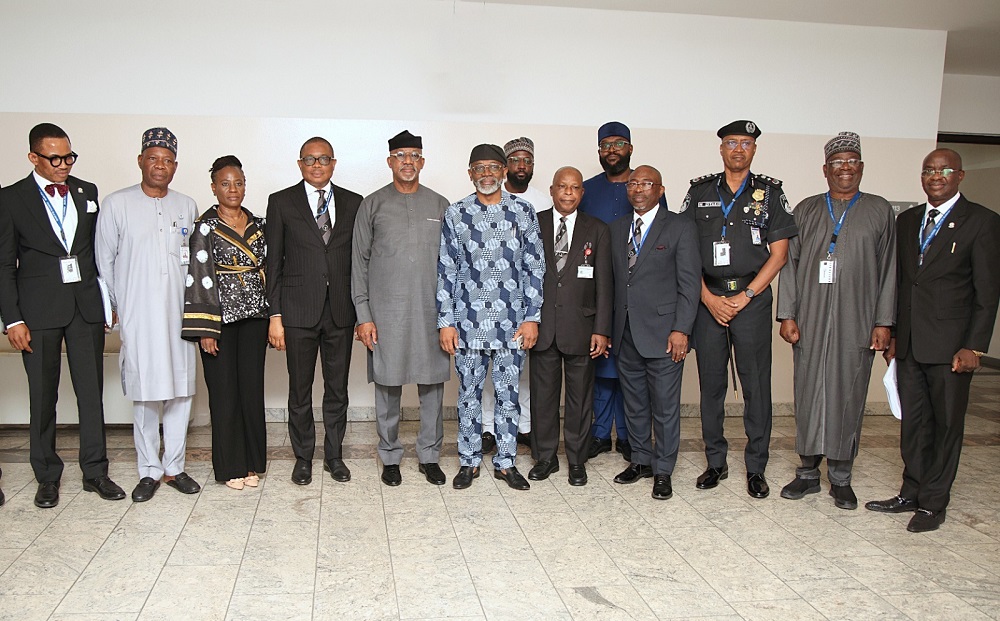
President Bola Ahmed Tinubu has inaugurated a seven-member Presidential Working Group to prepare the National Policing Bill that will provide the legal framework for the implementation of state police across Nigeria.
The committee, chaired by the President’s Chief of Staff, Femi Gbajabiamila, was inaugurated on Tuesday at the Presidential Villa, Abuja. President Tinubu, who was represented by Gbajabiamila, said the move demonstrates the administration’s determination to fast-track the implementation of state policing once the ongoing constitutional amendment process is completed.
The working group comprises the Attorney-General of the Federation and Minister of Justice, Lateef Fagbemi (SAN); the President of the Nigerian Bar Association (NBA), Afam Osigwe (SAN); the Chairman of the Nigeria Governors’ Forum (NGF); the National Security Adviser; the Inspector-General of Police; and the Chairman of the NGF Committee on State Police. A secretariat will provide administrative support to the panel.
The inauguration follows the recent passage by the National Assembly of the Constitution Alteration (State Police) Bill, 2026, which seeks to establish a dual policing structure comprising the Federal Police Service and 36 State Police Services.
Read Also:
NDC demands Gbajabiamila’s removal over PFIPC scandal
PFIPC: More questions than answers as presidency faces mounting pressure
Why the fake presidency agency case raises questions about internal controls
Speaking at the inauguration, President Tinubu explained that while the constitutional amendment creates the legal foundation for state policing, a separate National Policing Bill is required to provide the operational framework.
“The Constitution Amendment Bill establishes the framework for dual policing, but it does not operationalise it. That work is left to the National Policing Bill,” the President said.
According to him, the proposed legislation will address critical issues, including minimum policing standards, certification of states’ readiness, coordination between federal and state police authorities, accountability mechanisms, human rights safeguards, and funding arrangements.
Tinubu said the committee had been constituted to produce a technically sound and implementation-ready draft bill for transmission to the National Assembly immediately after the constitutional amendment process is concluded.
“We must not wait until the constitutional process is concluded before beginning this important assignment,” he added.
Speaking on behalf of the Nigeria Governors’ Forum, Ogun State Governor Dapo Abiodun pledged the support of all 36 state governors toward ensuring the speedy implementation of the reform.
He assured that governors would work with their respective State Houses of Assembly to facilitate the ratification of the constitutional amendment once transmitted.
Abiodun described the proposed state police as a response to longstanding calls for community-based policing, noting that the reform would strengthen grassroots security architecture across the country.
He also cited the success of regional security outfits such as Amotekun in the South-West as evidence that decentralised policing can improve security outcomes.
According to him, if each state recruits about 6,000 police personnel, Nigeria could add nearly 200,000 officers to complement the existing federal police force.
The Attorney-General of the Federation and Minister of Justice, Lateef Fagbemi (SAN), described the initiative as timely in view of the country’s prevailing security challenges.
“There is no denying the fact that we are in a critical moment security-wise, and all hands must be on deck,” Fagbemi said.
He appealed to state governors to ensure the speedy ratification of the constitutional amendment by their respective legislatures.
Also speaking, the President of the Nigerian Bar Association (NBA), Afam Osigwe (SAN), reaffirmed the association’s support for the establishment of state police, saying Nigeria can no longer rely solely on one central police force to meet its growing security demands.
He, however, stressed the importance of building strong legal safeguards into the proposed legislation to prevent abuse of state police powers.
“We must ensure we do not create a monster. The right legal framework must guarantee accountability and prevent oppression,” Osigwe stated.
He pledged the NBA’s commitment to supporting the committee in developing legislation that strengthens national security while protecting the rights and freedoms of Nigerians.
The inauguration marks another significant milestone in the Federal Government’s ongoing efforts to reform Nigeria’s security architecture and establish a more decentralised policing system aimed at addressing evolving security challenges across the federation.

2027: ‘It’s Time to Pay Tinubu Back,’ Ganduje Tells Supporters

World Post Day: NIPOST highlights digital postcodes, logistics opportunities in Kano

A4A Appoints Abubakar Aminu Ibrahim as Mobilisation Secretary in Kano

World Post Day: Postal network eyes new opportunities as NIPOST goes digital

Kano family seeks urgent help after five children die in seven days
ABCOAD Unveils Journal, Bids Farewell to Provost

Nigerian Army Begins DSSC 29/2026 Recruitment, Outlines Eligibility Criteria
2027: NDC Releases Full List of Consensus Candidates in Kano

Gaya Polytechnic Opens Recruitment, Advertises 46 Academic, Non-Academic Positions