National
NESREA raids illegal donkey abattoirs as FG backs donkey farming

By Umar Idris Shuaibu
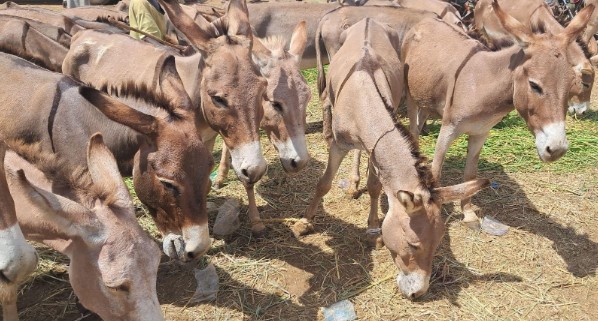
The National Environmental Standards and Regulations Enforcement Agency (NESREA) has shut down two clandestine commercial donkey abattoirs in Adamawa State, raising fresh concerns over the growing illegal trade in donkey skins destined for the international ejiao market, even as the Federal Government intensifies efforts to promote sustainable donkey farming and conservation across Nigeria.
The facilities, located in Muchalla and Kwanta Muchalla villages in Gombi Local Government Area, were sealed following an intelligence-led operation by the agency after credible information was received from local whistleblowers.
Coordinator of NESREA’s Adamawa Field Office, Abubakar Aliyu, said investigations revealed that the two facilities were operating on a commercial scale, with more than 20 workers engaged in the slaughter and processing of donkeys.
According to the agency, about 50 donkeys were slaughtered weekly at the two locations, translating to an estimated 2,600 animals annually.
Read Also:
Defence Headquarters to Establish Large-Scale Livestock Enterprise in Plateau
Ministry of Livestock Commissions 2,000-Litre Milk Collection Centre in Bauchi
300-Year-Old Kano Farming Settlement Faces Extinction Over Sand Mining
Aliyu disclosed that the manager of the facilities, identified as ThankGod Stumpit, claimed the business had operated for four years and possessed permits allegedly issued by the Gombi Local Government Council, the Adamawa State Ministry for Livestock and the Gombi Chiefdom.
However, NESREA maintained that the operations violated federal environmental regulations and national laws governing environmental protection and wildlife conservation.
The agency explained that the illegal slaughterhouses were primarily supplying donkey skins to the lucrative international ejiao market rather than processing the animals for local consumption.
Ejiao, a gelatin extracted from donkey skins, is widely used in traditional Chinese medicine and luxury cosmetic products, creating a global demand that conservationists say is threatening donkey populations across Africa.
Environmental experts estimate that the global ejiao industry requires about 4.8 million donkey skins annually to sustain production, a demand that has fuelled illegal slaughter, theft and cross-border smuggling of donkeys in several African countries.
NESREA warned that the continued depletion of donkey populations poses serious economic consequences for rural communities, where the animals remain indispensable for transporting water, farm produce, firewood and other household needs.
The agency noted that the disappearance of working donkeys often places additional physical and economic burdens on farming families, particularly women and children, while negatively affecting agricultural productivity and rural livelihoods.
The development mirrors similar experiences in East Africa, where Kenya imposed a nationwide ban on donkey slaughter in 2020 after licensed abattoirs drastically reduced the country’s donkey population within a few years. Other countries, including Tanzania and Ethiopia, have also tightened regulations to curb the illegal donkey skin trade.
Meanwhile, the Federal Government has reaffirmed its commitment to developing Nigeria’s donkey industry through regulated breeding, conservation and investment. During a meeting with the National Association of Donkey Farmers of Nigeria, the Minister of Livestock Development, Idi Mukhtar Maiha, said donkeys remain vital to rural livelihoods, serving as an important means of transportation and supporting smallholder agriculture in many communities across the country.
Maiha said the ministry would partner with the association to strengthen donkey farming through funding, research, disease control and the establishment of breeding programmes. He added that the government also plans to develop policies that would encourage sustainable donkey production while promoting legitimate commercial opportunities, including regulated processing and export of donkey skins.

The minister further disclosed that the Federal Government is reviewing existing legislation to curb illegal donkey trading and slaughter, noting that unregulated activities pose a serious threat to the country’s donkey population. He stressed that the ministry would engage stakeholders to better understand the challenges confronting donkey farmers and users with a view to developing practical solutions for the sector.
Also speaking, President of the National Association of Donkey Farmers of Nigeria, Abubakar Kagu, expressed concern over the declining donkey population, which he attributed to uncontrolled slaughter, illegal trade and the absence of structured breeding, conservation and management programmes.
Kagu called on the government to formulate clear policies on donkey breeding and establish multiplication centres in major donkey-producing areas, while commending the Ministry of Livestock Development for its efforts to promote livestock production and management in Nigeria.
NESREA said it would intensify surveillance across Adamawa and neighbouring states, warning that any facility found engaging in illegal donkey slaughter would face immediate closure and prosecution.
The agency also urged rural communities to safeguard their working animals and report suspicious activities, stressing that the long-term economic value of donkeys far outweighs the short-term financial gains offered by the illegal skin trade.

CITAD plants 625 trees in 1 million tree campaign, flags seedling shortage

FG declares Thursday public holiday

AHIP trains stakeholders on risks of irregular migration

PCACC arrests suspect over sale of Kano Govt horse stable

Katsina takes governance to 361 wards with community development programme
ABCOAD Unveils Journal, Bids Farewell to Provost

Nigerian Army Begins DSSC 29/2026 Recruitment, Outlines Eligibility Criteria

2027: NDC Releases Full List of Consensus Candidates in Kano

Gaya Polytechnic Opens Recruitment, Advertises 46 Academic, Non-Academic Positions