








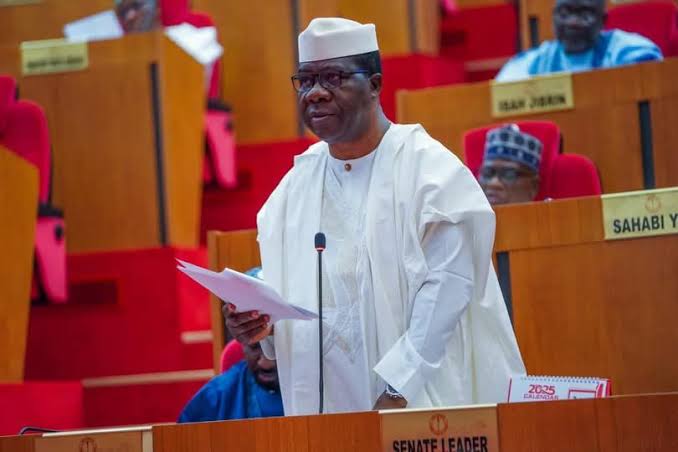
The House of Representatives has passed a bill seeking the establishment of state police for further legislative action, marking a significant step in ongoing efforts to reform Nigeria’s security architecture and address the country’s growing security challenges.
The proposal, considered under HB 617, was approved during plenary on Thursday through a voice vote presided over by Speaker Abbas Tajudeen.
The bill forms part of the ongoing constitutional amendment process aimed at decentralising policing and strengthening internal security in response to rising incidents of terrorism, banditry, kidnapping, and other violent crimes across the country.
Proceedings commenced with more than 290 lawmakers in attendance.
The House Leader, Prof. Julius Ihonvbere (APC, Edo), moved a motion seeking the suspension of House rules to allow consideration of a motion on the rescission of an earlier decision regarding the presentation of reports by the Committee on Constitution Review.
Read Also:
Meet Prof. Ogunsakin and His Team on State Police Creation
Associate Professor Amina Ganduje’s Quiet March into Nigeria’s Intellectual Elite
Photos: FG, North-West Governors, Development Partners Unite on Social Protection Agenda
The motion was seconded by the Minority Leader, Hon. Fred Agbedi (PDP, Bayelsa), and was subsequently adopted.
Following the adoption, the House proceeded to deliberate on the security-related constitutional amendment bill.
Speaker Abbas Tajudeen explained that lawmakers chose to prioritise the state police proposal because of its urgency and relevance to the nation’s security situation.
He also noted that the decision was informed by the House’s planned two-week end-of-legislative-year recess, which would provide members with sufficient time to study other constitutional amendment bills before deliberations resume.
During the session, the Speaker announced that the electronic voting system was not functioning, necessitating the use of a manual voice vote.
Presenting the bill, the Deputy Speaker and Chairman of the House Committee on Constitution Review, Benjamin Kalu, described the proposal as a timely response to Nigeria’s worsening security challenges.
Kalu argued that the existing centralised policing structure has often resulted in delayed responses to security threats because operational decisions are concentrated at the federal level.
According to him, state police would improve intelligence gathering and emergency response by allowing officers who understand local languages, geography, culture, and community dynamics to handle security issues within their respective states.
He urged lawmakers to view the proposal as a landmark reform capable of strengthening national security beyond conventional military interventions.
Kalu further maintained that the bill reflects growing national consensus on the need for security decentralisation and improved grassroots policing.
Following deliberations, Speaker Tajudeen ruled that the bill would be considered based on its long title rather than clause-by-clause consideration.
A manual count conducted after the vote showed overwhelming support for the proposal, with 289 lawmakers voting in favour and only four members opposing it.
The outcome effectively cleared the bill for further progression within the constitutional amendment process.
Following its passage, the House adjourned plenary until July 7, allowing lawmakers to embark on their end-of-legislative-year break and return to their constituencies.
The Speaker said the recess would also provide members with adequate time to review other constitutional amendment proposals expected to come before the House upon resumption.
With the approval of the House of Representatives secured, the state police bill will now proceed to the Senate for concurrence.
If passed by the upper legislative chamber, the proposal will be transmitted to the 36 State Houses of Assembly, where it must secure approval from at least two-thirds of the states before it can proceed further.
Upon receiving the required state endorsements, the constitutional amendment will be forwarded to the President for assent before becoming law.
The latest development represents one of the most significant legislative efforts in recent years to restructure Nigeria’s security framework and enhance the capacity of states to tackle emerging security threats.