

The Alliance of Sahel States (AES) has taken another decisive step toward regional integration and media sovereignty with the inauguration of the headquarters of its confederal broadcaster, AES Television, during the bloc’s second summit held in Bamako, Mali.
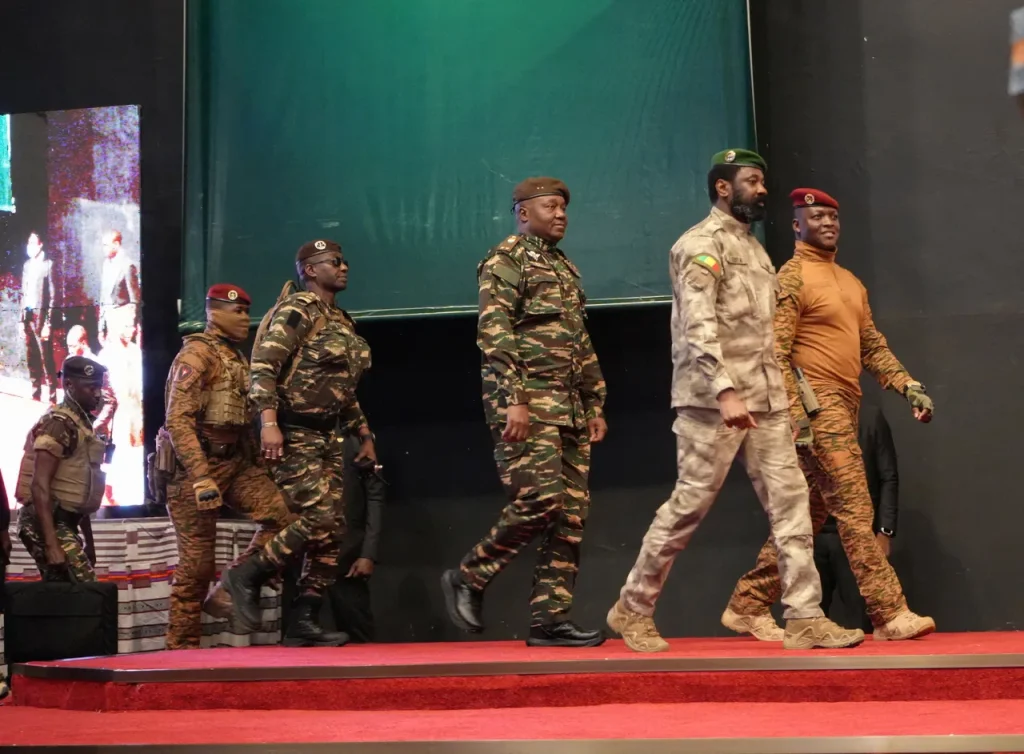
The broadcaster was jointly launched by Malian President General Assimi Goïta, Burkina Faso’s President Captain Ibrahim Traoré, and Niger’s President General Abdourahamane Tiani. Officials described AES Television as a strategic platform aimed at countering disinformation, projecting the Sahel’s own narrative, and strengthening communication among member states.
The inauguration formed part of activities marking the two-day summit, which opened on Monday and focused on reviewing the AES confederation’s first-year roadmap following its formation in 2024. The summit also served as a platform to assess progress, consolidate gains and chart future priorities for the bloc, which formally withdrew from the Economic Community of West African States (ECOWAS) in January.
According to a statement issued by the Burkinabe presidency on Tuesday, the leaders evaluated implementation reports, adopted key decisions to strengthen cooperation, and addressed major political, security and economic challenges confronting the confederation. President Traoré was also scheduled to engage with the Burkinabe community resident in Mali as part of the visit.
Read Also:
FG Engages Burkinabe Authorities Over Detention of NAF Plane, Soldiers
One-Party State Allegations Baseless, APC Governors Tell Nigerians
Tinubu Presents N58.47trn 2026 Budget to National Assembly
The launch of AES Television adds to a growing list of milestones recorded by the alliance within a short period. Earlier this month, the Confederal Bank for Investment and Development (BCID-AES) was established with an initial capital base of 500 billion CFA francs, aimed at financing critical infrastructure, energy and agricultural projects across the three countries, while reducing dependence on external funding.
In the area of security, the AES recently operationalised its Unified Force (FU-AES) on December 20, when President Goïta formally handed over the force’s standard to its new commander. Headquartered in Niamey, the force is expected to comprise about 5,000 troops tasked with coordinated operations against armed groups across the Sahel.
Leaders of the bloc have consistently described these initiatives as practical expressions of sovereignty, self-reliance and collective resilience. They have emphasised that the strength of the AES lies in the unity of its people and the determination of member states to take ownership of their security, economy and information space.
With a combined population of about 78 million people, the AES continues to deepen integration across security, economic development and media, signalling a clear push for greater regional autonomy and a redefinition of cooperation in the Sahel.