The Historica Nigeria

Politics

Abuja, National, Politics

After Gombe Incident, Ganduje Reasserts Call for Political Decorum

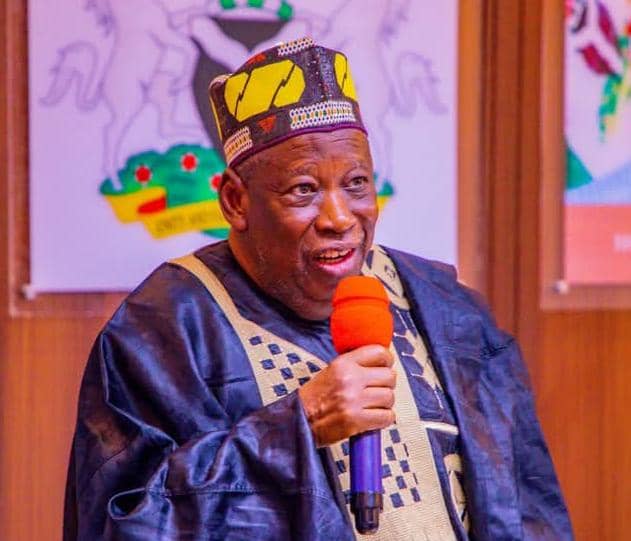
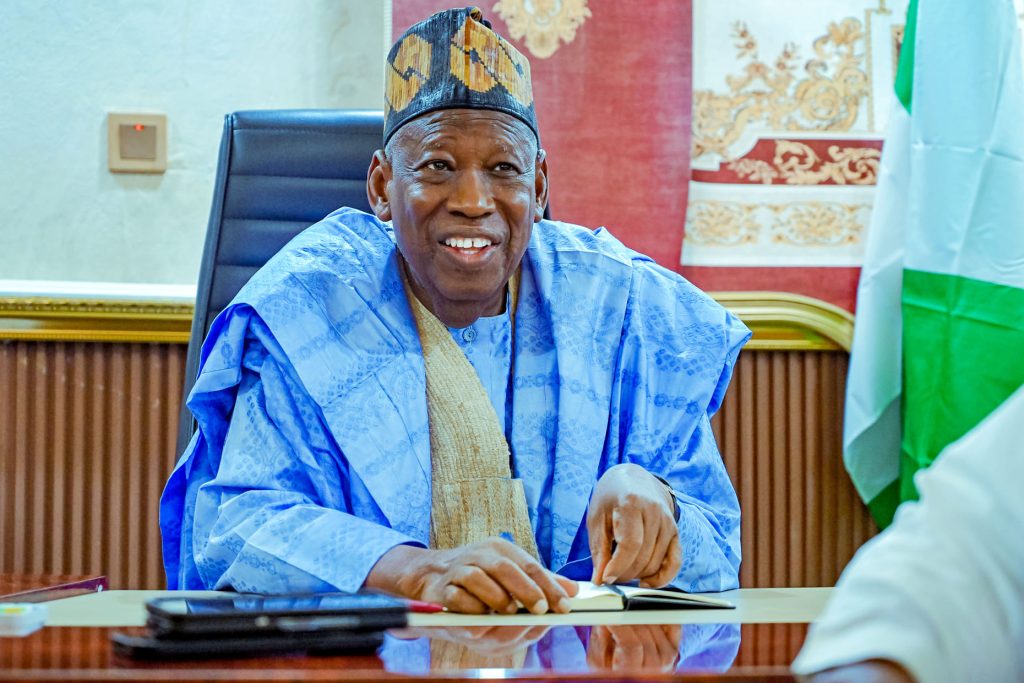
By Umar Idris Shuaibu In what was supposed to be a high-level consultative meeting for stakeholders of the ruling All Progressives Congress (APC) in the North East, a disturbing turn of events unfolded on Sunday in Gombe, when a group of unruly party elements attempted to disrupt proceedings and physically assault the National Chairman of the APC, Dr. Abdullahi Umar Ganduje. What transpired was not just an affront to the man leading the party’s national structure, but a slap to the core values of democracy, civility, and party discipline. Despite the tension, Dr. Ganduje maintained composure, attempting to restore calm and reiterate his unwavering support for the North East zone, a region that produced Nigeria’s Vice President, Senator Kashim Shettima. His appeals for unity and recognition of the constitutional integrity of the Tinubu-Shettima joint ticket were met with recalcitrance from a disruptive faction bent on chaos. Chief Oliver Okpala, Special Assistant on Public Enlightenment to the APC National Chairman, described the act as “condemnable, unpatriotic, and irresponsible.” He warned of the dangerous precedent being set, drawing parallels to the Western Region political crisis that helped precipitate the collapse of Nigeria’s First Republic. Read Also: APC’s Rising Star: The Woman Ganduje Trusted with the Future “How do you treat a man who has laboured round the clock for peace like this?” Okpala asked rhetorically, echoing the sentiments of many party faithful who watched the events unfold with dismay. While some may view the event as isolated, it has ignited deeper reflection within the party and beyond. Dr. Ganduje, a veteran in Nigerian politics, has consistently worked behind the scenes to reconcile aggrieved members, unify party ranks, and deepen the internal democratic process of the APC. His contributions toward building a strong political structure that cuts across ethnic and regional divides are well documented, from his time as governor of Kano State to his current role at the apex chairman of the party. That such a man would be physically threatened while performing his duties as National Chairman is both an aberration and an indictment of those who seek power not through persuasion or consensus but through aggression and political brigandage. Yet, in the face of this provocation, Ganduje did not retaliate. Instead, he reaffirmed his commitment to party discipline, decorum, and dialogue principles that should be the bedrock of modern Nigerian politics. His speech at the meeting was clear: the APC remains one party, under one leadership, with a joint presidential ticket that values every region of Nigeria equally. He reminded the stakeholders that Shettima’s position as Vice President is not symbolic but strategic, and that the North East plays a crucial role in the APC’s national outlook. His attempt to calm tempers did not go unnoticed. Security operatives, acting swiftly, shielded him from what could have easily turned into a national embarrassment. That prompt intervention likely saved the party from descending into a public relations crisis and further disunity. Read Also: Dr. Ganduje Undertakes Hajj Amid Rising Political Influence Across the political spectrum, voices are rising in solidarity with Ganduje. Observers and analysts have described the attack as “politically unwise,” “disrespectful,” and “a shameful display of desperation.” Even within the North East, many responsible party leaders have begun calling for discipline and sanctioning of those responsible. More than ever, Dr. Ganduje’s stature as a leader of peace and unity is being tested, but if history is any indicator, this moment will not weaken him. Rather, it strengthens his resolve to build an APC that is not just electorally dominant, but internally stable, ideologically consistent, and democratically driven. A Call for Political Decency Chief Okpala’s warning must be heeded. Nigeria’s political culture must never tolerate thuggery, particularly within parties that pride themselves on progressivism. It’s not just about Ganduje; it’s about the future of internal party democracy and the need to safeguard our political institutions from the recklessness of fringe elements. As Nigeria’s largest political party, the APC must rise above internal provocations. Leaders across all zones must rally around the values of consultation, consensus, and mutual respect, values that Dr. Ganduje continues to promote in every forum. For now, the dust in Gombe may settle, but the implications remain. Dr. Ganduje, unshaken and unbroken, walks forward with the dignity of a leader focused not on retaliation but on rebuilding trust and reinforcing unity, the kind of leadership the APC, and indeed Nigeria, needs in these times. This piece was written by Umar Idris Shuaibu, a digital journalist based in Kano. He can be reached via email at shuaibuumaridris@gmail.com
Kano, News, Politics

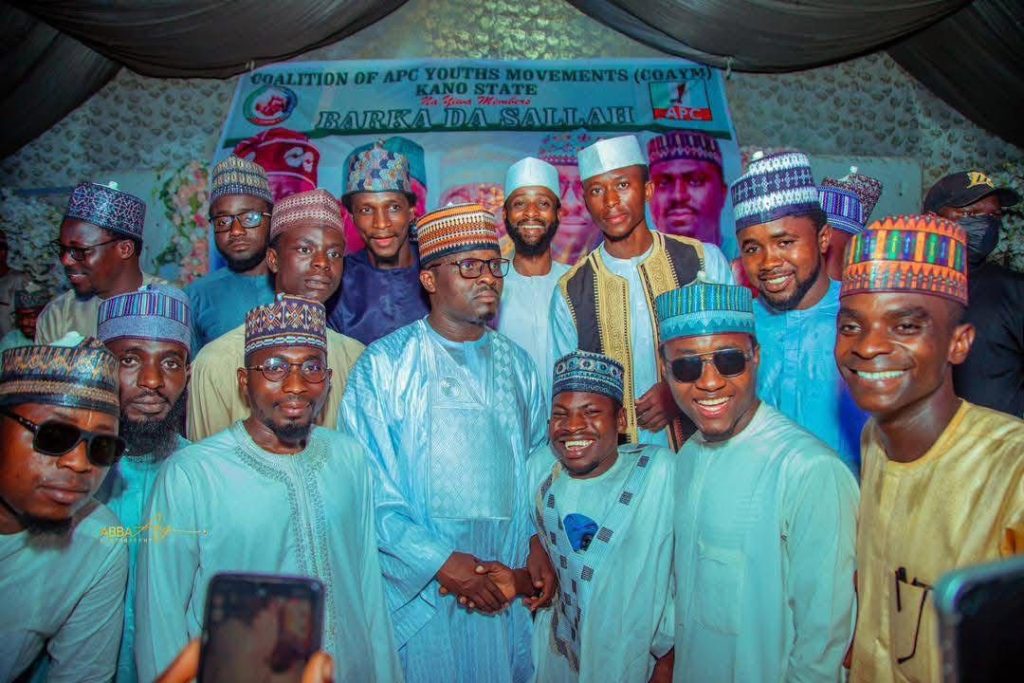
APC Youth Movement Hosts Eid Celebration, Reaffirms Unity under Hon. Adam Mukhtar’s Leadership

In a show of unity and political engagement, the Coalition of APC Youth Movement held a vibrant Eid-el-Kabir (Babbar Sallah) celebration, led by Hon. Adam Mukhtar Unguwar Gini. The event brought together youth members, party stakeholders, and community leaders in a festive atmosphere aimed at strengthening bonds and reaffirming commitment to the party’s core values. Hon. Adam Mukhtar, in his remarks, praised the dedication of the youth, emphasizing the importance of sustained participation and unity within the APC. He urged members to remain committed to grassroots mobilization and the broader goal of national development. Read Also: APC’s Rising Star: The Woman Ganduje Trusted with the Future The celebration served as a platform to deepen political collaboration, promote inclusion, and recognize the contributions of young party members across different levels. Participants expressed appreciation for the initiative and pledged continued support for the movement’s objectives. — Ahmad GogelChairman, APC Eagle Forum (X/Twitter)  

Kano, News, Politics

20 Groups Petition Police Over “Inciting” Statement by Former Kano SSG Usman Alhaji

Twenty organizations across Kano State have submitted a petition to the Inspector General of Police through the Assistant Inspector General of Police in charge of Zone One Kano, against former Secretary to the State Government Alhaji Usman Alhaji over a contents of a press statement dated 30th May 2025, issued under the aegis of the APC Patriotic Volunteers. The petitioners expressed concern over the content of the statement which they said can instigate violence and disturbed public peace. “We, the undersigned concerned citizens and stakeholders of Kano State, write to you with deep concern and a sense of urgency, to formally bring to your attention the contents of a press statement dated 30th May 2025, issued under the aegis of the APC Patriotic Volunteers, and signed by Alhaji Usman Alhaji, former Secretary to the State Government (SSG). Read Also: APC Patriotic Volunteers Misinformation: Where Usman Alhaji Got It Wrong The petitioners accused Alhaji Usman Alhaji of making provocative statements over the demolition of illegal structures at Filin Idi, Daula Hotel premises and Race Course, the Matter which is currently under judicial review. “This statement, in our considered opinion, contains incendiary rhetoric and deliberate distortions that pose a grave threat to public peace, civic unity, and the commendable efforts of the Kano State Government to promote mutual understanding, lawful engagement, and the welfare of its people”. The organization specifically pointed out areas where the former SSG deliberately attempted to provoc the citizens as follows. 1. Deliberate Misrepresentation of the Rimin Zakara Land Dispute** Alhaji Usman Alhaji’s attempt to incite the residents of Rimin Zakara against the Kano State Government over the long-standing land dispute involving Bayero University Kano (a Federal Government institution) is deeply troubling. This dispute, dating back over four decades, is federal in nature, and the Kano State Government has only intervened in a supportive and reconciliatory capacity. To suggest otherwise is not only misleading but also undermines the genuine efforts made by the state government, which include: The constitution of a neutral investigative committee, The payment of compensation to affected individuals, The provision of essential social amenities such as a Primary Health Care Centre, places of worship, and electrification of the community. These actions were carried out in good faith to ensure peace and development in the area. Alhaji Usman Alhaji’s narrative twists these facts and risks fueling unnecessary resentment among the populace. 2. Incitement over Ongoing Legal Matters: The Filin Idi Demolitions** Equally disturbing is his attempt to stoke public unrest over the demolition of illegal structures at Filin Idi, Daula Hotel premises, and Race Course—matters currently under judicial review. By making provocative statements on cases sub judice, Alhaji Usman Alhaji not only undermines the integrity of our judiciary but also risks violating court protocols, potentially amounting to contempt of court. More alarmingly, his remarks appear to be aimed at sowing division, instigating protest, and destabilizing public order. Such conduct is deeply unbecoming of a statesman of his stature and threatens the fragile peace and social fabric of our dear state. It is incumbent upon all leaders, especially former public office holders, to uphold values of truth, unity, and responsibility in their public engagements. OUR HUMBLE REQUEST In light of the above, we respectfully call upon your esteemed office to: i. Thoroughly investigate the statement issued by Alhaji Usman Alhaji and the potential consequences of his actions, ii. Call Alhaji Usman Alhaji (Wazirin Gaya) and his platform, APC Patriotic Volunteers, to order and impress upon them the importance of desisting from actions and utterances that threaten peace and public order, iii. Encourage all political and community leaders to utilize legal and peaceful channels in airing grievances or resolving disputes. “We reaffirm our unwavering commitment to the peace, unity, and development of Kano State, and appeal to all well-meaning citizens to place public interest and harmony above personal or political considerations”. “We trust in your office’s commitment to the preservation of law and order and look forward to swift and decisive action in the interest of peace.” Note: A copy of the press statement is hereby attached. Yours faithfully, Tijjani Sarki Convener Kano Legacy Group Abbas Abdullahi, Secretary Kano Legacy Group The coalition member organizations are: 1. Inter Tribe Community Support Forum – Mr. John Anyawu Chizoro 2. Foundation for the Eradication of Child Abuse – Asma’u Mustapha 3. Women Democracy Monitors – Rahina Sani Usman 4. Fidelity Foundation, Rijiyar Zaki – Ibrahim Khalil Yusuf 5. Youth Movement of Area – Tajuddeen A. 6. Taimakon Juna Youth Development Association – Umar Ahamad Baba 7. Girls Gate Initiative – Amb. Mashkura Abubakar 8. Igbo Community Association – Mr. Michael Nworisa 9. Dakata Community Development Association – Auwalu Alhaji 10. Area Ina Mafita – Bello Umar Faruk 11. Kano Youth Development Political Forum – Sen. Usman Abubakar 12. The Patriot – Usman Garba 13. Arewa Youth Vanguard – Musa Ahmed 14. Kano Youth Enlightenment Forum – Bashir Ahmed Amada 15. Creative Mind Initiative – Rabi Musa Yakubu 16. Arewa Youth Advocate for Good Governance – Asma’u Mohammed Dorayi 17. Progressive Movement of Kano – Kabiru Idris 18. Amputation of Northern Youth Forum – Yusuf Nuhu 19. League of Kano Loyalist – Ibrahim Khalil Hussaini 20. Youth Mobilization – Hajara Musa Ahmed

Abuja, Feature, Kano, National, Politics

APC’s Rising Star: The Woman Ganduje Trusted with the Future

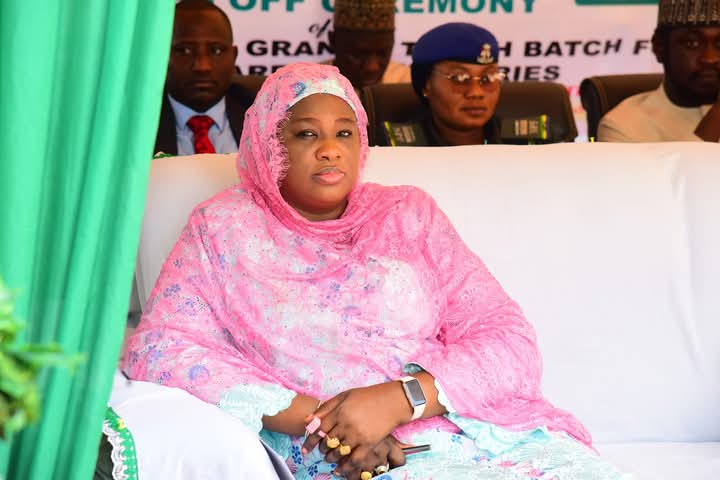
Within the rich tapestry of Nigeria’s public service, few stories reflect consistency, discipline, and rising influence like that of Dr. Mariya Mahmoud Bunkure, the current Minister of State for the Federal Capital Territory (FCT). Her journey from a Commissioner in Kano State to a key figure in Nigeria’s federal cabinet is not just a tale of political ascension, it’s a testament to purposeful service, strategic alignment, and a passion for grassroots development. Born in the historic town of Bunkure in Kano State, Dr. Mariya Mahmoud’s early life was steeped in education, community service, and the values of discipline and humility. Trained as a medical doctor, she brought her professional insights into governance when she was appointed Commissioner for Higher Education in Kano State under the administration of Dr. Abdullahi Umar Ganduje. During her tenure as Commissioner, Dr. Mariya stood out for her calm resolve and administrative foresight. At a time when Kano’s higher education sector was faced with funding challenges, infrastructural gaps, and the need for curricular reform, she championed policies that improved institutional governance and promoted access, especially for female students. Her ability to blend professionalism with political acumen quickly earned her the respect of colleagues and constituents alike. Read Also: Dr. Ganduje Undertakes Hajj Amid Rising Political Influence It was this performance and loyalty that placed her firmly in the trust circle of Dr. Ganduje, then Governor of Kano State and now the National Chairman of the All Progressives Congress (APC). As Ganduje’s national influence widened, so did the prospects of those he mentored. Dr. Mariya’s elevation to the national stage as Minister of State for the FCT under the administration of President Bola Ahmed Tinubu can be traced to a political trajectory rooted in merit, trust, and northern regional representation. At the FCT Ministry, Dr. Mariya now holds a significant portfolio overseeing policy implementation, urban development, and service delivery in Nigeria’s capital. Her approach has been inclusive and participatory, often engaging with stakeholders from traditional institutions, civil society, and the private sector. Whether addressing sanitation in satellite towns, reviewing land allocation procedures, or supervising school health programs, she carries her medical and administrative experience into every detail. Observers note her calm but firm style, which contrasts with the bustling and sometimes chaotic political landscape of Abuja. She is often described as the “silent engine” behind some of the Ministry’s grassroots-focused reforms, particularly those relating to women empowerment and youth engagement in the FCT’s area councils. In the wider context of Nigerian politics, Dr. Mariya Mahmoud’s story also highlights the growing relevance of Kano State as a breeding ground for national leadership. Under Ganduje’s leadership, several Kano-born technocrats and politicians have moved into key federal roles, a sign of the former governor’s long-term strategy to plant loyal, competent allies across the federal structure. Yet, despite her growing influence, Dr. Mariya remains relatively media-shy, choosing to let her work speak for her. Her aides describe her as diligent, prayerful, and deeply committed to public service. “She sees politics not just as a platform for power, but as an opportunity to heal communities, improve lives, and leave a legacy,” one staff member noted. As Nigeria navigates complex national challenges from urban planning to education and healthcare reform, the presence of focused leaders like Dr. Mariya Mahmoud Bunkure provides a glimmer of hope. For young girls in Kano and beyond, her story is a living proof that with education, integrity, and dedication, the journey from Bunkure to Abuja is not just possible, but attainable. Dr. Mariya Mahmoud Bunkure’s rise from the heart of Kano State to the corridors of power in Abuja is a remarkable example of determination, service, and strategic leadership. Her journey underscores the importance of competence over rhetoric, and dedication to public service above personal gain. As the Minister of State for the FCT, she remains an embodiment of the values instilled in her during her years in Kano values that continue to guide her work as she addresses the needs of the capital’s diverse communities. With her vision and quiet resolve, Dr. Mariya is poised to leave an indelible mark on Nigeria’s urban development and public policy, offering a model of leadership for future generations.

Kano, News, Politics

APC Patriotic Volunteers Misinformation: Where Usman Alhaji Got It Wrong

One should’ve overlooked the press briefing by the former Secretary to the Government of Kano State, Alhaji Usman Alhaji under the banner of “APC Patriotic Volunteers”, in which he accused the government of Kano State of lack of clear policy direction, petty sentiments, and incompetence in managing the state affairs. His assessment of the 2-Year NNPP Administration in Kano State, Alhaji Usman Alhaji, was unjustifiably harsh on Alhaji Abba Kabir Yusuf’s administration, accusing it of bad governance and non-performance. However, while ignoring such weighty accusations without clarifications, it will amount to giving it a tacit approval. In essence, it is like supporting the misinformation and distortion of facts. Alhaji Usman Alhaji’s vituperation is like “the ranting of an ant.” As a “political figure’ who held various political positions, there is no doubt experiencing a fall from grace to grass, is indeed painful. It is obvious that he is gasping for political relevance, hoping to bounce back into the circle of politically relevant personalities in the State and in the country, at large. Related: Your Underperformance Allegations Against Kano Govt Baseless, Misleading, Eye On Kano Initiative Replies Usman Alhaji The best way to describe his predicament is the Hausa proverb that says “Tururuwa in taso lalacewa fukafuki ta kan yi,” meaning “if an ant is about to lose relevance, it will develop wings.” A cursory look at Alhaji Usman Alhaji’s political history would reveal like an ant whose time was up, how he has been gradually losing relevance due to his serial election loses and lack of political impact even at the lowest grassroots level. Although Alhaji Usman Alhaji, is a man who has assigned to key important positions in politics. He was General Secretary of National Republican Convention (NRC), a National Political Party. He also served as Education Commissioner in Kano State and later became Secretary to the State Government, yet it was evident all these positions he held were never impactful, as they were all acquired not through dent of hard work but through political consensus and negotiations. All his records of political contests had resulted in failure, a development that perhaps explained his deep frustrations and why he is suddenly drifting to the depths of irrelevance and is currently hanging on a Kangaroo and Mushroom Political Support Group to regain his feet. A further close examination of Alhaji Usman Alhaji’s political life would reveal how he is gradually undergoing a sense of political decline with diminishing relevance and is equally experiencing a fall from prominence to irrelevance. How can a politician who has occupied key positions in political parties at national and state levels lack a visible political structure but are suddenly reduced to holding a banner of a support group? His tale is a perfect description of a person experiencing a significant decline and downfall from a position of success as appointee, holding a position of power and influence to a state of minimal importance, effectiveness and relevance. Read Also: RE: Kano Govt Borrowed $6.6 Million External Loan A politician who has been reduced to such level and is now gasping for air through a pressure group can best be described as someone drifting from political peak to a political pit. The misinformation and distortion of facts he rather chose to profess is perhaps borne out of these political frustrations, which is associated with his sudden decline and irrelevance, as he is currently experiencing. In the year 2007, Alhaji Usman Alhaji ran for the Senate under the People’s Democratic Party (PDP) but lost to Senator Kabiru Ibrahim Gaya. He equally contested for the Senate under the Congress for Progressive Change (CPC) in 2011, yet he lost the election. During the 2015 election, he was one of the most visible aspirants in terms of publicity, but unknown to many, he was a paper tiger, bargaining for an appointment. He stepped down for Dr. Abdullahi Umar Ganduje who was in the gubernatorial election but was compensated with the position of SSG. Psychologists are of the view that the psychological impact of repeated electoral defeats can lead to increased stress and anxiety levels, as they can potentially affect a person’s mental health and decision-making abilities. While serial losses of elections may erode a politician’s confidence and his abilities to perform, it thus makes it more challenging for him to bounce back and regain momentum in his political career. His situation can also lead to the loss of public support and can add to the stress and pressure on his political life and emotional distress, which can be substantial, and can potentially lead to feelings of disappointment, frustration, and despair, as in the case of Alhaji Usman Alhaji, who had a free fall from national relevance to a state of obscurity. For almost eleven years, Alhaji Usman Alhaji had held the position of secretary to the Kano State Government (SSG). The first four years were under Engineer Rabi’u Musa Kwankwaso and the remaining years under Abdullahi Umar Ganduje. Let’s look at his antecedents and performance. His performance has been dismally low, falling short of expectations, with no record of significant achievements and policy direction. Engineer Rabi’u Musa Kwankwaso tolerated him and gave his administration a clear direction, while the Ganduje administration caved into failure along with him. This is a man who was privileged to hold key positions in his educational career and later in political circle, but, one can see how desperate he is holding to a Kangaroo political support group to gain prominence. It’s worth noting that politicians like this are not immune to the emotional and psychological effects of repeated failures. Hence, there is no doubt that Alhaji Usman Alhaji has been the case. His narration is a tale of a politician betraying his State while biting the figures that fed him, showing a difference between dignity and political desperation. However, despite his antics, if you keep your ears to the ground, you will hear the footsteps of NNPP Administration, under Alhaji Abba Kabir Yusuf on education,

Kano, News, Politics

Your Underperformance Allegations Against Kano Govt Baseless, Misleading, Eye On Kano Initiative Replies Usman Alhaji

It is truly baffling how individuals, comfortably seated in their air-conditioned offices and who are detached from the realities on ground, could issue such a watery, unsubstantiated and  misleading statement, under the guise of public commentary. The recent publication by the so-called APC Patriotic Volunteers, led by Alhaji Usman Alhaji the former Secretary to Kano State Government (self acclaimed Wazirin Gaya), reeks of desperation, a feeble attempt to whitewash a sordid past and distract people from the genuine efforts being made by the NNPP-led administration under the capable leadership of His Excellency Engr. Abba Kabir Yusuf. Ideally, APC members should have buried their heads in shame, for the atrocities they had committed, which included: mismanagement and misappropriation of the resources of Kano people, self – enrichment and misuse of public properties. Read Also: Mu’az Magaji: “26 Years of Democracy in Nigeria, A Journey Worth Reflecting On” Let us set the record straight, point by point: 1. Water Supply: Mismanagement and Recovery It is laughable and hypocritical for APC sympathizers to lament water scarcity when the current crisis is the direct fallout of years of neglect, decay, and mismanagement under their watch. The NNPP administration inherited a comatose water infrastructure but is already making measurable progress: i.Procurement of 10  high-capacity water pumps to revamp the state’s water supply system. ii.Drilling of 6 industrial boreholes. Ongoing rehabilitation of distribution networks. Your government never made such strategic or comprehensive interventions. Expecting instant results after years of neglect is unrealistic and disingenuous. 2. Education: From Ruins to Revitalization The APC left Kano’s education sector in a deplorable state  dilapidated classrooms, underpaid and demoralized teachers, zero strategic investment, and no annual increments or promotions. Under Governor Abba Kabir Yusuf: i.A State of Emergency on education was declared. ii.Education budget allocations rose dramatically to 29% in 2024 and 31% in 2025  the highest in Kano’s history. iii.Hundreds of classrooms are being renovated and newly constructed across all LGAs. iv.Recruitment of qualified teachers is underway to fill critical gaps neglected for years. To claim “little to see” is either blatant dishonesty or willful blindness. 3. Demolitions: Restoring Public Purpose Yes, demolitions have occurred,but not out of vindictiveness. They are necessary actions to reclaim illegally acquired public lands. The APC shamelessly converted public assets and green spaces into private estates for cronies, including Filin Idi, Race Course, Kundila Housing Estate, State Road civil servant quarters, and more. Unlike your era of privatization and land grabbing, the current government is restoring these spaces to serve public needs  schools, hospitals, roads, and green areas. This is justice, not chaos. 4. Independent Power Project (IPP): Clarifying the Facts The IPP was not an APC initiative. It was inherited in a fragmented state and was being deliberately dismantled. The NNPP administration intervened to restore the original plan and ensure electricity reaches strategic areas like Kwankwasiyya and Amana Cities. Even if you argue these estates benefit a few, remember that Kwankwasiyya City is the largest single housing estate in Kano state. When completed, it will significantly boost the state’s socio-economic prospects  unlike the empty infrastructure projects under your administration, which served contractors more than the people. 5. Silencing Opposition? Promoting Responsible Media No media house has been banned for airing opposition views. The recent agreement among media executives aimed to curb vulgar, indisciplined, and defamatory political programming that promotes hate speech and misinformation. no fewer than 262 broadcast violations relating to politics and personality attacks were recorded in Kano State within just two months (January–February 2025). Would you prefer we continue down a path that inevitably leads to unrest? 6. Ecological Funds: Tangible Actions There is no dispute about the receipt of ecological funds. The difference lies in tangible project execution: i.Bulbulawa in Ungoggo LGA now has active erosion control works after years of neglect,by your administration. ii.Wailari and several other erosion control projects are ongoing. iii.Drainage rehabilitation and flood prevention are progressing in multiple roads in state capital and some LGAs. If you cannot acknowledge this progress, at least refrain from misleading the public. 7. External Borrowing and Transparency Your administration was infamous for accruing debts without transparency or accountability. We challenge you to publicly disclose: The total debts acquired under the Ganduje administration. Detailed reports on how those debts were utilized. The NNPP administration, unlike yours, has not taken any foreign loans since assuming office. The books are open for public scrutiny. 8. Salary and Pension Irregularities: Accountability in Action Irregularities discovered in April salary payments were promptly addressed with disciplinary actions a hallmark of transparency. Contrast this with your tenure, where: i.Civil servants were often unaware of their exact salary figures. ii.Salaries and pensions were arbitrarily cut. iv.Payroll fraud thrived unchecked with ghost workers on the payroll. v. Under your administration hundreds of pensioners died without receiving their legitimate gratuity after serving the state fir over 30 years. 9. Local Government Autonomy and Emirate Disputes Pretending to champion local government autonomy is hollow when your government controlled all 44 LGAs as mere extensions of the State Executive Council. The current administration is working to ensure LGAs are governed by elected officials, not puppets. Regarding the Emirate dispute, it remains a matter before competent courts. The NNPP government consistently respects the rule of law, unlike your blatant disregard for multiple court rulings during your demolition excesses. 10. Legitimacy and Performance It is irresponsible to brand this government “illegitimate” when INEC declared it the winner and courts upheld the results. Attempts to rewrite history with propaganda only tarnish the APC’s already dwindling reputation in Kano. Instead of bitter attacks, the APC should answer: Why were schools left in ruins? Why was water unavailable for years despite billions spent? Why were public properties sold to cronies? Why were debts piled without meaningful progress? The NNPP-led Kano State Government under Governor Abba Kabir Yusuf may not be perfect, but it is genuinely working  restoring sanity, investing in people, and rebuilding Kano from the ruins your administration left behind. Your desperate attempt to undermine

Abuja, Feature, Kano, Politics, Profile

Barau Jibrin’s Two Years as Deputy Senate President: A Chronicle of Impact

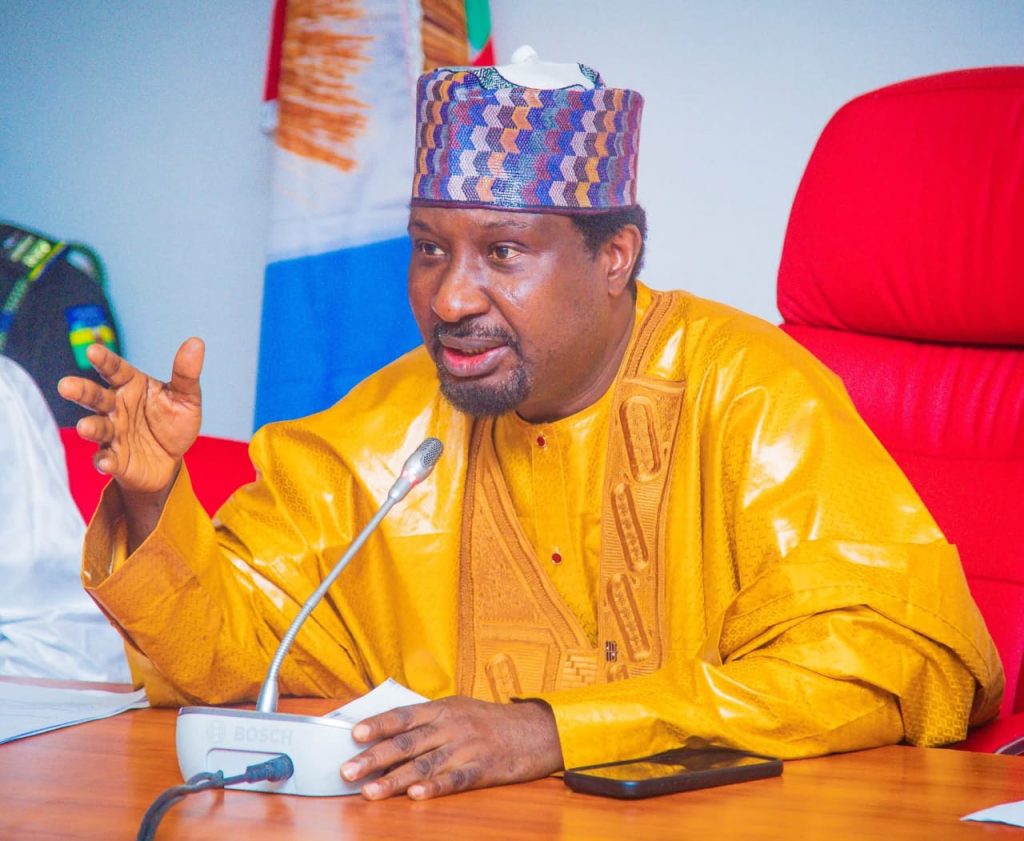
In Nigeria’s complex political landscape, where ambition is often loud and calculated, Senator Barau I. Jibrin, Deputy President of the Nigerian Senate, has charted a different course, one marked by quiet influence, policy depth, and grassroots transformation. From his native Kano North Senatorial District to the floor of the National Assembly in Abuja, Barau has built a legacy grounded in strategic legislative work and visible constituency development. He is widely seen as a political stabilizer and a technocrat-legislator who understands both the art of politics and the science of governance. Born on January 1, 1959, in Kano City, Barau’s early life was shaped by a disciplined upbringing and a strong emphasis on education. He obtained degrees in Accounting and Business Administration, followed by postgraduate qualifications in Financial Management, Pricing, and Management. Read Also: June 12: Tinubu Cancels Democracy Day Broadcast His early career spanned public service and business, including roles in the Kano State Ministry of Finance and Nigeria’s oil sector. This blend of technocratic training and administrative experience define his performance in the legislature. Barau’s national political journey began in 1999, when he was elected to the House of Representatives, where he chaired the House Committee on Appropriations. After years in both state and national engagements, he was elected as Senator for Kano North in 2015, and has since won re-election due to his consistent delivery and leadership. Now in his third term, Barau has chaired critical Senate Committees, including Appropriations, Tertiary Institutions and TETFUND, and currently serves as Deputy Senate President, a position he assumed in June 2023 through bipartisan consensus, testimony to his reputation as a unifier and strategist. Visible Impact in Kano North While Barau’s influence is national, his developmental footprint in Kano North is tangible and wide-reaching. He is often praised not only as a lawmaker but as a builder of institutions and opportunities. One of his most celebrated achievements is the upgrade of the Federal Polytechnic Kabo into the Federal University of Science and Technology Kabo, a transformative development that has elevated Kano North as an emerging hub for scientific and technical education. The initiative is expected to create thousands of direct and indirect jobs, boost local businesses, and foster innovation across Northern Nigeria. In addition Barau spearheaded the construction and rehabilitation of major roads across Rogo, Danbatta, and Gwarzo local government areas, connecting rural communities to markets and services. He has provided thousands of scholarships to indigent students across the district, particularly those pursuing science, technology, engineering, and mathematics (STEM). Courtesy of his representation multiple solar-powered boreholes and electrification projects have been installed in remote villages under his constituency outreach programs. He launched youth empowerment programs in tailoring, ICT, agro-processing, and welding, and distributing startup kits to help young entrepreneurs. Barau also facilitated the upgrading and equipping of health centres across the senatorial district, particularly during the post-COVID recovery period. His developmental focus, especially on education, infrastructure, and youth employment, has earned him the admiration of both traditional rulers and local leaders across Kano North. Influence in the Senate As Deputy Senate President, Barau plays a critical role in shaping Nigeria’s legislative direction. He is not known for dramatics or partisanship, but for negotiating peace, pushing bills quietly, and ensuring the Senate remains a functioning institution. In 2024, he helped midwife the passage of the Technical and Vocational Education Reform Bill, aimed at repositioning polytechnics and technical schools to better equip Nigerian youth for the job market. On national issues, from fiscal federalism to petroleum regulation and national security, Barau is seen as a voice of reason, often tasked with brokering deals and calming tensions behind closed doors. “He’s the one who talks when others have finished shouting,” said one legislative aide. “And when he speaks, things start to move.” 2027 Journey As the 2027 general elections approach, political analysts continue to speculate about Barau’s next move. While some suggest he may aim for a ministerial appointment or executive office, others believe he could play a kingmaker role in shaping northern and national political alliances. Yet, Barau himself has remained grounded. At a recent event in Kano, he remarked, “Leadership, to me, is not a title. It is the ability to deliver, to listen, and to solve problems. That is what I will continue to do.” Senator Barau Jibrin’s story is one of diligence, strategy, and quiet revolution. In an era where theatrics often eclipse substance, he has offered a different vision, a servant-leader who builds, not boasts. From transforming Kano North’s educational landscape to guiding legislative reforms in Abuja, Barau represents a rare kind of leadership rooted in results, not noise. And as Nigeria looks for reliable hands to guide its future, the gentle man from Kano North may well be one of the country’s most valuable assets.

National, News, Politics

Mu’az Magaji: “26 Years of Democracy in Nigeria, A Journey Worth Reflecting On”

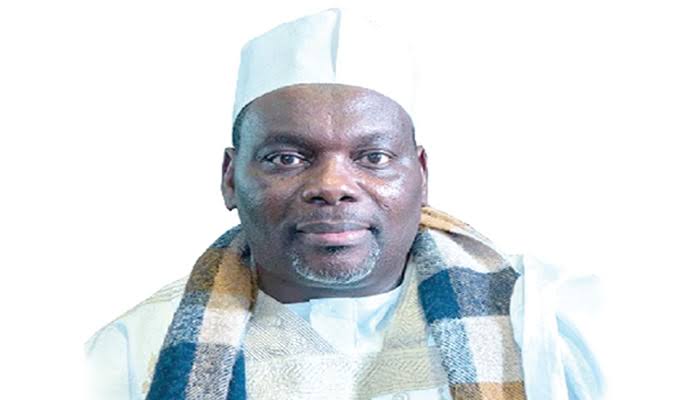
Political activist and former Kano State Commissioner for Works and Infrastructural Development under the administration of Dr. Abdullahi Umar Ganduje, Engr. Mu’az Magaji, popularly known as Dan Sarauniya, has described Nigeria’s 26 years of uninterrupted democracy as a significant journey though with mixed results. In an exclusive interview with The Historica Nigeria, Magaji commended the progress made in parts of the country, particularly in the South, while expressing disappointment at the North’s inability to fully harness the opportunities democracy offers. He praised states such as Lagos, Akwa Ibom, Rivers, Enugu, Anambra, and Abia for embracing democratic values and translating them into tangible development outcomes. Read Also: June 12: Tinubu Cancels Democracy Day Broadcast “These states have come to understand the importance of democracy and good governance. Their leaders prioritize development and economic progress. They believe their growth is in their own hands and are committed to improving the lives of their people,” he said. Magaji pointed out that these states have significantly increased their Internally Generated Revenue (IGR) and built strong local economies capable of sustaining governance even without federal allocations. “Their IGR continues to grow. They have positioned themselves to maintain governance independently. Even without federal funds, they can stand on their own,” he added. However, Magaji lamented the state of governance in Northern Nigeria, describing it as a region still struggling to understand and maximize the benefits of democracy. “It is unfortunate that many northern states have not yet grasped democracy as a tool for transforming lives. Instead, leadership is often used as a means of personal enrichment rather than public service,” he stated. He criticized the mismanagement of federal allocations in the North, warning that such a path could lead to economic instability and future dependence crises. “Governors in the North often spend federal allocations recklessly, focusing more on self-interest than public interest. This is unsustainable and poses a serious threat to the region’s long-term development.” Magaji cautioned that as southern states continue to strengthen their local economies, the North risks being left behind if it fails to take similar steps. “The future might no longer guarantee continuous federal allocations. We must start preparing to be self-reliant by investing in our economy, education, healthcare, and infrastructure.” He reiterated by calling for a return to the leadership values of Nigeria’s founding fathers, urging both leaders and citizens to prioritize competence, vision, and integrity. “We must emulate great leaders like Sir Abubakar Tafawa Balewa and Sir Ahmadu Bello, the Sardauna of Sokoto—leaders who governed with purpose, discipline, and a deep sense of responsibility. Democracy should be our pathway to progress, not a tool for personal gain.” Magaji emphasized that the only way to redirect the country’s future is by electing visionary and responsible leaders who genuinely serve the people and the nation.

Abuja, Kano, National, Politics

Ganduje’s APC: The Party That’s Swallowing the Opposition

Umar Idris Shuaibu, Kano Since his emergence as National Chairman of the All Progressives Congress (APC), Dr. Abdullahi Umar Ganduje has quietly engineered a political shift that is redefining the party’s strength and reshaping Nigeria’s broader political landscape. Known for his calm, consultative, and strategic leadership style, Ganduje has fostered internal cohesion within the APC while steadily drawing high-profile figures from rival parties into its fold. Under his stewardship, a wave of defections has swept through the political terrain. From governors and senators to federal and state legislators, opposition heavyweights are increasingly finding a new political home in the APC. Many cite Ganduje’s inclusive approach, stability-focused leadership, and non-combative style as key attractions. Unlike some political figures who court publicity, Ganduje has quietly pursued a strategy rooted in reconciliation, grassroots mobilization, and party unity. He has avoided factionalism, choosing dialogue and accommodation over divisive rhetoric. Observers and party insiders alike believe this approach has catalyzed a realignment of political forces across the country. Read Also: APC’s Rising Star: The Woman Ganduje Trusted with the Future Party loyalists describe this new phase as unprecedented in the APC’s recent history. According to them, the influx of defectors reflects Ganduje’s political maturity, discipline, and commitment to building a truly national institution. “Ganduje is not leading with ego or noise,” one party insider remarked. “He’s leading with wisdom and strategy. That’s what is winning hearts—even among the opposition.” The past several months have seen a series of notable defections. Governors, former governors, and senators who once criticized the APC have now embraced the party, pointing to Ganduje’s reconciliatory tone and the party’s renewed sense of direction. At the National Assembly, at least five lawmakers from opposition parties have officially crossed over to the APC. In states like Plateau, Benue, Bauchi, Enugu, and Cross River, politicians who previously stood firmly with rival parties are now speaking of “true leadership” within the APC. Even in the South-East and South-South traditionally challenging regions for the party the Ganduje-led APC is gaining traction. Ganduje’s rise to chairmanship was seen by many as a stabilizing move, endorsed by party elders, governors, and key stakeholders eager to resolve internal crises. Since assuming the role, he has focused on internal healing before projecting strength outward, a formula that is paying political dividends. His leadership is markedly different from past party heads. As a former deputy governor, governor, and long-serving public administrator, Ganduje brings institutional experience, regional sensitivity, and a collaborative spirit to the role. His record of managing Kano one of Nigeria’s most politically dynamic states is seen as a microcosm of his ability to navigate national complexities. Significantly, Ganduje’s interactions with opposition defectors have been structured around long-term integration rather than short-term reward. Reports suggest new entrants are encouraged to contribute to party structures and grassroots development, rather than being enticed with appointments or patronage. This approach has minimized internal friction, preserved the loyalty of existing members, and ensured a smoother absorption of newcomers. While many past defections triggered internal strife within the APC, Ganduje’s leadership has created a welcoming yet balanced environment retaining old allies while embracing new converts. It’s a rare equilibrium that political observers say is fueling the APC’s expansion as opposition parties grapple with disunity. The sentiment resonates beyond APC ranks. A former PDP senator from the North-Central region who recently joined the APC told Daily Trust that Ganduje’s leadership style influenced his decision. “We weren’t necessarily opposed to APC’s policies,” he said. “We were uncomfortable with how the party was managed. Under Ganduje, that has changed. There’s a new sense of professionalism, fairness, and vision.” Similar endorsements have come from youth leaders in the South-East, who visited the APC headquarters to show support. They praised Ganduje’s leadership as “inclusive, mature, and stabilizing.” Despite these achievements, Ganduje has refrained from criticizing past party leaders. Instead, he has built on their legacies, refined internal processes, and emphasized unity over blame. This restraint, according to stakeholders, has protected the party from internal explosions that often rock large political organizations. Looking ahead to the 2027 general elections, Ganduje’s leadership is repositioning the APC as the party of choice for both relevance and refuge. While challenges remain such as managing pre-primary ambitions, delivering on government promises, and maintaining cohesion across state chapters, the party is regaining lost confidence under his direction. Supporters insist Ganduje is not merely managing the party but laying the groundwork for institutional stability and national inclusiveness. “You can’t talk about today’s APC without acknowledging the quiet leadership of Dr. Ganduje,” a top party official said. “He doesn’t need to shout. His results speak. People are joining not because of pressure, but out of conviction.” Indeed, from Abuja to the states, one conclusion is emerging: Ganduje’s professional and inclusive leadership is not just stabilizing the APC, it is transforming it into a magnetic force, steadily consuming the opposition. Umar Idris Shuaibu is a digital journalist and writes from Kano. He can be reached at shuaibuumaridris@gmail.com.

Scroll to Top