



By Said Adam Muhammad
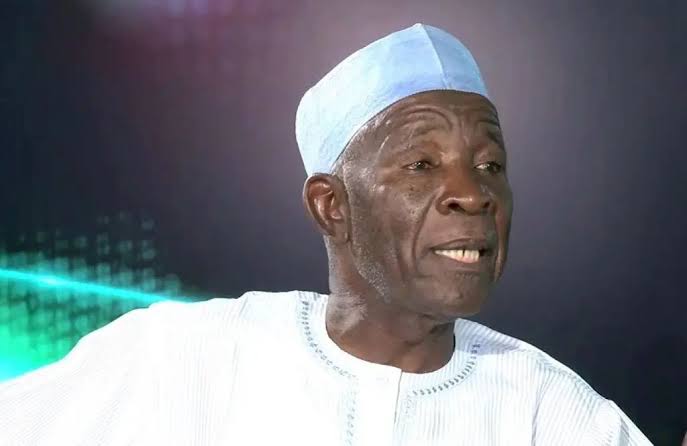
There comes a moment in politics when noise must surrender to proof, when loud commentary must submit to measurable structure. That moment has arrived for Buba Galadima.
For years, he has positioned himself as a political analyst and insider. Yet the central question remains unanswered: where is the independent structure that proves his political weight?
The Politics of Noise Versus the Politics of Structure
Nigeria has a familiar category of political actors, individuals who survive not on grassroots machinery or electoral command, but on controversy and microphone dominance. They deploy political brouhaha as a strategy for relevance because they lack demonstrable capacity on the ground.
In Hausa, we call them ’yan hayaniya, professional noise makers.
They migrate between power blocs, attaching themselves to structures built by others while building none of their own. Their influence is proximity-based, not structure-based.
Read Also:
Ganduje, Kuku Lead Nigeria’s Airports Into a New Era
Kano Polytechnic Gets New Chairman as Yusuf Removes Galadima
Understanding Kano Politics: Beyond Anointment and Allegiances
Anyone who studies Galadima’s political trajectory, from his time around the late Muhammadu Buhari to earlier alignments during the muhammad Abacha saga, will observe a consistent pattern of movement without institutional consolidation. Alliances shift. Platforms change. Yet no independent political fortress emerges.
That is not strategic evolution. That is structural absence.
The “I Made the Governor” Assertion
Perhaps the most extraordinary claim in his recent outburst was his insistence that he “made” Governor Abba Kabir Yusuf, even suggesting he contributed more to the Governor’s electoral victory than the Governor himself.
If such political engineering capacity truly exists, then it demands demonstration.
If he possesses that level of electoral machinery, let him return to Yobe State. Let him establish even a councillor through his independent structure. Let him build from ward level upward. Ultimately, let him contest for governor in Yobe and replicate the same “work” he claims to have done in Kano, this time for himself.
Political capacity is most convincingly proven when applied to oneself.
Yobe, with a population of roughly 3–4 million people, does not experience the same scale of political intensity as Kano, a state of over 15 million people and arguably the most politically competitive terrain in Nigeria. If electoral victories can be engineered with such ease, Yobe should be the ideal laboratory.
Let him test his credibility there.
The Core of Waiya’s Challenge
At the center of this controversy is a very specific and direct challenge made by Comrade Waiya.
First: political relevance.
Waiya’s argument is straightforward, there is no visible, measurable political structure attributable to Galadima in his home base. No demonstrable grassroots command. No proven independent electoral machinery. Political relevance is not claimed; it is built and tested.
Second: performance in office.
According to Waiya, his performance during his appointment reflected weak output, limited initiative, and absence of impactful proposals. Public office is not sustained by commentary. It demands innovation, structured programs, and value-adding initiatives capable of justifying public resources.
Governments do not release funds into empty space. Funding follows vision. Resources follow documented proposals. Budgets follow structured impact plans.
When pressed about his performance, his response was that there was “no money.” But governance does not begin with money, it begins with initiative. A compelling, value-driven proposal attracts funding. A transformative idea earns support.
If the ideas were strong enough, they would have been defended, documented, and implemented.
Third: failure to respond substantively.
Most revealing was his inability to directly address these criticisms during his interview. Rather than provide documented achievements or structured rebuttals, he became visibly agitated when the journalist pressed him on Waiya’s claims. The exchange deteriorated into anger and personal remarks toward the journalist.
Strong leaders answer with data.
Confident administrators respond with records.
Prepared officials rebut with documented achievements.
Emotional reactions are not evidence.
Governance Under Siege
While these exchanges dominate headlines, Governor Abba Kabir Yusuf is navigating one of the most intense opposition climates in Kano’s political history. From prolonged post-election legal battles challenging his mandate, to the Emirate restructuring saga, to sustained internal and external political resistance, this administration has operated under constant pressure.
Political hostility has been consistent and coordinated.
Yet governance continues. Focus remains intact. Administrative functions move forward. Leadership under sustained pressure is the true test of capacity, and resilience under siege separates substance from spectacle.
Few administrations in Kano’s modern history have confronted this degree of organized resistance while maintaining operational continuity.
Visible Frustration and Outdated Calculations
What has become increasingly evident is the visible frustration in recent public appearances. Excessive defensiveness, boastful assertions, and emotional responses suggest a struggle to preserve relevance rather than exercise it.
Political analysis rooted in outdated frameworks cannot interpret today’s realities. Kano’s political terrain has evolved. The electorate is more informed. The dynamics are more complex. Historical proximity to power does not automatically translate into contemporary influence.
Old formulas cannot decode new politics.
The Final Test
The challenge remains clear and open:
If there is political relevance, demonstrate it structurally.
If there was strong performance, present documented impact.
If there is electoral engineering capacity, apply it independently.
Return to Yobe.
Build structure.
Contest.
Win.
Political credibility is not sustained by volume.
It is sustained by verifiable strength.
The time for commentary has passed.
It is time for a real action and proof.