









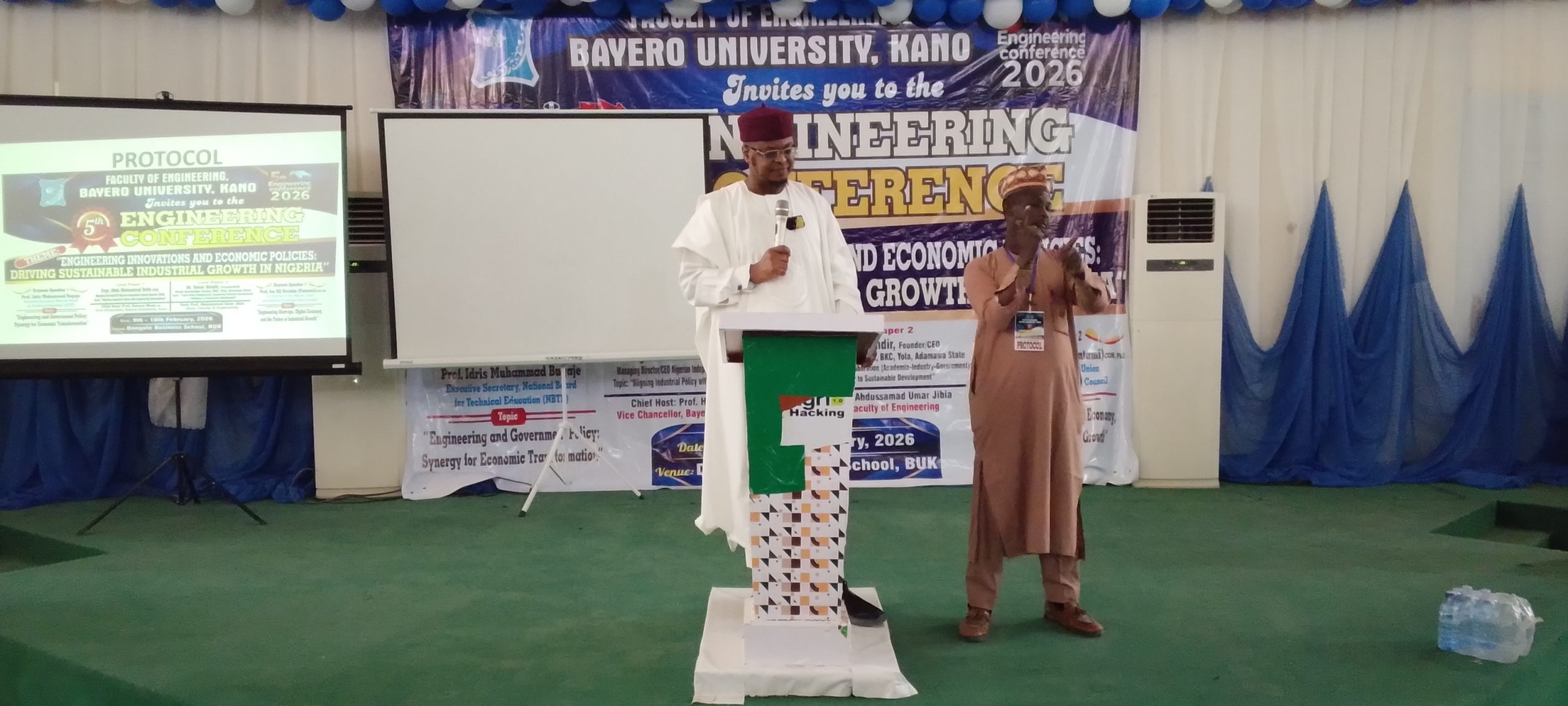
The Faculty of Engineering, Bayero University Kano (BUK), has hosted its 5th Engineering Conference, drawing policymakers, academics, engineers, and industry stakeholders to deliberate on pathways to sustainable industrial growth and economic diversification in Nigeria.
The conference, themed “Engineering Innovations and Economic Policies: Driving Sustainable Industrial Growth in Nigeria,” focused on repositioning the country from oil dependency to an innovation-driven and diversified economy through engineering, technology, and sound policy implementation.
Delivering the keynote address, the Executive Secretary of the National Board for Technical Education (NBTE), Professor Idris Muhammad Bugaje, identified energy as the most critical pillar of national development, warning that poor energy planning continues to undermine industrial productivity across the country.
Professor Bugaje decried the deteriorating state of public infrastructure, attributing much of the decline to weak energy policies and implementation failures. He urged state governments to adopt mini-grid energy solutions as a practical and sustainable approach to expanding electricity access, particularly for industrial clusters and rural communities.

According to him, innovation must be environmentally responsible, stressing that engineers should go beyond inventions to develop sustainable solutions that align with climate realities and long-term economic objectives.
Earlier, former Minister of Communications and Digital Economy, Professor Isa Ali Ibrahim Pantami, delivered a lecture titled “Engineering Start-ups, Digital Economy and the Future of Industrial Growth.” He said critical evaluation of Nigeria’s education system should be seen as a pathway to reform rather than an attack on the system or its products.
Read Also:
Ganduje, Kuku Lead Nigeria’s Airports Into a New Era
FG Set to End HND–Degree Divide, Empowers Polytechnics to Award Degrees
Why Science College Dawakin Kudu Remains a Pride of Kano’s Educational Heritage
Pantami observed that the current curriculum remains largely theoretical and outdated, offering limited space for creativity, research, and problem-solving.
“Our education system often operates on the principle of ‘garbage in, garbage out,’ because students are not encouraged to question, innovate, or contribute to knowledge creation,” he stated.
He noted that emerging technologies such as Artificial Intelligence (AI), the Internet of Things (IoT), datafication, blockchain technology, nanotechnology, augmented reality, and virtual reality are rapidly reshaping global economies and industrial processes.
Pantami emphasised that Nigerian students must be equipped with critical soft skills, including social skills, creative thinking, analytical reasoning, and problem-solving abilities, alongside technical expertise, to remain competitive in a digital economy driven by innovation and collaboration.
The former minister highlighted the growing importance of engineering start-ups in addressing societal and industrial challenges, revealing that over 150 million start-ups exist globally. He added that Africa currently hosts seven unicorn companies, five of which are Nigerian, attributing the growth to an enabling policy environment during his tenure at NITDA and as minister.
However, he identified poor policy implementation as Nigeria’s major challenge, describing it as a key contributor to corruption and institutional inefficiency. He called for stronger collaboration between universities, industry, and government to ensure graduates emerge as job creators rather than job seekers.
In his remarks, the Registrar of the Council for the Regulation of Engineering in Nigeria (COREN), Engr. Prof. Okorie Austine Uchegusi, stressed the need for certified engineers to occupy leadership positions in engineering-related agencies and parastatals.
He argued that assigning engineering responsibilities to qualified COREN-certified professionals would significantly reduce infrastructural failures, building collapses, and recurring power grid challenges.
“Putting certified engineers at the helm of engineering institutions is a major step towards restoring professionalism and technical competence,” he said.
Prof. Uchegusi also expressed concern over the increasing migration of young Nigerian engineers in search of opportunities abroad, blaming the trend on limited recognition and lack of meaningful projects at home. He pledged COREN’s commitment to restoring the dignity of the profession and called on policymakers to strengthen the manufacturing sector to reduce import dependence and ease the economic burden on citizens.