






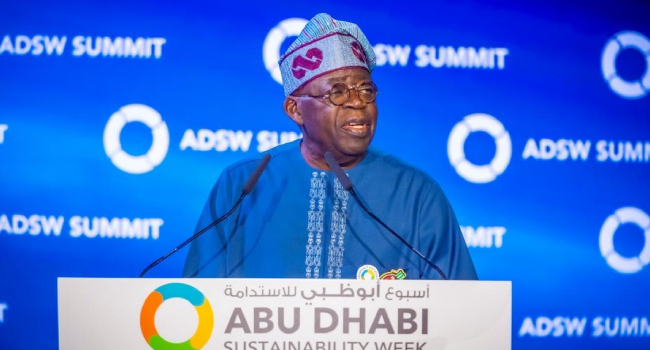
President Bola Ahmed Tinubu has disclosed that Nigeria is mobilising climate finance through a newly activated carbon market framework expected to unlock between $2.5 billion and $3 billion annually over the next decade.
Tinubu made this known on Tuesday while speaking at the 2026 edition of the Abu Dhabi Sustainability Week, themed “The Nexus of Next: All Systems Go,” where he told global leaders that Nigeria had taken decisive regulatory steps to strengthen its climate governance architecture.
According to the President, these steps include the adoption of the National Carbon Market Activation Policy and the launch of the National Carbon Registry to enhance emissions reporting, transparency and verification.
“Nigeria feels at the heart of development opportunity. In this spirit, Nigeria has launched a climate and green industrialisation investment to unlock between $20 billion and $30 billion annually in climate finance,” Tinubu said.
He also cited the 2023 Electricity Act, noting that it provides for decentralised and inclusive energy access to rural communities, off-grid health facilities, educational institutions, markets and other underserved areas across the country.
Read Also:
US Delivers Military Supplies to Nigeria to Support Security Operations
Inflation to Fall Below 10% as Nigeria’s Economy Rebounds — Tinubu
Islamic Month of Rajab Holds Spiritual Significance but No Exclusive Worship, Says Kano Cleric
Tinubu said the Federal Government was modernising Nigeria’s energy architecture to deploy sustainable power nationwide, stressing the urgency of advancing green technologies to improve efficiency, modernise infrastructure and accelerate access to clean energy.
“Nigeria recognises the urgent need to deploy and advance technologies to improve green efficiency, modernise infrastructure, and accelerate the delivery of sustainable energy to underserved areas,” he added.
The President announced several financing initiatives, including a climate investment platform targeting $500 million for climate-resilient infrastructure, a national climate platform aimed at supporting $2 billion in capital investment, and a $50 billion sub-regional green bond, which he said was oversubscribed by 97.7 per cent.
He further highlighted the World Bank’s involvement, revealing that the institution is implementing a $750 million programme to expand clean electricity access to over 17.5 million Nigerians.
Tinubu said Nigeria’s Energy Transition Plan integrates climate mitigation, industrial growth and social development into a single framework, with a target of achieving net-zero emissions by 2060 while delivering universal energy access.
He called for stronger partnerships with developed nations in technology transfer, innovation and knowledge exchange, noting that the adoption of artificial intelligence to optimise efficiency was no longer a futuristic concept.
Nigeria approved the National Carbon Market Framework in October 2025. The framework provides guidelines for carbon credit registration, issuance and verification, and is designed to incentivise emissions reduction projects in forestry, renewable energy, clean cooking and agriculture.
In November 2025, the Federal Government operationalised the Climate Change Fund and restored the National Council on Climate Change to the federal budget. Nigeria also submitted its updated climate commitments to the United Nations in September 2025.