



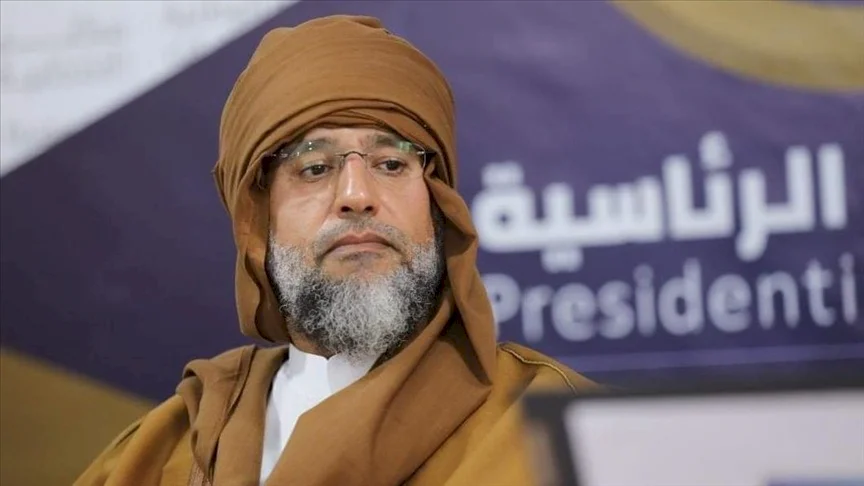
Saif al-Islam Gaddafi, son of former Libyan leader Muammar Gaddafi, was laid to rest in the city of Bani Walid following his death in Zintan, marking a moment of renewed historical reflection on Libya’s political past and the legacy of the Gaddafi era.
Thousands of mourners attended the funeral, including supporters of the former Libyan government, as the burial took place beside his late brother. The ceremony drew attention not only for its turnout but also for its symbolism, reopening discussions about a period that shaped Libya’s modern political history.
A Funeral That Reopened History
The burial in Bani Walid, a city long associated with loyalty to the former government, became a focal point for reflection on Libya’s past leadership and the years preceding the 2011 uprising. The presence of former regime supporters and the display of historical symbols underscored the enduring influence of the Gaddafi period in parts of Libyan society.
Read Also:
Why the Killing of Saif al-Islam Gaddafi Matters for Libya
How Muammar Gaddafi’s Son, Saif al-Islam, was Killed in Zintan
Mali, Burkina Faso, Niger Strengthen Unity with Launch of AES Television
While the funeral remained largely ceremonial, it highlighted how deeply the legacy of the former political order continues to resonate more than a decade after its collapse.
Saif al-Islam Gaddafi’s Public Role
Saif al-Islam Gaddafi was one of the most visible figures of Libya’s leadership in the years leading up to 2011. Educated abroad, he played a prominent role in international engagement and domestic political discussions, particularly during the 2000s.
He was frequently associated with government reform initiatives and represented the Libyan state in high-level dialogues with foreign governments and international institutions. His public standing placed him at the center of national attention during Libya’s most turbulent political period.
Libya Under Muammar Gaddafi: Historical Context
Libya under Muammar Gaddafi, who ruled from 1969 until 2011, operated within a centralized political framework shaped by revolutionary governance structures.
Political authority was tightly controlled, and state institutions functioned under a system that did not accommodate formal opposition parties.
Throughout the late 20th century, the government relied on public trials, executions, and extensive state surveillance as part of its governance approach. Events such as the 1996 incident at Abu Salim prison later became significant reference points in discussions about state authority and political control in Libya.
The 2011 Uprising and a Turning Point
When nationwide protests broke out in February 2011, Saif al-Islam addressed Libyans in a nationally broadcast speech, outlining the leadership’s position on the unfolding crisis. His remarks focused on national unity, economic stability, and the risks associated with political fragmentation.
During this period, some segments of the population viewed him as a possible intermediary between the state and the protesters, given his earlier involvement in reform-oriented initiatives. However, he remained aligned with the existing leadership structure as events rapidly unfolded.
Burial as a Moment of National Memory
The funeral of Saif al-Islam Gaddafi has since been viewed as more than a private burial.
For many Libyans, it served as a moment to revisit the political era that ended in 2011 and to reflect on the long-term consequences of that transition.
As Libya continues to navigate its post-revolution identity, events such as this funeral highlight how history, memory, and political legacy remain deeply intertwined.
A Figure in Libya’s Modern History
Saif al-Islam Gaddafi’s life and death are closely linked to one of the most transformative periods in Libya’s history. His burial in Bani Walid has reinforced his place in the national narrative, not only as the son of a former leader but as a public figure whose story remains part of Libya’s ongoing historical discourse.
(Libya Herald)